Question
Why it is much hotter above a fire than by its side?

Answer

Heat carried away from a fire sideways mainly by radiation. Above the fire, heat is carried by both radiation and convection of air but convection carries much more heat than radiation. So, it is much hotter above a fire than by its sides.

Need a full question paper?

Generate a complete, print-ready paper with questions like this in minutes — across 16+ boards, with answer keys.
Start Generating Free

Similar questions

Give the magnitude and direction of the net force acting on a stone of mass 0.1kg, (Neglect air resistance throughout.)
Just after it is dropped from the window of a train accelerating with 1ms-2.
Just as precise measurements are necessary in science, it is equally important to be able to make rough estimates of quantities using rudimentary ideas and common observations. Think of ways by which you can estimate the following (where an estimate is difficult to obtain, try to get an upper bound on the quantity):
The number of strands of hair on your head.
Two large glass plates are placed vertically and parallel to each other inside a tank of water with separation between the plates equal to 1mm. Find the rise of water in the space between the plates. Surface tension of water = 0.075N/m.
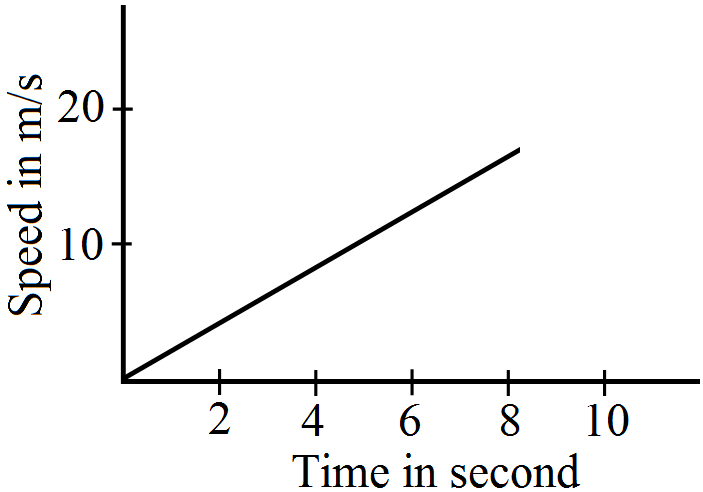
The speed of a car as a function of time is shown in figure. Find the distance travelled by the car in 8 seconds and its acceleration.

As oscillating pendulum stops after some time. Is this a violation of the law of conservation of mechanical energy?
A mosquito net over a 7ft × 4ft bed is 3ft high. The net has a hole at one corner of the bed through which a mosquito enters the net. It flies and sits at the diagonally opposite upper corner of the net.
  1. Find the magnitude of the displacement of the mosquito.
  2. Taking the hole as the origin, the length of the bed as the X-axis, its width as the Y-axis, and vertically up as the Z-axis, write the components of the displacement vector.
Derive the law of conservation of liner momentum from Newton's third law of motion.
A block of mass 250g slides down an incline of inclination 37° with a uniform speed. Find the work done against the friction as the block slides through 1.0m.
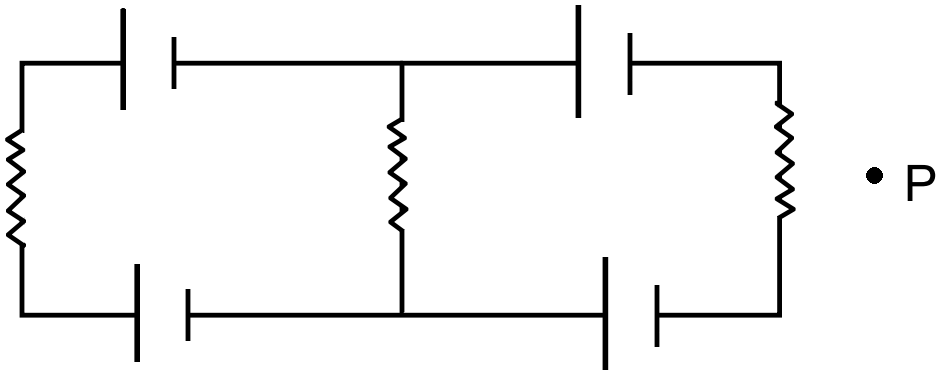
Each of the batteries shown in figure has an emf equal to 5V. Show that the magnetic field B at the point P is zero for any set of values of the resistances.

A block of mass M is held against a rough vertical wall by pressing it with a finger. If the coefficient of friction between the block and the wall is $\mu$ and the acceleration due to gravity is g, calculate the minimum force required to be applied by the finger to hold the block against the wall?