Question
Why length, mass and time are chosen as base quantities in mechanics?

Answer

In mechanics, length, mass and time are chosen as the base quantities because
  1. There is nothing simpler to length, mass and time.
  2. All other quantities in mechanics can be expressed in terms of length, mass and time.
  3. Length, mass and time cannot be derived from one another.

Need a full question paper?

Generate a complete, print-ready paper with questions like this in minutes — across 16+ boards, with answer keys.
Start Generating Free

Similar questions

A ball of mass $0.50kg$ moving at a speed of 5.0m/s collides with another ball of mass $1.0kg$. After the collision the balls stick together and remain motionless. What was the velocity of the $1.0kg$ block before the collision?
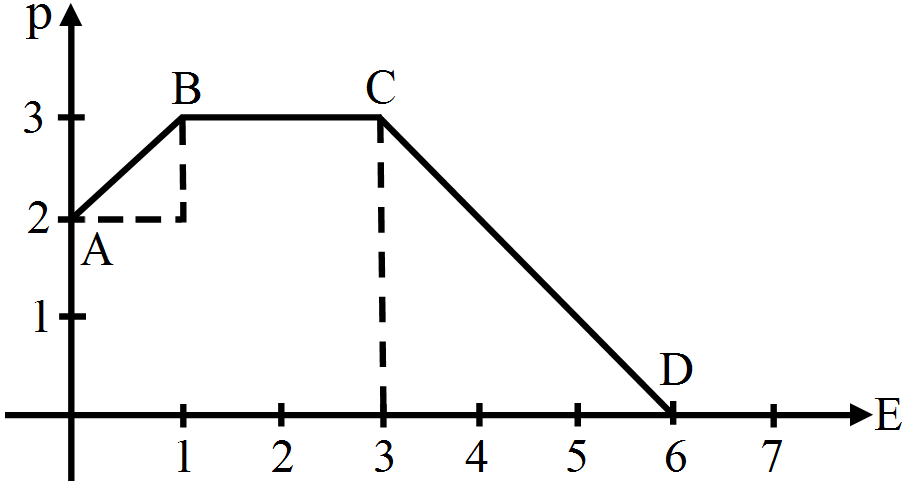
Figure shows momentum versus time graph for a particle moving along x-axis. In which region, force on the particle is large. Why?
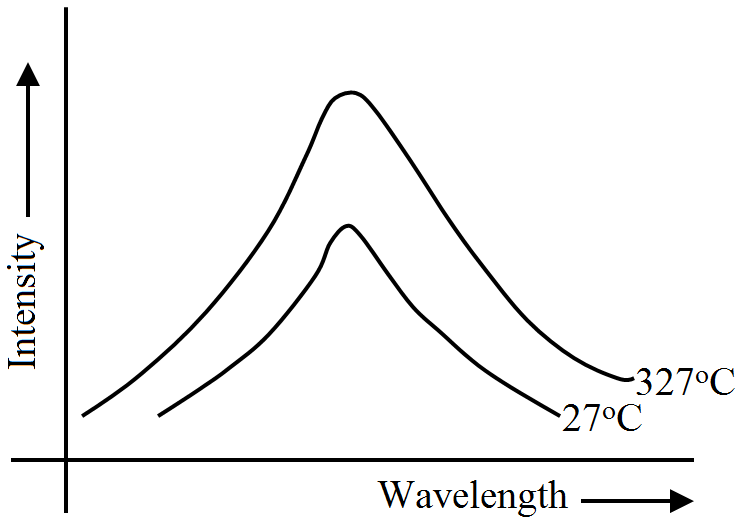
The spectrum of a black body at two temperatures $27 {}^\circ C$ and $327 {}^\circ C$ is shown in the figure. Let $A_1$ and  $A_2$ be the respective areas under the two curves. Estimate the ratio $\frac{A_2}{A_1}.$
A person travelling by a car moving at 100km/h finds that his wristwatch agrees with the clock on a tower A. By what amount will his wristwatch lag or lead the clock on another tower B, 1000km (in the earth's frame) from the tower A when the car reaches there?
Figure shows a light rod of length l rigidly attached to a small heavy block at one end and a hook at the other end. The system is released from rest with the rod in a horizontal position. There is a fixed smooth ring at a depth h below the initial position of the hook and the hook gets into the ring as it reaches there. What should be the minimum value of h so that the block moves in a complete circle about the ring?
Answer the following questions:The motion of a simple pendulum is approximately simple harmonic for small angle oscillations. For larger angles of oscillation, a more involved analysis shows that T is greater than $2\pi\sqrt{\frac{\text{l}}{\text{g}}}.$ Think of a qualitative argument to appreciate this result.
A beam of light having wavelengths distributed uniformly between 450nm to 550nm passes through a sample of hydrogen gas. Which wavelength will have the least intensity in the transmitted beam?
Why is electrical power required at all when the elevator is descending? Why should there be a limit on the number of passengers in this case?
By using the method of dimension, check the accuracy of the following $\text{T}=\frac{\text{rh } \rho\text{g}}{2\cos\theta}$ where T is the surface tension, h is the height of the liquid in a capillary tube, $\rho$ is the density of the liquid, g is the acceleration due to gravity, $\theta$ is the angle of contact, and r is the radius of the capillary tube.
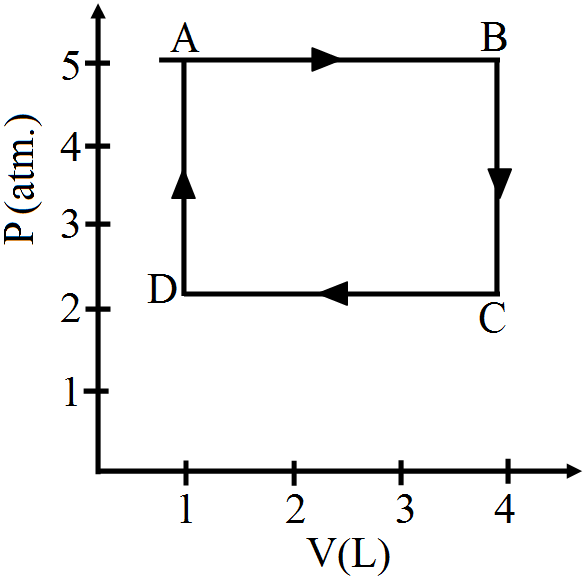
One mole of an ideal gas undergoes a cyclic change ABCD. From the given diagram, calculate the net work done in the process. $1$ atmosphere = $10^\circ dyne\ cm^{-2}$.