Question
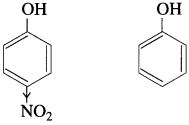
Why p-nitrophenol is a stronger acid than phenol ?

Answer

(1) In p-nitrophenol, nitro group $\left( NO _2\right)$ is an electron withdrawing group present at para position which enhances the acidic strength ($ -1$ effect). The $O - H$ bond is under strain and release of proton $\left( H ^{+}\right)$becomes easy. Further pnitrophenoxide ion is more stabilised due to resonance.
(2) Since the absence of electron withdrawing group (like $NO _2$ ) in phenol at ortho and para position, the acidic strength of phenol is less than that of
p-nitrophenol.​​​​​​​

Image

Need a full question paper?

Generate a complete, print-ready paper with questions like this in minutes — across 16+ boards, with answer keys.
Start Generating Free

Similar questions

Calculate the standard enthalpy of the reaction, $2 C _{\text {(graphite) }}+3 H _{2( g )} \longrightarrow C _2 H _{6( g )} \quad ; \Delta H^0=$ ? from the following $\Delta H^0$ values:
(a) $C _2 H _{6( g )}+\frac{7}{2} O _{2( g )} \longrightarrow 2 CO _{2( g )}+3 H _2 O _{(l)} \quad ; \Delta H^0=-1560 kJ$
(b) $H _{2( g )}+\frac{1}{2} O _{2( g )} \longrightarrow H _2 O _{( l )}$$\text { ; } \Delta H^0=-285.8 kJ$
(c) $C _{\text {(graphite) }}+ O _{2( g )} \longrightarrow CO _{2( g )} \quad ; \Delta H^0=-393.5 kJ$
Write any two uses of alloy.
Describe the action of the following on chlorobenzene :
(1) Methyl chloride in the presence of anhydrous $AlCl _3$
(2) Acetyl chloride in the presence of anhydrous $AlCl _3$.
Consider the reaction $2 A + B \rightarrow 2 C$. Suppose that at a particular moment during the reaction, rate of disappearance of $A$ is $0.076 M / s$,
(a) What is the rate of formation of $C$ ?
(b) What is the rate of consumption of B?
(c) What is the rate of the reaction?
In the reaction, $PCl _{5( g )} \rightarrow PCl _{3( g )}+ Cl _{2( g )}$, at a particular moment, the rate of disappearance of $PCl _5$ is $0.015 Ms ^{-1}$. What are the rates of formation of $PCl _3$ and $Cl _2$ ?
Write classification of polymers on the basis of structure.
Ammonia and oxygen react at high temperature as:
$
4 NH _{3( g )}+5 O _{2( g )} \longrightarrow 4 NO _{( g )}+6 H _2 O _{( g )}
$
In an experiment, rate of formation of $NO _{( g )}$ is $3.6 \times 10^{-3} mol L ^{-1} \cdot s ^{-1}$
Calculate: (a) Rate of disappearance of ammonia. (b) Rate of formation of water.
Write and explain reactions to convert propan-l-ol into propan-$2-ol$.
The half life of a first order reaction is $1.7$ hours. How long will it take for $20\%$ of the reactant to react? ($32.9$ min)
Explain haloform reaction with suitable example.