Question
Why should electrostatic field be zero inside a conductor?

Answer

In the static situation, there is no current inside, or on the surface, of the conductor. Hence the electric field is zero everywhere inside the conductor.

Alternate Answer

since the charge inside the conductor is zero, the electric field is also zero.

Alternate Answer

since the conductor is uncharged so the electric field inside it is zero.

Need a full question paper?

Generate a complete, print-ready paper with questions like this in minutes — across 16+ boards, with answer keys.
Start Generating Free

Similar questions

If all the terms in an equation have same units, is it necessary that they have same dimensions? If all the terms in an equation have same dimensions, is it necessary that they have same units?
When the skeleton of an elephant and the skeleton of a mouse are prepared in the same size, the bones of the elephant are shown thicker than those of the mouse. Explain why the bones of an elephant are thicker than proportionate. The bones are expected to withstand the stress due to the weight of the animal.
A cube of iron (density = 8000kg m-3, specific heat capacity = 470J kg-1 K-1) is heated to a high temperature and is placed on a large block of ice at 0°C. The cube melts the ice below it, displaces the water and sinks. In the final equilibrium position, its upper surface just goes inside the ice. Calculate the initial temperature of the cube. Neglect any loss of heat outside the ice and the cube. The density of ice = 900kg m-3 and the latent heat of fusion of ice = 3.36 × 10⁵J kg-1.
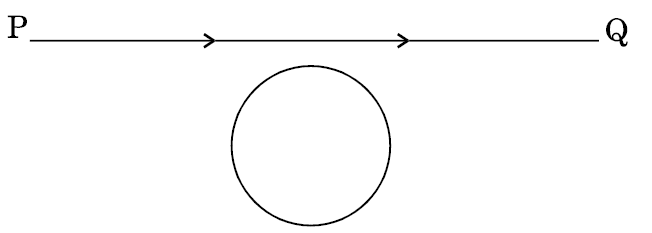
A conducting loop is held below a current carrying wire PQ as shown. Predict the direction of the induced current in the loop when the current in the wire is constantly increasing.

Define dispersion of colours.
If in a single slit diffraction experiment the width of the slit is doubled, what will be the effect on the central maximum?
Answer the following questions:
The earth’s magnetic field varies from point to point in space. Does it also change with time? If so, on what time scale does it change appreciably?
Name the phenomenon which shows the quantum nature of electromagnetic radiation.
The dielectric constant of the material kept between the plates of a capacitor is 5 and its capacitance is C. If it is replaced with a material having dielectric constant 20, then what will be the new capacitance of the capacitor?
A battery-operated torch is adjusted to send an almost parallel beam of light. It produces an illuminance of 40 lux when the light falls on a wall 2m away. The illuminance produced when it falls on a wall 4m away is close to:
  1. 40 lux
  2. 20 lux
  3. 10 lux
  4. 5 lux