Question
Why the tansition elements are hard and have high melting and boiling points?

Answer

$\rightarrow$ The high melting points of these metals are attributed to the involvement of greater number of electrons from $(n-1)d$ in addition to the ns electrons in the interatomic metallic bonding.
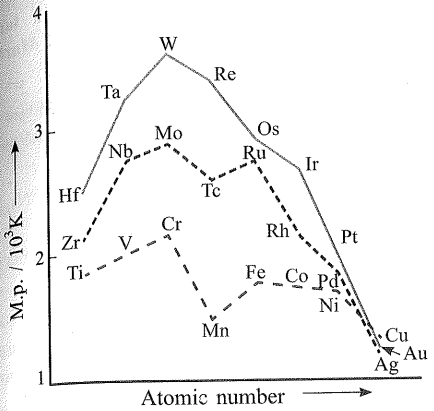
$\rightarrow$ In any row the melting points of these metals rise to a maximum at $d^5$ except for anomalous values of $Mn$ and $Te$ and fall regularly as the atomic number increases.
Image
Trends in melting points of transition elements
$\rightarrow Zn, Cd,$ and $Hg$ are soft and volatile and they have low melting point because all these elements have no unpaired electrons.

Need a full question paper?

Generate a complete, print-ready paper with questions like this in minutes — across 16+ boards, with answer keys.
Start Generating Free

Similar questions

Explain the observed $K_b$ order: $\ce{Et_2NH > Et_3N > EtNH_2}$ in aqueous solution.
What are hydrolysis products of
(i) Sucrose and (ii) Lactose?
  1. Arrange the following in an increasing order of basic strength in water$:$
$\ce{C_6H_5NH_2, (C_2H_5)_2NH, (C_2H_5)_3N}$ and $\ce{NH_3}.$
  1. Arrange the following in increasing order of basic strength in gas phase$:$
$\ce{C_2H_5NH_2, (C_2H_5)_2NH, (C_2H_5)_3N}$ and $\ce{CH_3NH_2}.$
Complete the following reactions by identifying A, B and C.
$\ \ \ \ \ \ \ \ \ \ \ \ \ \text{CH}_3\\ \ \ \ \ \ \ \ \ \ \ \ \ \ |\\\text{CH}_3-\text{C}-\text{C}-\text{CH}_3\ +\ \text{NaOI}\ \rightarrow\ \text{B}\ +\ \text{C}\\ \ \ \ \ \ \ \ \ \ \ \ \ \ | \ \ \ \ \ \ || \ \\ \ \ \ \ \ \ \ \ \ \ \ \ \text{CH}_3\text{O}$
Answer the following questions:
Amongst the isomeric dihalobenzenes which isomer has the highest melting point and why?
Explain the mechanism of the following reaction:
$\text{CH}_{3}-\text{CH}_{2}-\text{OH}\xrightarrow[443 K]{H^+}\text{CH}_{2}=\text{CH}_{2}+\text{H}_{2}\text{O}$
Explain Rosenmund reduction in brief.
An organic compound contains $69.77\%$ carbon $, 11.63\%$ hydrogen and rest oxygen. The molecular mass of the compound is $86.$ It does not reduce Tollen's reagent but forms an addition compound with sodium hydrogensulphite and give positive iodoform test. On vigorous oxidation it gives ethanoic and propanoic acid. Write the possible structure of the compound.
(A) why are transition elements good catalysts ?
(B) Zinc does not exhibit variable oxidate state, why?
Of all the methods of preparing amines identify by which aniline cannot be prepared?