MCQ
Width of interference fringe is :
  • $ B=\frac{D\lambda}{d} $
  • B
    $ B=\frac{d}{D\lambda} $
  • C
    $ B=\frac{D\lambda}{D} $
  • D
    d.Dλ

Answer

Correct option: A.
$ B=\frac{D\lambda}{d} $
A

Need a full question paper?

Generate a complete, print-ready paper with questions like this in minutes — across 16+ boards, with answer keys.

Start Generating Free

Similar questions

Plane polarised light is passed through a polaroid. On viewing through the polaroid we find that when the polariod is given one complete rotation about the direction of the light, one of the following is observed (a) The intensity of light gradually decreases to zero and remains at zero (b) The intensity of light gradually increases to a maximum and remains at maximum(c) There is no change in intensity (d) The intensity of light is twice maximum and twice zero


A nuclear reaction with positive Q value is:
The masses of neutron and proton are 1.0087 a.m.u. and 1.0073  a.m.u. respectively. If the neutrons and protons combine to form a helium nucleus (alpha particles) of mass 4.0015 a.m.u. The binding energy of the helium nucleus will be (1 a.m.u.= 931 MeV)(a) 28.4  MeV(b) 20.8  MeV(c) 27.3  MeV(d) 14.2  MeV
       
The photoelectric effect proves that light consists of :
In an electromagnetic wave, the direction of the magnetic induction B is
Two point charges placed at a certain distance $r$ in air exert a force $F$ on each other. Then the distance $r\ '$ at which these charges will exert the same force in a medium of dielectric constant $k$ is given by
The resistivity of ‘X’ decreases with temperature and its coefficient of resistivity is negative. Identify X.
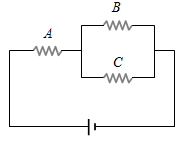
Three identical resistances $A, B$ and $C$ are connected as shown in the given figure. The heat produced will be maximum
When the intensity of light falling on a surface producing photoelectric effect is doubled, then :
A heavy stone is thrown from a cliff of height $h$ with a speed $\nu.$ The stone will hit the ground with maximum speed if it is thrown: