Question
Will a current loop placed in a magnetic field always experience a zero force?

Answer

If the magnetic field is uniform in space. If it is non-uniform net force will not be always zero.

Need a full question paper?

Generate a complete, print-ready paper with questions like this in minutes — across 16+ boards, with answer keys.
Start Generating Free

Similar questions

Light is incident normally on a small plane surface. If the surface is rotated by an angle of 30° about the incident light, does the illuminance of the surface increase, decrease or remain same? Does your answer change if the light did not fall normally on the surface? 
Express the speed of transmission of electromagnetic wave in terms of peak values of electric and magnetic fields.
What will be the difference in the chemical properties of radioactive isotopes and stable isotopes of an element?
Show variation of resistivity of Si with temperature in a graph.
Answer the following:
The top of the atmosphere is at about 400kV with respect to the surface of the earth, corresponding to an electric field that decreases with altitude. Near the surface of the earth, the field is about 100Vm–1. Why then do we not get an electric shock as we step out of our house into the open? (Assume the house to be a steel cage so there is no field inside!)
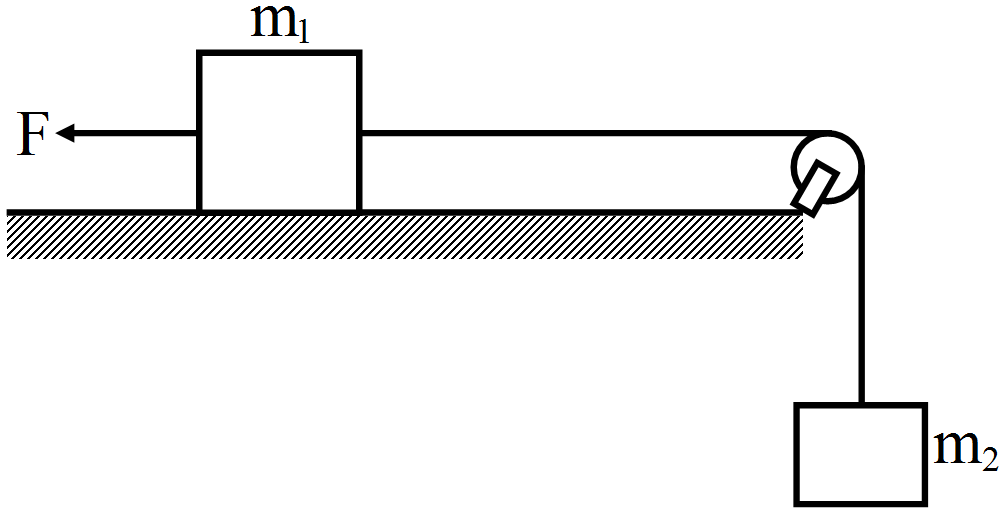
Consider the situation shown in The force F is equal to the $\frac{\text{m}_2\text{g}}{2}$ If the area of cross-section of the string is A and its Young's modulus Y, find the strain developed in it. The string is light and there is no friction anywhere.

On what does the value of the angle of deviation for a given prism depend?
Using Huygens principle, write Snell's law related to refraction of plane waves.
Choose the correct alternative from the clues given at the end of the each statement:
In the ground state of .......... electrons are in stable equilibrium, while in .......... electrons always experience a net force. (Thomson’s model/ Rutherford’s model.)
In an experiment on photoelectric effect, a photon is incident on an electron from one direction and the photoelectron is emitted almost in the opposite direction. Does this violate conservation of momentu?