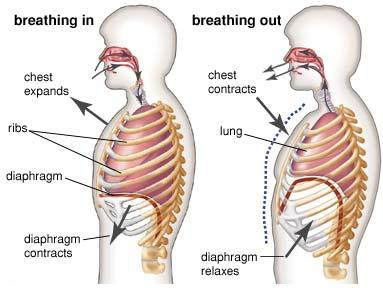
With a schematic diagram, explain the overall process of respiration.
Download our app for free and get startedPlay store
The primary organs of therespiratory system are the lungs, which function to take in oxygen and expel carbon dioxide as we breathe. The gas exchangeprocess is performed by the lungs and respiratory system. Air, a mix of oxygen and other gases, is inhaled.
art

Download our app
and get started for free

Experience the future of education. Simply download our apps or reach out to us for more information. Let's shape the future of learning together!No signup needed.*

Similar Questions

  • 1
    Describe the parts of our tooth with the help of a labelled diagram.
    View Solution
  • 2
    What are the different modes of nutrition? Explain with one example of each mode of nutrition.
    View Solution
  • 3
    A, B and C are three living organisms. The organism A is a unicellullar fungus which can live without air. It is used in the commercial production of an organic compound P from molasses. The organism B is a unicellular animal which lives in water and feeds and moves by using pseudopodia. It breathes through an organelle Q. The organism C is a tiny animal which acts as a carrier of malarial parasite. It breathes and respires through a kind of tiny holes R and air - tubes S in its body.
    1. What are organisms A, B and C?
    2. Name P, Q, R and S.
    3. Which organism/ organisms undergo aerobic respiration?
    4. Which organism/ organisms undergo anaerobic respiration?
    View Solution
  • 4
    Name the main organs of the human digestive system in the order they participate in the process of digestion. Describe how digestion of carbohydrates and proteins take place in our body.
    View Solution
  • 5
    How do carbohydrates, proteins and fats get digested in human beings?
    View Solution
  • 6
    The liquid connective tissue A circulates in our body continuously without stopping. This tissue contains a pigment B which imparts it a colour C. The tissue A consists of four components D, E, F and G. The component D fights infection and protects us from diseases. The component E helps in the clotting of tissue A if a person gets a cut. The component F is a liquid which consists mainly of water with many substances dissolved in it and component G carries oxygen from the lungs to all the parts of the body.
    1. What is (i) tissue A, (ii) pigment B and (iii) colour C?
    2. Name (i) D, (ii) E, (iii) F and (iv) G.
    3. Name one substance (other than oxygen) which is transported by tissue A in the human body.
    4. Which two components of tissue A are the cells without nucleus?
    5. Name any two organisms (animals) which do not have liquid like A in their body.
    View Solution
  • 7
    Describe the structure and functioning of nephrons.
    View Solution
  • 8
    Breathing cycle is an essential process for the exchange of gases’. Justify this statement.
    View Solution
  • 9
    What are the methods used by plants to get rid of their waste products?
    View Solution
  • 10
    Consider the following chemical reactions which take place in different organisms/ tissues under various conditions:
    1. Glucose → Respiration → Respiration Ethanol + Carbon-dioxide + Energy.
    2. Glucose → Respiration → Respiration Carbon-dioxide + Water + Energy.
    3. Glucose → Respiration → Respiration Lactic acid + Energy.
    1. Name one organism which respires according to equation (i) above.
    2. Name one organism which respires according to equation (ii) above.
    3. When and where does respiration represented by equation (iii) above take place?
    4. Which equation/ equations represent aerobic respiration?
    5. Which equation/ equations represent anaerobic respiration?
    6. Which of the above reactions produces the maximum amount of energy?
    View Solution