MCQ
With increase in temperature the conductivity of:
  • A
    Metals increases and of semiconductor decreases.
  • Semeconductors increases and metals decreases.
  • C
    In both metals and semiconductors increases.
  • D
    In both metal and semiconductor decreases.

Answer

Correct option: B.
Semeconductors increases and metals decreases.

Need a full question paper?

Generate a complete, print-ready paper with questions like this in minutes — across 16+ boards, with answer keys.

Start Generating Free

Similar questions

The rest energy of an electron is $0.511 \, MeV$. The electron is accelerated from rest to a velocity $0.5\, c$. The change in its energy will be ............ $MeV$
Current of $4.8\,A$ is flowing through a conductor. The number of electrons per second will be
A galvanometer coil has a resistance of $12\,\Omega $ and meter shows full scale deftection for a current of $3\,mA$ then to convert it into a voltmeter of range $0\,-18\, V$ a resistance should be added
Ionisation energy of 10 times ionised sodium atom will be :
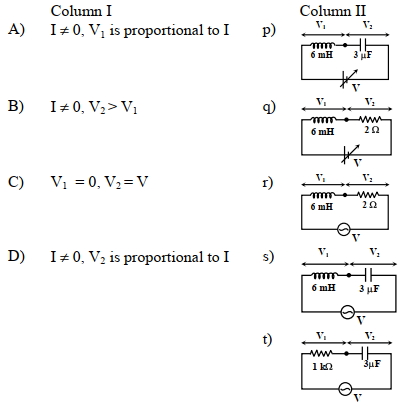
You are given many resistances, capacitors and inductors. These are connected to a variable $DC$ voltage source (the first two circuits) or an $\mathrm{AC}$ voltage source of $50 \mathrm{~Hz}$ frequency (the next three circuits) in different ways as shown in Column $II$. When a current $I$ (steady state for $DC$ or rms for $AC$) flows through the circuit, the corresponding voltage $\mathrm{V}_1$ and $\mathrm{V}_2$. (indicated in circuits) are related as shown in Column $\mathrm{I}$. Match the two

$Image$

The magnetic field at a distance r from a long wire carrying current i is 0.4 Tesla. The magnetic field at a distance 2r is
The charge in an $LC$ circuit with negligible resistance oscillates as given by equation $\frac{{{d^2}q}}{{d{t^2}}} + 16{\pi ^2}q = 0$. If the charge is maxiumum equal to $24\,\mu C$ at $t = 0$, find the charge at $t = \frac{1}{{12}}\,s$............$\,\mu C$
Parallel rays are incident on a thick plano-convex lens having radius of curvature $R$, refractive index $μ$ and thickness $t$. When rays are incident on plane surface they converge at a distance $x$ from plane surface. When rays are incident on curved surface then rays converge at $y$ distance from curved surface. Then
Specific rotation of sugar solution is 0.01 SI units. 200 kgm$^{-3}$ of impure sugar solution is taken in a polarimeter tube of length 0.25m and an optical rotation of 0.4rad is observed. The percentage of purity of sugar is the sample is 
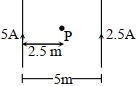
For adjoining fig., The magnetic field at point, $P$ will be