MCQ
With increasing principal quantum number, the energy difference between adjacent energy levels in $H-$ atom
- ✓decreases
- Bincreases
- Cremains constant
- Ddecreases for high value of $z$ and increases for low value of $z$
$\mathrm{E}_{3}-\mathrm{E}_{2}=13.6 \times 1^{2}\left(\frac{1}{2^{2}}-\frac{1}{3^{2}}\right)=13.6 \times \frac{5}{36}$
$\mathrm{E}_{4}-\mathrm{E}_{3}=13.6 \times 1^{2}\left(\frac{1}{3^{2}}-\frac{1}{4^{2}}\right)=13.6 \times \frac{9}{144}$
Energy difference decreases as principal quantum number increases
Generate a complete, print-ready paper with questions like this in minutes — across 16+ boards, with answer keys.
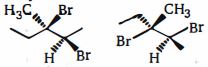
$\mathop {\begin{array}{*{20}{c}}
{\begin{array}{*{20}{c}}
{COOH\,\,} \\
{|\,\,\,\,\,\,\,\,\,\,\,\,\,\,\,} \\
{H - C - OH\,\,\,\,\,\,\,\,\,\,\,} \\
{|\,\,\,\,\,\,\,\,\,\,\,\,\,\,\,}
\end{array}} \\
{Br - C - H\,\,\,\,\,\,\,\,\,\,\,\,\,\,\,\,\,} \\
{|\,\,\,\,\,\,\,\,\,\,\,\,\,\,\,\,\,} \\
{\,\,\,COOC{H_3}}
\end{array}}\limits_{(I)} $ $\mathop {\begin{array}{*{20}{c}}
{\begin{array}{*{20}{c}}
{\,\,\,\,\,\,\,\,COOC{H_3}\,\,} \\
{|\,\,\,\,\,\,\,\,\,\,\,\,\,\,\,} \\
{H - C - Br\,\,\,\,\,\,\,\,\,\,\,} \\
{|\,\,\,\,\,\,\,\,\,\,\,\,\,\,\,}
\end{array}} \\
{HO - C - H\,\,\,\,\,\,\,\,\,\,\,\,\,\,\,\,\,} \\
{\,\,|\,\,\,\,\,\,\,\,\,\,\,\,\,\,\,\,\,} \\
{\,\,\,\,\,\,\,COOH\,\,\,\,\,\,\,\,}
\end{array}}\limits_{(II)} $
$(I)$ $\begin{array}{*{20}{c}}
{C{H_3} - CH - COOH} \\
{|\,\,\,\,\,\,\,\,\,\,\,\,\,\,} \\
{C{H_3}\,\,\,\,\,\,\,}
\end{array}$
$(II)$ $\begin{array}{*{20}{c}}
{C{H_3} - CH - C{H_2} - COOH} \\
{|\,\,\,\,\,\,\,\,\,\,\,\,\,\,\,\,\,\,\,\,\,\,\,\,\,\,\,\,\,\,} \\
{C{H_3}\,\,\,\,\,\,\,\,\,\,\,\,\,\,\,\,\,\,\,\,\,\,}
\end{array}$
$(III)$ $\begin{array}{*{20}{c}}
\,\,{C{H_3}} \\
{|\,\,\,\,\,\,\,\,} \\
{C{H_3} - C - COOH} \\
{|\,\,\,\,\,\,} \\
\,\,{C{H_3}\,}
\end{array}$
$(IV)$ $(CH_3-CH_2)_3C-COOH$
$(A)$ Denaturation of proteins causes loss of secondary and tertiary structures of the protein
$(B)$ Denturation leads to the conversion of double strand of $DNA$ into single strand
$(C)$ Denaturation affects primary structure which gets distorted
(At. nos. $Cr = 24, Mn = 25, Fe = 26, Co = 27$)
${A_2}B(g) \to {A_2}(g) + B(g);\,\,\,\Delta {H^o} = 40\,kJ/mol$
${A_2}B(g) \to A(g) + AB(g);\,\,\,\Delta {H^o} = 50\,kJ/mol$
.....$ kJ/mol$