MCQ
With reference to the observations in photo-electric effect, identify the correct statements from below:

$A.$ The square of maximum velocity of photoelectrons varies linearly with frequency of incident light.

$B.$ The value of saturation current increases on moving the source of light away from the metal surface.

$C.$ The maximum kinetic energy of photo-electrons decreases on decreasing the power of LED (light emitting diode) source of light.

$D.$ The immediate emission of photo-electrons out of metal surface can not be explained by particle nature of light/electromagnetic waves.

$E.$ Existence of threshold wavelength can not be explained by wave nature of light/electromagnetic waves.

Choose the correct answer from the options given below:

  • A
    $A$ and $B$ only
  • $A$ and $E$ only
  • C
    $C$ and $E$ only
  • D
    $D$ and $E$ only

Answer

Correct option: B.
$A$ and $E$ only
b
$\frac{1}{2} mV _{\max }^{2}= hf -\phi$

Photoelectric effect can be explained by particle nature of light. Threshold $\lambda$ is max wavelength at which emission takes place.

Need a full question paper?

Generate a complete, print-ready paper with questions like this in minutes — across 16+ boards, with answer keys.

Start Generating Free

Similar questions

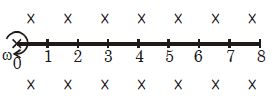
A rod of length $l$ is rotating with constant angular velocity $\omega $ and we marked the rod $0, 1, 2, .......... 8$ at equal spacing. Potential difference between consecutive points, if we go from left to right will be 
Nuclear binding energy is equivalent to
If frequency of electromagnetic wave is $60 \mathrm{MHz}$ and it travels in air along $\mathrm{z}$ direction then the corresponding electric and magnetic field vectors will be mutually perpendicular to each other and the wavelength of the wave (in $\mathrm{m}$ ) is :
In a wheatstone bridge in the battery and galvanometer are interchanged then the deflection in galvanometer will:
Two lenses of power $+12$ and $-2$ diopters are placed in contact. What will the focal length of combination......$cm$
A flexible wire loop in the shape of a circle has a radius that grows linearly with time. There is a magnetic field perpendicular to the plane of the loop that has a magnitude inversely proportional to the distance from the centre of loop i.e. $B(r) \propto \frac{1}{r}$ . How does the emf $E$ vary with time?
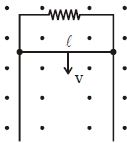
A conductor of length $l$ and mass $m$ can slide along a pair of vertical metal guides connected by a resistance $R,$ as shown in fig. Friction, resistance of conductor and guide rails are negligible. There exist a horizontal uniform magnetic field of strength $B$ normal to the plane of the page and is directed outward. The terminal speed of fall under the unfluence of gravity is, then :-
A current carrying coil is subjected to a uniform magnetic field. The coil will orient so that its plane becomes
If a photon has velocity $c$ and frequency $\nu$, then which of following represents its wavelength
The decay constant of a radioactive sample is $\lambda.$ The half-life and the average$-$life of the sample are respectively: