Respiration and Energy Transfer — Biology STD 11 Science — Question
Maharashtra BoardEnglish MediumSTD 11 ScienceBiologyRespiration and Energy Transfer5 Marks
Question
With the help of an experiment explain how yeast respires anaerobically.
✓
Answer
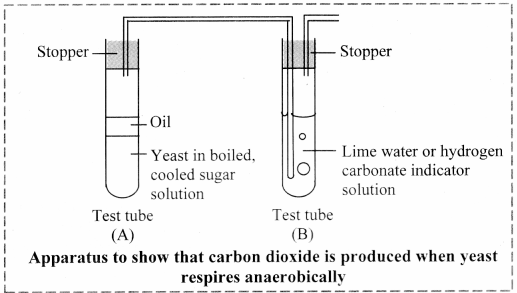
Respiration in yeast can be demonstrated with the help of an experiment. Anaerobic respiration in yeast:
A pinch of dry baker’s yeast suspended in water containing 10ml of 10% glucose in a test tube (test tube A).
The surface of the liquid is covered with oil to prevent entry of air and the test tube is closed tightly with rubber stopper to prevent leakage.
One end of a short-bent glass tube is inserted through it to reach the air inside the tube.
Other end of the glass tube is connected by a polyethylene or rubber tubing to another bent glass tube fitted into a stopper.
The open end of the glass tube (delivery tube) is dipped into lime water containing in a test tube (Tube B).
Stoppers of both the tubes are fitted tightly to prevent leakage of gases. First test tube is placed in warm water (37° C-38° C) in a beaker.
Lime water gradually turns milky, indicating the evolution of carbon dioxide from the yeast preparation.
Level of the lime water in the delivery tube does not rise, showing that there is no decline in volume of gas in test tube A and consequently no utilization of oxygen by yeast. Preparation is stored for a day or two.
When we open the stopper of tube A we will notice a smell of alcohol indicating the formation of ethanol.
From this activity it may be inferred that yeast respires anaerobically to ferment glucose to ethanol and carbon dioxide.
Need a full question paper?
Generate a complete, print-ready paper with questions like this in minutes — across 16+ boards, with answer keys.