Question
With the help of vapour pressure-temperature curves for solution and solvent, explain why boiling point of solvent is elevated when a nonvolatile solute is dissolved into it.
Answer

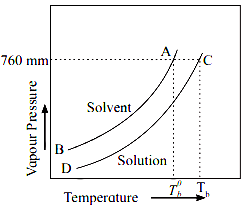
  1. The vapour pressures of solution and of pure solvent are plotted as a function of temperature in the given diagram.
  2. At any temperature, the vapour pressure of the solution is lower than that of the pure solvent. Hence, the vapour pressure-temperature curve of solution (CD) lies below that of the solvent (AB).
  3. The difference between the two vapour pressures increases as temperature and vapour pressure increase as predicted by the equation,
    $\Delta P = P _1^0 x _2$
  4. The intersection of the curve CD with the line corresponding to 760 mm is the boiling point of the solution. The similar intersection of the curve AB is the boiling point of the pure solvent. It is clear from the diagram that the boiling point of the solution (Tb) is higher than that of pure solvent $\left( T _{ b }^0\right)$.
  5. At the boiling point of a liquid, its vapour pressure is equal to 1 atm.
  6. In order to reach boiling point, the solution and solvent must be heated to a temperature at which their respective vapour pressures attain 1 atm.
  7. At any given temperature the vapour pressure of the solution is lower than that of the pure solvent. Hence, the vapour pressure of the solution needs a higher temperature to reach 1 atm than that needed for the vapour pressure of the solvent.
  8. In other words, the solution must be heated to a higher temperature to cause it to boil than the pure solvent. Thus, the solution containing nonvolatile solute boils at a temperature higher than the boiling point of the pure solvent i.e. $T _{ b }> T _{ b }^0$

Need a full question paper?

Generate a complete, print-ready paper with questions like this in minutes — across 16+ boards, with answer keys.

Start Generating Free

Similar questions