MCQ
With the increase in principle quantum number, the energy difference between the two successive energy levels
  • A
    Increases.
  • B
    Decreases
  • Remains constant
  • D
    Sometimes increases and sometimes decreases

Answer

Correct option: C.
Remains constant
 Decreases

Need a full question paper?

Generate a complete, print-ready paper with questions like this in minutes — across 16+ boards, with answer keys.
Start Generating Free

Similar questions

According to Gauss’ Theorem, electric field of an infinitely long straight wire is proportional to
A beam of well collimated cathode rays travelling with a speed of $5 \times {10^6}\,m{s^{ - 1}}$ enter a region of mutually perpendicular electric and magnetic fields and emerge undeviated from this region. If $| B |=0.02\; T$, the magnitude of the electric field is
Two equal point charges are fixed at x = -a and x = +a on the x-axis. Another point charge Q is placed at the origin. The Change in the electrical potential energy of Q, when it is displaced by a small distance x along the x-axis, is approximately proportional to(a) (b) (c) (d)
In a transformer, number of turns in the primary coil are $140$ and that in the secondary  coil are $280$. If current in primary is $4A$, then that in coil secondary is.....$A$
If the electric flux entering and leaving an enclosed surface respectively is ${\varphi _1}$ and ${\varphi _2}$ the electric charge inside the surface will be
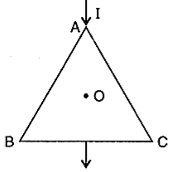
An equilateral triangle is made by uniform wires AB, BC, CA. A current I enteres at A and leaves from the midpoint of BC. If the lengths of each side of the triangle is L, the magnetic field B at the centroid O of the triangle is:
Image
The radii of two metallic spheres P and Q are $r_1$ and $r_2$ respectively. They are given the same charge. If $r_1>r_2$. then on connecting them with a thin wire, the charge will flow
Radiations of monochromatic waves of wavelength $400\  nm$ are incident on the surface of metals $Zn$, $Fe$ and $Ni$ of work functions $3.4\  eV$, $4.8\  eV$ and $5.9\  eV$ respectively. (Take $hc = 1242\  eV\  nm$)

$(a)$ Maximum $KE$ associated with photoelectrons from the surface of any metal is $0.3\  eV$

$(b)$ No photoelectrons are emitted from the surface of $Ni$

$(c)$ If the frequency of the source of radiation is doubled then $KE$ of photoelectrons is also doubled

$(d)$ Photoelectrons will be emitted from the surfaces of all the three metals if the wavelength of the incident radiation is less than $200\  nm$

Correct statements are

In Gallilean telescope, the final image formed is
A lens of focal power $0.5 D$ is