MCQ
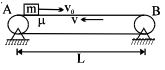
With what minimum velocity should block be projected from left end $A$ towards end $B$ such that it reaches the other end $B$ of conveyer belt moving with constant velocity $v$. Friction coefficient between block and belt is $\mu$ .
  • A
    $\sqrt {\mu gL} $
  • $\sqrt {2\mu gL} $
  • C
    $\sqrt {3\mu gL} $
  • D
    $2\sqrt {\mu gL} $

Answer

Correct option: B.
$\sqrt {2\mu gL} $
b
$a=\mu g$

$0^{2}=v_{0}^{2}-2 \mu g L$ or $v_{0}^{2}=2 \mu g L$

$\therefore V_{0}=\sqrt{2 \mu g L}$

Need a full question paper?

Generate a complete, print-ready paper with questions like this in minutes — across 16+ boards, with answer keys.

Start Generating Free

Similar questions

Which of the following pairs is an isobar
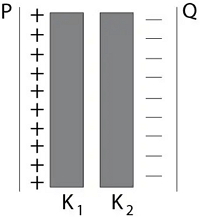
Two thin dielectric slabs of dielectric constants $K_1$ and $K_2$ $(K_1 < K_2)$ are inserted between plates of a parallel plate capacitor, as shown in the figure. The variation of electric field $E$ between the plates with distance $d$ as measured from plate $P$ is correctly shown by
If the two metals $A$ and $B$ are exposed to radiation of wavelength $350\,nm$. The work functions of metals $A$ and $B$ are $4.8\,eV$ and $2.2\,eV$. Then choose the correct option
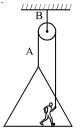
To paint the side of $a$ building, painter normally hoists himself up by pulling on the rope $A$ as in figure. The painter and platform together weigh $200N$. The rope $B$ can withstand $300N$. Then
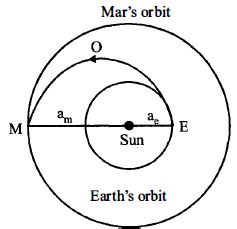
India's Mangalyan was sent to the Mars by launching it into a transfer orbit $EOM$ around the sun . It leaves the earth at $E$ and meets Mars at $M$ . If the semi-major axis of Earth's orbit is $a_e = 1.5 \times 10^{11}\, m$, that of Mars orbit $a_m= 2.28 \times 10^{11}\, m$, taken Kepler's laws give the estimate of time for Mangalyan to reach Mars from Earth to be close to ........ $days$.
A common emitter amplifier has a voltage gain of $50$ , an input impedance of $100\; \Omega$ and an output impedance of $200\; \Omega$. The power gain of the amplifier is 
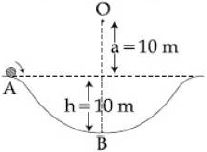
A particle of mass $20\,g$ is released with an initial velocity $5\,m/s$ along the curve from the point $A,$ as shown in the figure. The point $A$ is at height $h$ from point $B.$ The particle slides along the frictionless surface. When the particle reaches point $B,$ its angular momentum about $O$ will be ......... $kg - m^2/s$. [Take $g = 10\,m/s^2$ ]
The distance between the two charges $ + q$ and $ - q$ of a dipole is $r$. On the axial line at a distance $d$ from the centre of dipole, the intensity is proportional to
A bullet is fired vertically upwards with velocity $v$ from the surface of a spherical planet. When it reaches its maximum height, its acceleration due to the planet's gravity is $1 / 4^{\text {th }}$ of its value at the surface of the planet. If the escape velocity from the planet is $v_{e s c}=v \sqrt{N}$, then the value of $N$ is (ignore energy loss due to atmosphere)
A particle moving with velocity $\overrightarrow{\mathrm{V}}$ is acted by three forces shown by the vector triangle $PQR$. The velocity of the particle will