MCQ
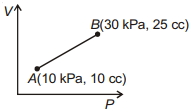
Work done for the process shown in the figure is ............ $J$
  • A
    $1$
  • B
    $1.5$
  • C
    $4.5$
  • $0.3$

Answer

Correct option: D.
$0.3$
d
(d)

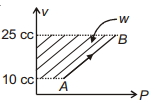
Area under graph and $V$ axis $=$ work done

$=\frac{1}{2} \times(30+10) \times 10^3 \times(25-10) \times 10^{-6}$

$=0.3 \,J$
Need a full question paper?

Generate a complete, print-ready paper with questions like this in minutes — across 16+ boards, with answer keys.

Start Generating Free

Similar questions

A particle has initial velocity $\left( {2\hat i + 3\hat j} \right)$ and acceleration $\left( {0.3\hat i + 0.2\hat j} \right)$. The magnitude of velocity after $10\, seconds$ will be 
An object of mass $10 \,kg$ is projected from ground with speed $40 \,m / s$ at an angle $60^{\circ}$ with horizontal. The rate of change of momentum of object one second after projection in SI unit is ........ [Take $g=9.8 \,m / s ^2$ ]
The main scale of vernier callipers reads in millimetre and its vernier is divided into $8$ divisions, which coincides with $5$ divisions of main scale. When two jaws of instrument touch each other, the zero of the vernier coincides with the zero of main scale. A rod is tightly placed along its length between both jaws. It is observed that the zero of vernier scale lies just left to $36^{th}$ division of main scale and fourth division of vernier scale coincides with the main scale Then the measured value is .......... $cm$
The gas which obeys Boyle's law for maximum range of temperature is
In electromagnetic theory, the electric and magnetic phenomena are related to each other. Therefore, the dimensions of electric and magnetic quantities must also be related to each other. In the questions below, $[E]$ and $[B]$ stand for dimensions of electric and magnetic fields respectively, while $\left[\varepsilon_0\right]$ and $\left[\mu_0\right]$ stand for dimensions of the permittivity and permeability of free space respectively. $[L]$ and $[T]$ are dimensions of length and time respectively. All the quantities are given in $SI$ units.

($1$) The relation between $[E]$ and $[B]$ is

$(A)$ $[ E ]=[ B ][ L ][ T ]$  $(B)$ $[ E ]=[ B ][ L ]^{-1}[ T ]$  $(C)$ $[ E ]=[ B ][ L ][ T ]^{-1}$  $(D)$ $[ E ]=[ B ][ L ]^{-1}[ T ]^{-1}$

($2$) The relation between $\left[\varepsilon_0\right]$ and $\left[\mu_0\right]$ is

$(A)$ $\left[\mu_0\right]=\left[\varepsilon_0\right][ L ]^2[ T ]^{-2}$  $(B)$ $\left[\mu_0\right]=\left[\varepsilon_0\right][ L ]^{-2}[ T ]^2$   $(C)$ $\left[\mu_0\right]=\left[\varepsilon_0\right]^{-1}[ L ]^2[ T ]^{-2}$  $(D)$ $\left[\mu_0\right]=\left[\varepsilon_0\right]^{-1}[ L ]^{-2}[ T ]^2$

Give the answer or quetion ($1$) and ($2$)

A pendulum clock that keeps correct time on the earth is taken to the moon. It will run:

  1. At correct rate.

  2. 6 times faster.

  3. $\sqrt{6}$ times faster.

  4. $\sqrt{6}$ times slower.

Two spherical bodies $\mathrm{A}$ (radius $6 \mathrm{~cm}$ ) and $\mathrm{B}$ (radius $18 \mathrm{~cm}$ ) are at temperature $\mathrm{T}_1$ and $\mathrm{T}_2$, respectively. The maximum intensity in the emission spectrum of $\mathrm{A}$ is at $500 \mathrm{~nm}$ and in that of $\mathrm{B}$ is at $1500 \mathrm{~nm}$. Considering them to be black bodies, what will be the ratio of the rate of total energy radiated by $A$ to that of $B$ ?
Four particles $A, B, C$ and $D$ each of mass $m$ are kept at the corners of a square of side $L$. Now the particle $D$ is taken to infinity by an external agent keeping the other particles fixed at their respective positions. The work done by the gravitational force acting on the particle $D$ during its movement is ..........
A $3.0\ kg$ bobbin consists of a central cylinder of radius $5.0\ cm$ and two end plates each of radius $6.0\ cm$ . It is placed on a slotted incline, where friction is sufficient to prevent sliding. A block of mass $4.5\ kg$ is suspended from a cord wound around the bobbin and passing through the slot under the incline. If the bobbin is in static equilibrium, ....... $^o$ is the angle of tilt of the incline.
The total energy of the body executing $S.H.M.$ is $E$. Then the kinetic energy when the displacement is half of the amplitude, is