MCQ
Work done in moving an object through an equipotential surface is:
  • A
    Positive
  • B
    Negative
  • Zero
  • D
    Depends on the field direction

Answer

Correct option: C.
Zero

Work done is given difference in potentials. In an equipotential surface, all points will have same potential. Thus work done is zero

Need a full question paper?

Generate a complete, print-ready paper with questions like this in minutes — across 16+ boards, with answer keys.
Start Generating Free

Similar questions

Resistances ${R_1}$ and ${R_2}$ are joined in parallel and a current is passed so that the amount of heat liberated is ${H_1}$ and ${H_2}$ respectively. The ratio $\frac{{{H_1}}}{{{H_2}}}$ has the value
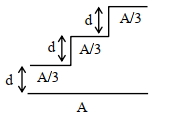
A capacitor is made of a tlat plate of area $A$ and a second plate having a stair-like structure as shown in figure. If the area of each stair is $\frac{A}{3}$ and the height is $\mathrm{d}$, the capacitance of the arrangement is:
The graph of ln$\Big(\frac{\text{R}}{\text{R}_{\text{0}}}\Big)$ versus In A (R = radius of a nucleus and A - its mass number) is:
The plates of a capacitor are charged to a potential difference of $320 \, volts$ and are then connected across a resistor. The potential difference across the capacitor decays exponentially with time. After $1 $ second the potential difference between the plates of the capacitor is $240 \, volts$, then after $2$ and $3$ seconds the potential difference between the plates will be
An electron has a mass of $9.1 \times 10^{-31} \mathrm{~kg}$. It revolves round the nucleus in a circular orbit of radius $0.529 \times 10^{-10} \mathrm{~metre}$ at a speed of $2.2 \times 10^6 \mathrm{~m} / \mathrm{s}$. The magnitude of its linear momentum in this motion is
A beam of light propagating in medium A with index of refraction n (A) passes across an interface into medium B with index of refraction n(B). The angle of incidence is greater than the angle of refraction; v(A) and v(B) denotes the speed of light in A and B. Then which of the following is true
A galvanometer gives full scale deflection with $0.006$ A current. By connecting it to a $4990 \ \Omega$ resistance, it can be converted into a voltmeter of range $0-30 \ V$. If connected to a $\frac{2 n }{249} \Omega$ resistance, it becomes an ammeter of range $0-1.5 \ A$. The value of $n$ is:
A potentiometer having the potential gradient of $2\, mV/cm$ is used to measure the difference of potential across a resistance of $10 \,\Omega$. If a length of $50\, cm$ of the potentiometer wire is required to get the null point, the current passing through the $10 \,\Omega$ resistor is (in $mA$)
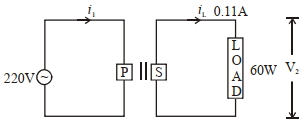
For the given circuit, comment on the type of transformer used:
For reading small letters with a lens: