MCQ
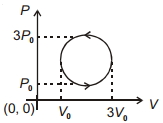
Work done in the cyclic process shown in figure is ...........
  • A
    $4 P_0 V_0$
  • B
    $-4 P_0 V_0$
  • $-\frac{22}{7} P_0 V_0$
  • D
    $-13 P_0 V_0$

Answer

Correct option: C.
$-\frac{22}{7} P_0 V_0$
c
(c)

Cyclic process is anticlockwise then

Work done $=-$ (Area of $P-V$ graph $)$

$W=-\pi R_1 R_2$

$=-\pi\left(\frac{3 P_0-P_0}{2}\right) \times\left(\frac{3 V_0-V_0}{2}\right)$

$=\frac{-22}{7} P_0 V_0$

Need a full question paper?

Generate a complete, print-ready paper with questions like this in minutes — across 16+ boards, with answer keys.

Start Generating Free

Similar questions

In case of uniform circular motion which of the following physical quantity do not remain constant
The specific heat of the mixture of two gases at constant volume is $\frac {13}{6}\,R$ . The ratio of number of moles of first gas to second is $1 : 2$. The respective gases may be
Thermoelectric thermometer is based on
The proportional limit of steel is $8 \times 10^8 \,N / m ^2$ and its Young's modulus is $2 \times 10^{11} \,N / m ^2$. The maximum elongation, a one metre long steel wire can be given without exceeding the elastic limit is ...... $mm$
A cricket ball of mass 150g has an initial velocity $\text{u}=(3\hat{\text{i}}+4\hat{\text{j}})\text{m s}^{-1}$ and a final velocity $\text{v}=-(3\hat{\text{i}}+4\hat{\text{j}})\text{m s}^{-1}$ after being hit. The change in momentum (final momentum-initial momentum) is (in kg m s1):

  1. $\text{zero}$
  2. $-(0.45\hat{\text{i}}+0.6\hat{\text{j}})$

  3. $-(0.9\hat{\text{i}}+1.2\hat{\text{j}})$

  4. $-5(\hat{\text{i}}+\hat{\text{j}})$

Third harmonic frequency in open argonpipe:
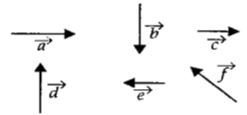
Six vectors, $\overrightarrow a$ through $\overrightarrow f$ have the magnitudes and directions indicated in the figure. Which of the following statements is true ?
A body is executing simple harmonic motion with an angular frequency $2\,rad/s$. The velocity of the body at $20\, mm$ displacement, when the amplitude of motion is $60\, mm$, is ...... $mm/s$
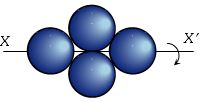
The moment of inertia of a sphere (mass $M$ and radius $R$ ) about it's diameter is $I$. Four such spheres are arranged as shown in the figure. The moment of inertia of the system about axis $XX'$ will be
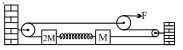
In the diagram shown, no friction at any contact surface. Initially, the spring has no deformation. What will be the maximum deformation in the spring? Consider all the strings to be sufficiency large. Consider the spring constant to be $K$.