MCQ
Work done on or by a gas, in general depends upon the
  • A
    Initial state only
  • B
    Final state only
  • C
    Both initial and final states only
  • Initial state, final state and the path

Answer

Correct option: D.
Initial state, final state and the path
d
(d)Work done $ = \int_{\,1}^{\,2} {\,PdV} $, which is state dependent as well as path dependent.

Need a full question paper?

Generate a complete, print-ready paper with questions like this in minutes — across 16+ boards, with answer keys.
Start Generating Free

Similar questions

The velocity of a particle executing SHM varies with displacement $( x )$ as $4 v ^2=50- x ^2$. The time period of oscillations is $\frac{x}{7} s$. The value of $x$ is $............$ $\left(\right.$ Take $\left.\pi=\frac{22}{7}\right)$
If the threshold of hearing is assumed to be the reference $(0\ dB)$ , then the threshold of pain is taken to be $120\ dB$ . Let the corresponding sound intensities be $I_0$ and $I$ respectively. Then $\frac{{{I_0}}}{I}$ is 
The velocity of a body at time $ t = 0$ is $10\sqrt 2 \,m/s$ in the north-east direction and it is moving with an acceleration of $ 2 \,m/s^{2}$ directed towards the south. The magnitude and direction of the velocity of the body after $5\, sec$ will be
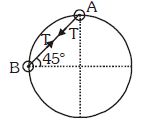
Two objects $A$ and $B$ each of mass $m$ are connected by a light inextensible string. They are restricted to move on a frictionless ring of radius $R$ in a vertical plane (as shown in fig). The objects are released from rest at the position shown. Then, the tension in the cord just after release is
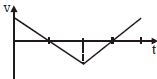
The graph below shows the velocity versus time graph for a body.

Which of the following graphs represents the corresponding acceleration $v/s$ time graph ?
The spectrum from a black body radiation is a
If a skater of weight $3 \,kg$ has initial speed $32\, m/s$ and second one of weight $4 \,kg$ has $5 \,m/s$. After collision, they have speed (couple) $5\, m/s$. Then the loss in K.E. is
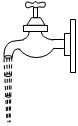
Water coming out of the mouth of a tap and falling vertically in streamline flow forms a tapering column, i.e., the area of cross-section of the liquid column decreases as it moves down. Which of the following is the most accurate explanation for this
What is the number of significant figures in $3400$
The terminal velocity of a copper ball of radius $5\,mm$ falling through a tank of oil at room temperature is $10\,cm\,s ^{-1}$. If the viscosity of oil at room temperature is $0.9\,kg\,m ^{-1} s ^{-1}$, the viscous drag force is :