MCQ
Work-energy theorem is valid in the presence of
  • A
    external forces
  • B
    conservative forces
  • C
    non-conservative forces
  • All types of forces

Answer

Correct option: D.
All types of forces
d
Work$-$energy principle is valid regardless of any non conservative force. As long as we are using the work done by the resultant force the work energy theorem is valid. Hence work$-$energy theorem is valid in the presence ofall types of forces i.e External force, Internal force and Conservative force.

Need a full question paper?

Generate a complete, print-ready paper with questions like this in minutes — across 16+ boards, with answer keys.
Start Generating Free

Similar questions

The potential energy of a particle of mass $0.1\,kg,$ moving along $x-$ axis, is given by $U = 5x(x-4)\,J$ where $x$ is in metres. It can be concluded that
Number of degrees present in one radian is
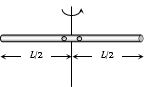
A smooth uniform rod of length $L$ and mass $M$ has two identical beads of negligible size, each of mass $m$, which can slide freely along the rod. Initially the two beads are at the centre of the rod and the system is rotating with angular velocity ${\omega _0}$ about an axis perpendicular to the rod and passing through the mid point of the rod (see figure). There are no external forces. When the beads reach the ends of the rod, the angular velocity of the system is
The pans of a physical balance are in equilibrium. Air is blown under the right hand pan; then the right hand pan will
Motion of a ball bearing inside a smooth curved bowl, when released from a point slightly above the lower point is:
  1. Simple harmonic motion.
  2. Non-periodic motion.
  3. Periodic motion.
  4. Periodic but not S.H.M.
An ice cube is suspended in vacuum in a gravity free hall. As the ice melts it.
  1. Will retain its cubical shape.
  2. Will change its shape to spherical.
  3. Will fall down on the floor of the hall.
  4. Will fly up.
A rod of mass $‘M’$ and length $‘2L’$ is suspended at its middle by a wire. It exhibits torsional oscillations; If two masses each of $‘m’$ are attached at distance $‘L/2’$ from its centre on both sides, it reduces the oscillation frequency by $20\%$. The value of ratio $m/M$ is close to
One mole of ${O_2}$ gas having a volume equal to $22.4$ litres at ${0^o}C$ and $1$ atmospheric pressure in compressed isothermally so that its volume reduces to $11.2$ litres. The work done in this process is ...... $J$
Two projectiles are projected at $30^{\circ}$ and $60^{\circ}$ with the horizontal with the same speed. The ratio of the maximum height attained by the two projectiles respectively is:
A vertical closed cylinder is separated into two parts by a frictionless piston of mass $m$ and of negligible thickness. The piston is free to move along the length of the cylinder .The length of the cylinder above the piston is $l_1,$ and that below the piston is $l_2,$ such that $l_1 > l_2.$ Each part of the cylinder contains $n$ moles of an ideal gas at equal temperature $T.$ If the piston is stationary, its mass, $m,$ will be given by: ( $R$ is universal gas constant and $g$ is the acceleration due to gravity)