Question
Write a detailed note on Transaction Processing System (TPS).

Answer

Transaction Processing System (TPS): They are the computerised systems that perform and record the daily routine transactions which are necessary to conduct the business. TPS serve the organisation at the operational level.Process of Transaction Procesing System: As the name suggests the Transaction Processing System (TPS) processes the transactions affecting the activities of the organisation. TPS follows the six steps given below:
  1. Data Collection: It gathers all data needed to complete one or more transactions either manually or using devices like scanners and point-of-sale equipment
  2. Data Editing: It is the process of checking the data for validity and completeness.
  3. Data Validation: It is the process of validating the data for correctness and then correcting the same if errors are found.
  4. Data Munipulation: it. It is the process of performing calculations.
  5. Data Storage: It is the process of placing transaction data into one or more databases.
  6. Output Generation 6: It is the process of creating reports and outputting records.
  7. Query Support: It is the process of making available the mechanism that empowers the users of TPS to query upon the stored data and extract the required information in required format.

Need a full question paper?

Generate a complete, print-ready paper with questions like this in minutes — across 16+ boards, with answer keys.

Start Generating Free

Similar questions

On 31st March, 2019, Cash Book of Mahesh showed debit bank balance of ₹ 75,000. When compared with the Bank Statement, following facts were discovered. On 30th March, two cheques of ₹ 5,000 and ₹ 7,000 were deposited in the bank but were not realised till date. On 28th March, three cheques of ₹ 6,000, ₹ 8,000 and ₹ 12,000 were issued but none of these were presented to the bank for payment. On 31st March, bank credited ₹ 1,250 as interest but this was not recorded in the Cash Book. Similarly, the bank had charged ₹ 150 as bank charges but this was not recorded in the Cash Book.
Bank paid insurance premium of ₹ 5,000 but it was recorded as ₹ 500 in Cash Book. Prepare Bank Reconcilation Statement on 31st March, 2019.
State main categories of data models.
Mr. Muneesh maintains his books of accounts from incomplete records. His books provide the information:
 April. 01, 2016 (₹)March. 31, 2017 (₹)
Cash1,2001,600
Bills receivable-2,400
Debtors16,80027,200
Stock22,40024,400
Investment-8,000
Furniture7,5008,000
Creditors14,00015,200

He withdrew ₹ 300 per month for personal expenses. He sold his investment of ₹ 16,000 at 2% premium and introduced that amount into business.
A sold goods to B on 1st September, 2018 for ₹ 16,000. B immediately accepted a 3 months bill. On the due date, B requested that the bill be renewed for a further period of 2 months. A agreed provided interest at 9% p.a. was paid immediately in cash. To this Bwas agreeable. The second bill was met on the due date. Give the Journal entries in the books of A.
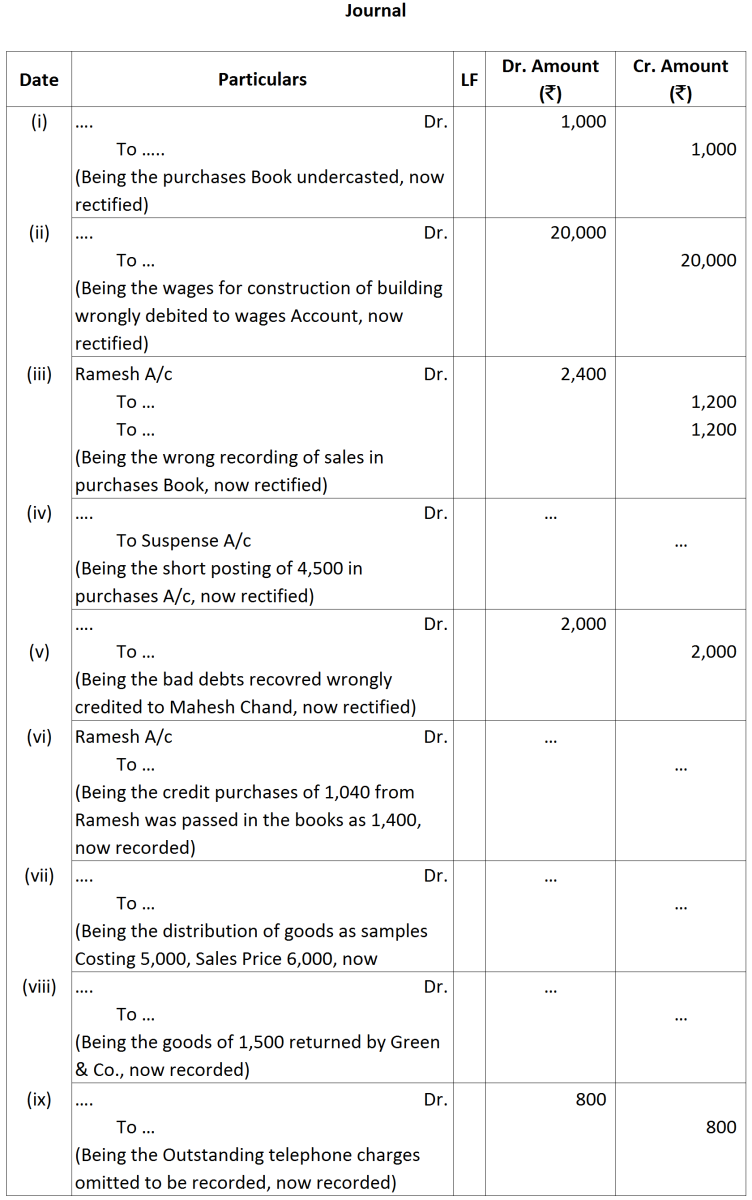
Determine the missing information in the following Rectifying Journal Entries:
What is the use of Data Base Management?
Give any three points of distinction between Capital Expenditure and Revenue Expenditure.
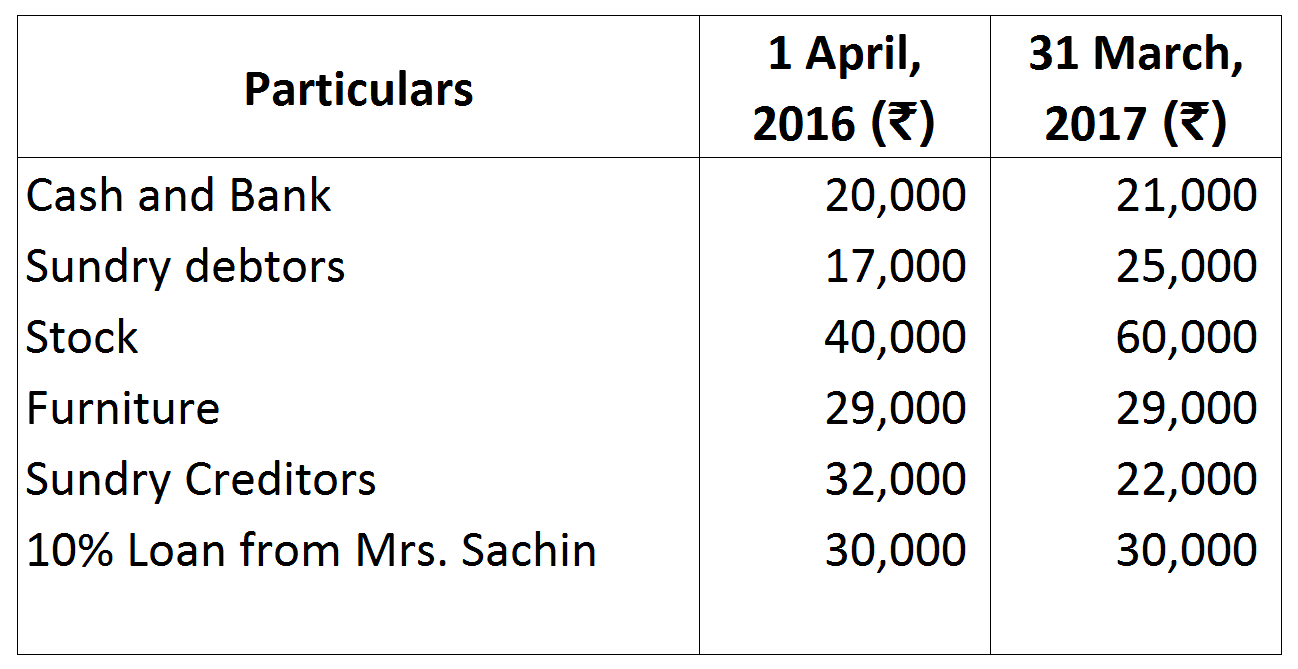
The following information is available from Sachin, who maintains books of accounts on single entry system:
Sachin withdrew $₹\ 5,000$ from the business every month for meeting his household expenses. During the year, he sold investments held by him privately for $₹\ 35,000$ and invested the amount in his business. At the end of the year $2016-17$, it was found that full year's interest on loan from Mrs. Sachin had not been paid. Depreciation $@ 10\%$ per annum was to be provided on furniture for the full year. Shop assistant was to be given a share of $5\%$ on the profits ascertained before charging such share. Calculate profit earned during the year ended $31^{st}$ March, $2017$ by Sachin.
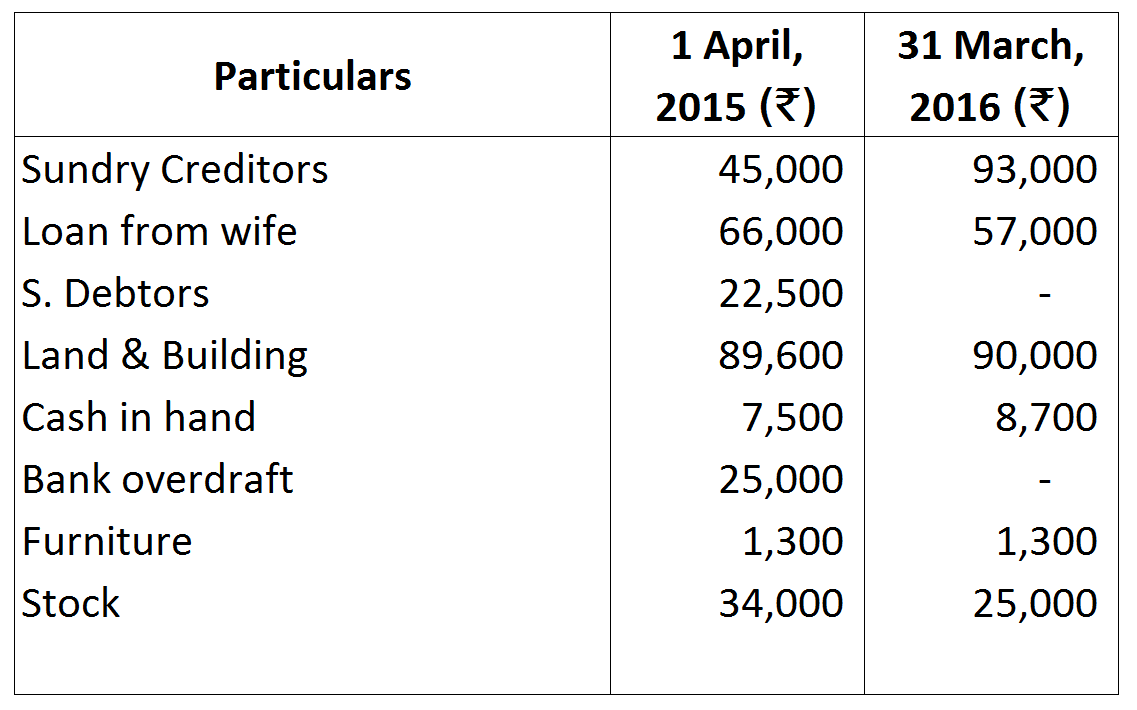
Mr. White does not keep his books properly. Following information is available from his books.
During the year Mr. White sold his private car for ₹ $50,000$ and invested this amount into the business. He withdrew from the business ₹ $1,500$ per month upto $31^{st}$ October, $2015$ and thereafter ₹ $4,500$ per month as drawings. You are required to prepare a statement of profit or loss and a statement of affairs as at March $31, 2016$.
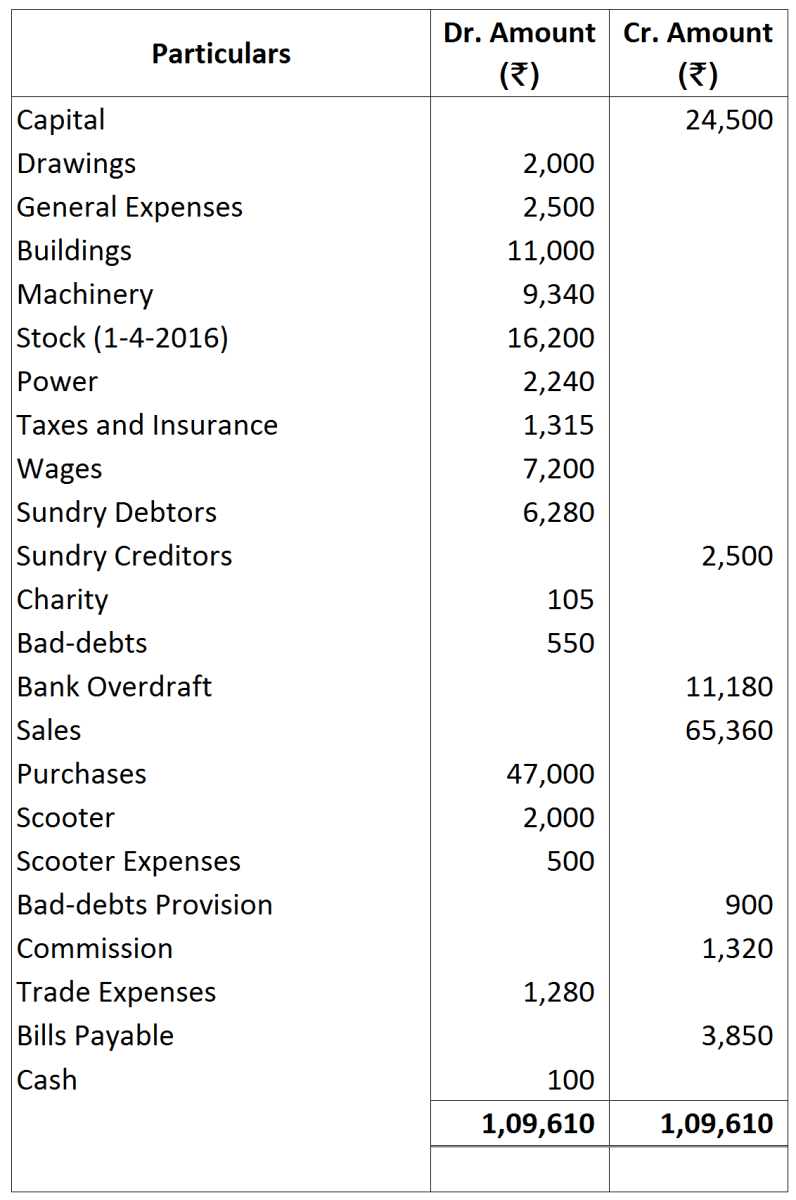
The following balances were extracted from the books of Shri Krishan Kumar as at 31st March, 2017:

Adjustments:
  1. Stock on 31st March, 2017 was valued at ₹ 23,500.
  2. $\frac{1}{5}\text{th}$ of general expenses and taxes & insurance to be charged to factory and the balance to the office.
  3. Write off a further Bad-debts of ₹ 160 and maintain the provision for Bad-debts at 5% on Debtors.
  4. Depreciate Machinery at 10% and Scooter by ₹ 240.
  5. Provide ₹ 700 for outstanding interest on Bank Overdraft.
  6. Prepaid Insurance is to the extent of ₹ 50.
  7. Provide for Manager's Commission at 10% on the Net Profit after charging such Commission.
Prepare final accounts for the year ended 31st March, 2017 after giving effect to the above adjustments.