Question
Write a detailed note on Transaction Processing System (TPS).

Answer

Transaction Processing System (TPS): They are the computerised systems that perform and record the daily routine transactions which are necessary to conduct the business. TPS serve the organisation at the operational level.Process of Transaction Procesing System: As the name suggests the Transaction Processing System (TPS) processes the transactions affecting the activities of the organisation. TPS follows the six steps given below:
  1. Data Collection: It gathers all data needed to complete one or more transactions either manually or using devices like scanners and point-of-sale equipment
  2. Data Editing: It is the process of checking the data for validity and completeness.
  3. Data Validation: It is the process of validating the data for correctness and then correcting the same if errors are found.
  4. Data Munipulation: it. It is the process of performing calculations.
  5. Data Storage: It is the process of placing transaction data into one or more databases.
  6. Output Generation 6: It is the process of creating reports and outputting records.
  7. Query Support: It is the process of making available the mechanism that empowers the users of TPS to query upon the stored data and extract the required information in required format.

Need a full question paper?

Generate a complete, print-ready paper with questions like this in minutes — across 16+ boards, with answer keys.

Start Generating Free

Similar questions

From the following information prepare trading and profit and loss account of M/s Indian sports house for the year ending March 31, 2017. Adjustments:
  1. Closing stock was 45,000.
  2. Provision for doubtful debts is to be maintained @ 2% on debtors.
  3. Depreciation charged on : furniture and fixture @ 5%, plant and Machinery @ 6% and motor car @ 10%.
  4. A Machine of 30,000 was purchased on October 01, 2016.
  5. The manager is entitle to a commission of @ 10% of the net profit after charging such commission.
Prepare a Bank Reconciliation Statement as on 31st March, 2019 from the following:
  1. On 31st March, 2019, Cash Book of a firm showed bank balance of ₹ 36,000 (Dr.).
  2. Cheques had been issued for ₹ 30,000, out of which cheques of ₹ 24,000 were presented for payment.
  3. Cheques of ₹ 8,400 were deposited in the bank on 28th March, 2019 but had not been credited by the bank. Also, a cheque of ₹ 3,000 entered in the Cash Book on 30th March, 2019 was banked on 3rd April.
  4. A cheque from Suresh for ₹ 2,400 was deposited in the bank on 26th March, 2019 was dishonoured, advice was received on 2nd April.
  5. Pass Book showed bank charges of ₹ 120 debited by the bank.
  6. One of the Debtors deposited ₹ 3,000 in the bank account of the firm on 26th March, 2019, but the intimation in this respect was received from the bank on 2nd April.
Mohan commenced business on $1^{st}$ April, $2012$ with a capital of $₹\ 50,000.$ On $1^{st}$ January, $2013,$ he introduced $₹\ 25,000$ into business of which $₹\ 10,000$ was borrowed from Ram. His position on $31^{st$} March, $2013$ was as under:
Assets: Cash in hand $₹\ 4,000;$ Bank (Cr.) $₹\ 6,500;$ Debtors $₹\ 24,000;$ B/R $₹\ 18,600.$
Stock $₹\ 25,400$; Furniture $₹\ 15,000;$ Prepaid expenses $₹\ 1,000.$
Liabilities : Creditors $₹\ 13,500;$ B/P $₹\ 4,800;$ Ram's Loan $₹\ 10,000;$ Outstanding expenses $₹\ 700.$
Actual drawings were not known but his living expenses are $₹\ 1,000$ p.m. Depreciate furniture by $10\%.$ Interest on loan is due $@ 12\%$ p.a.
Ascertain his profit or loss for the year $2012-13$ & prepare final statement of affairs.
On examining the Bank Statement of Green Ltd., it is found that the balance shown on 31st March, 2019, differs from the bank balance of ₹ 23,650 shown by the Cash Book on that date. From a detailed comparison of the entries it is found that:
  1. ₹ 2,860 is entered in the Cash Book as paid into the bank on 31st March, 2019 but not credited by the bank until the following day.
  2. Bank charges of ₹ 70 on 31st March, 2019 are not entered in the Cash Book.
  3. A bill for ₹ 5,500 discounted with the bank is entered in the Cash Book without recording the discount charges of ₹ 270.
  4. Cheques totalling ₹ 16,720 were issued by the company and duly recorded in the Cash Book before 31st March, 2019 but had not been presented at the Bank for payment until after that date.
  5. On 25th March, 2019, a debtor paid ₹ 1,000 into the Company's Bank in settlement of his account but no entry was made in the Cash Book of the company in respect of this.
  6. No entry has been made in the Cash Book to record the dishonour on 15th March, 2019, of a cheque for ₹ 550 received from Ram Babu. Prepare a Bank Reconciliation Statement as on 31st March, 2019.
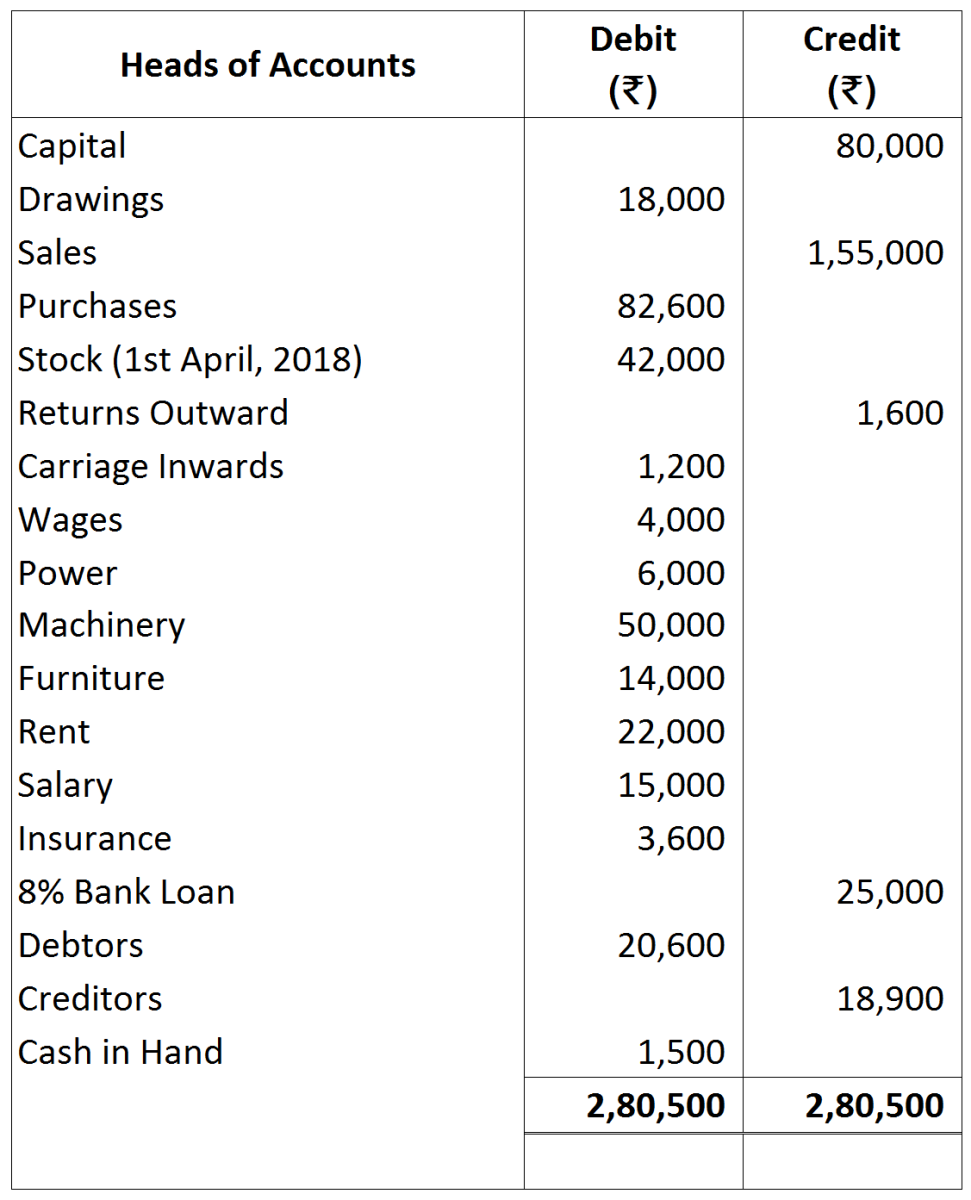
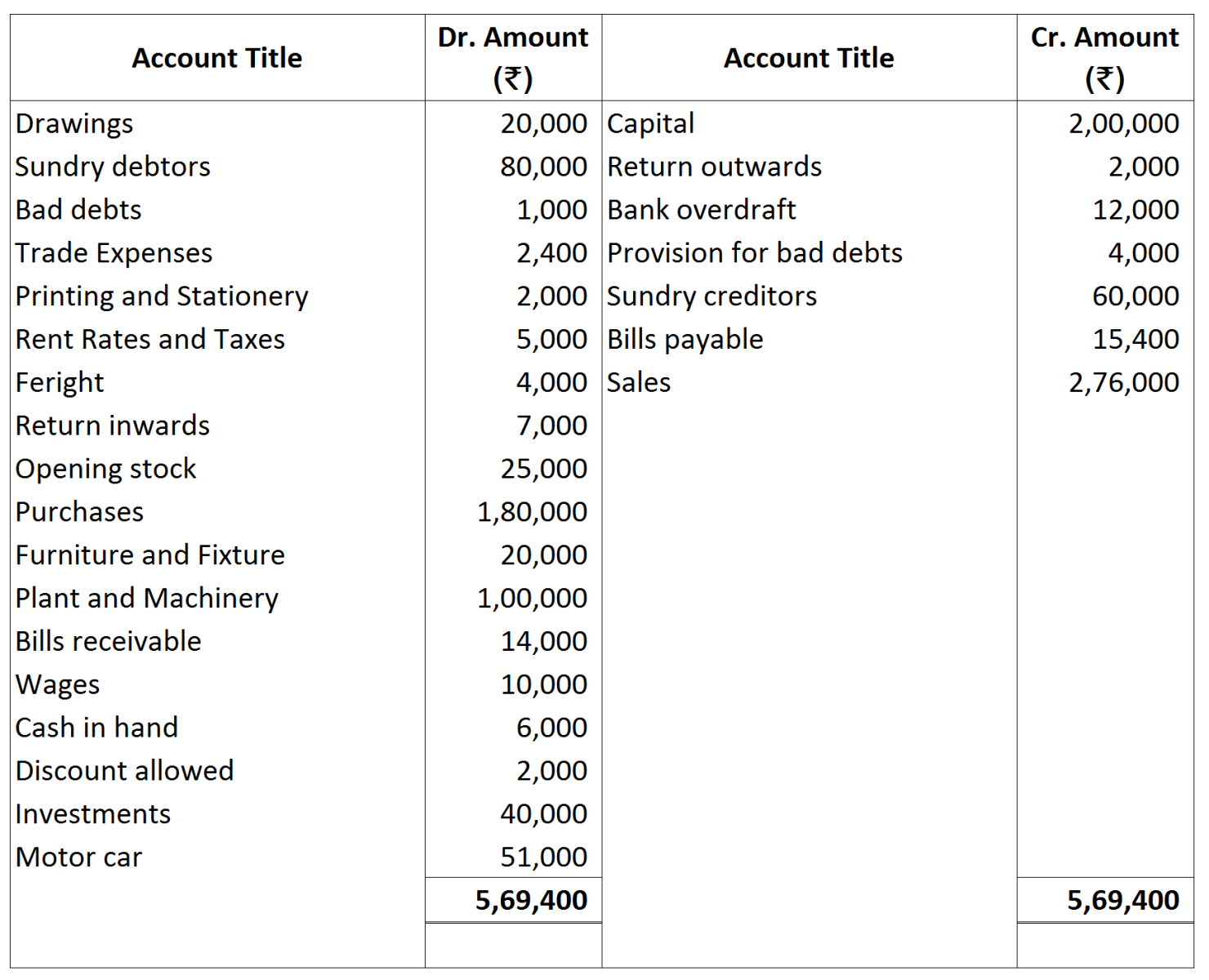
From the following Trial Balance of shradha as on 31st March, 2019, prepare Trading and profit and Loss Account and balance Sheet:

adjustmnet:
  1. Closing Stock ₹ 64,000.
  2. wages outstanding ₹ 2,400.
  3. Bad Debts ₹ 600.
  4. Provision for Doubtful debts to be 5%.
  5. Rent is paid for 11 months.
  6. Insurance premium is paid per annum, ended 31st May, 2019.
  7. Loen from the bank was taken on 1st October, 2018.
  8. Provide depreciation on Machinery @ 10% and on Furniture @ 5%.
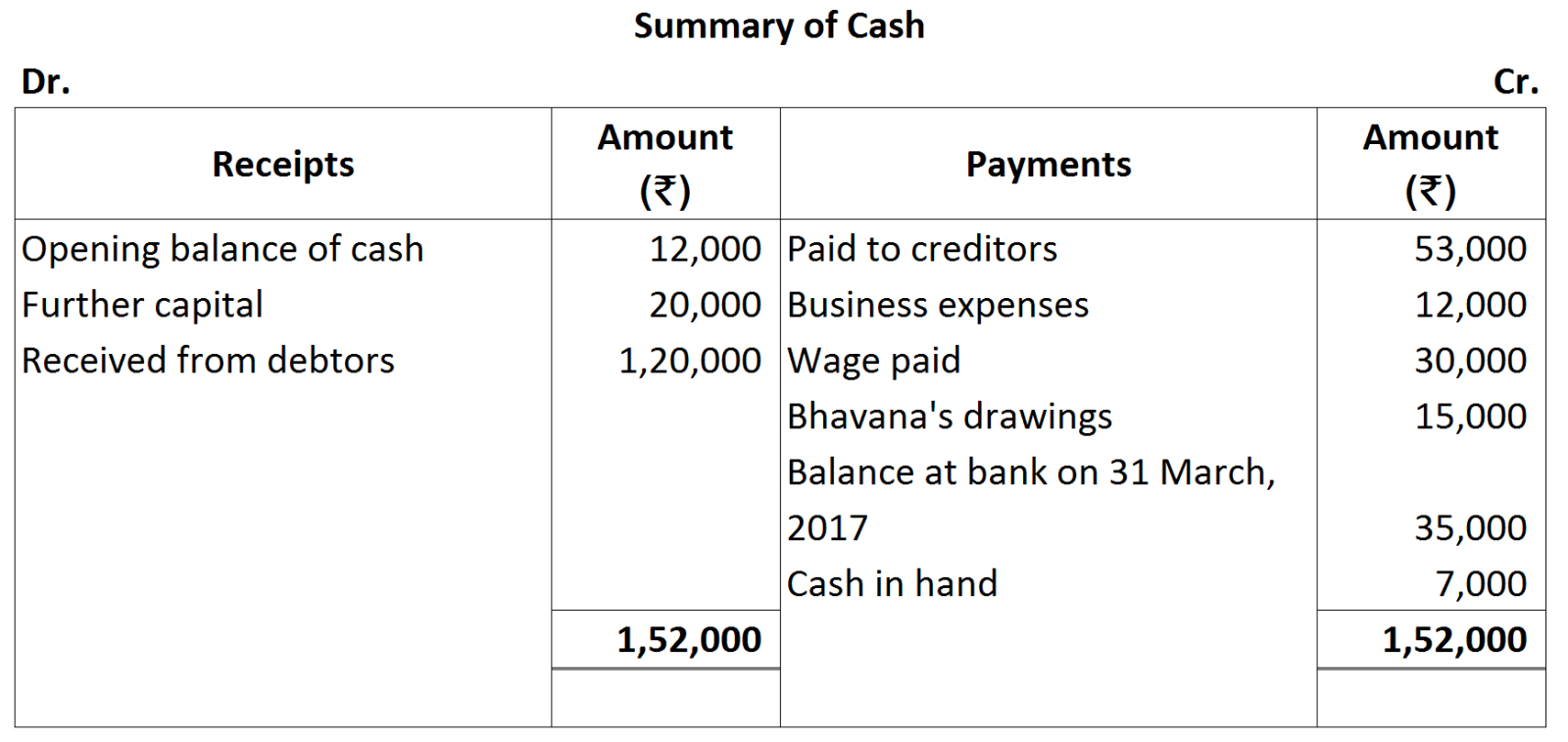
Mrs. Bhavana keeps his books by Single Entry System. You’re required to prepare final accounts of her business for the year ended March 31, 2017. Her records relating to cash receipts and cash payments for the above period showed the following particulars:

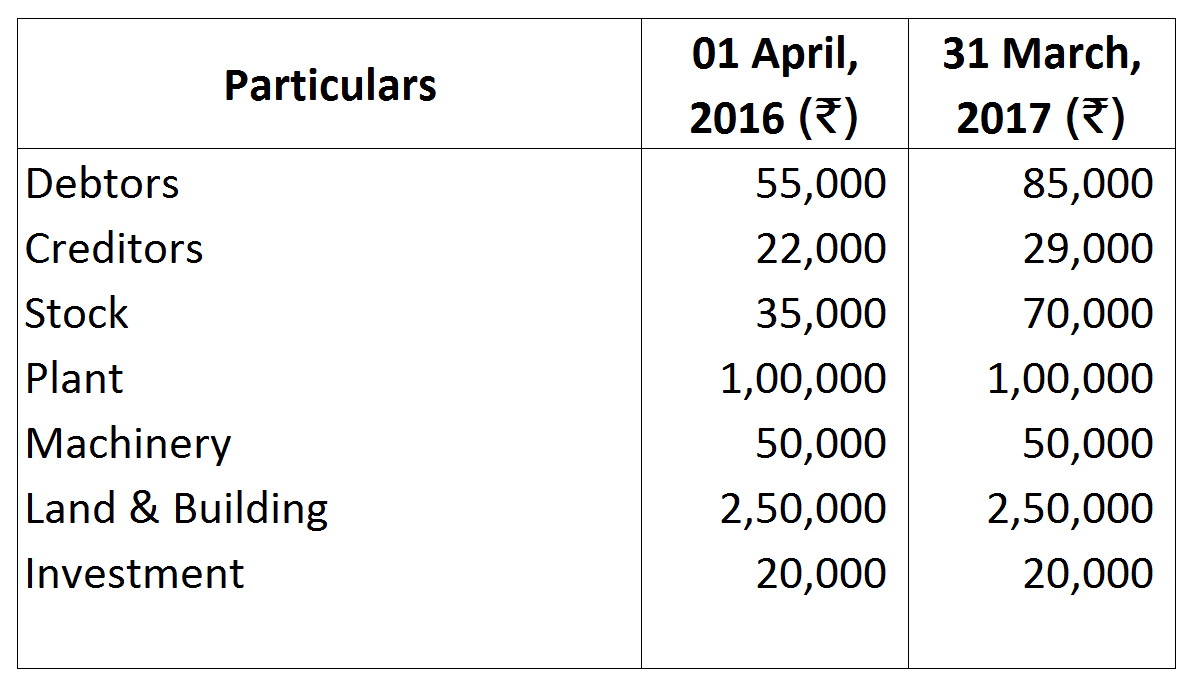
The following information is also available:

All her sales and purchases were on credit. Provide depreciation on plant and building by 10% and machinery by 5%, make a provision for bad debts by 5%.
Modern Ltd. purchased a machinery on 1st August, 2016 for ₹ 60,000. On 1st October, 2017, it purchased another machine for ₹ 20,000 plus CGST and SGST @ 6% each. On 30th June, 2018, it sold the first machine purchased in 2016 for ₹ 38,500 charging IGST @ 12%. Depreciation is provided @ 20% p.a. on the original cost each year. Accounts are closed on 31st March every year. Prepare the Machinery Account for three years.
Give rectifying Journal entries for the following errors:
  1. Sales of goods to Madan ₹ 6,000 were entered in the Sales Book as ₹ 600.
  2. Credit purchase of ₹ 1,500 from Ajay has been wrongly passed through the Sales Book.
  3. Repairs to building ₹ 300 were debited to Building Account.
  4. ₹ 2,050 paid to Rohit is posted to the debit of Mohit’s Account as ₹ 5,020.
  5. Purchases Return Book is overcasted by ₹ 400.
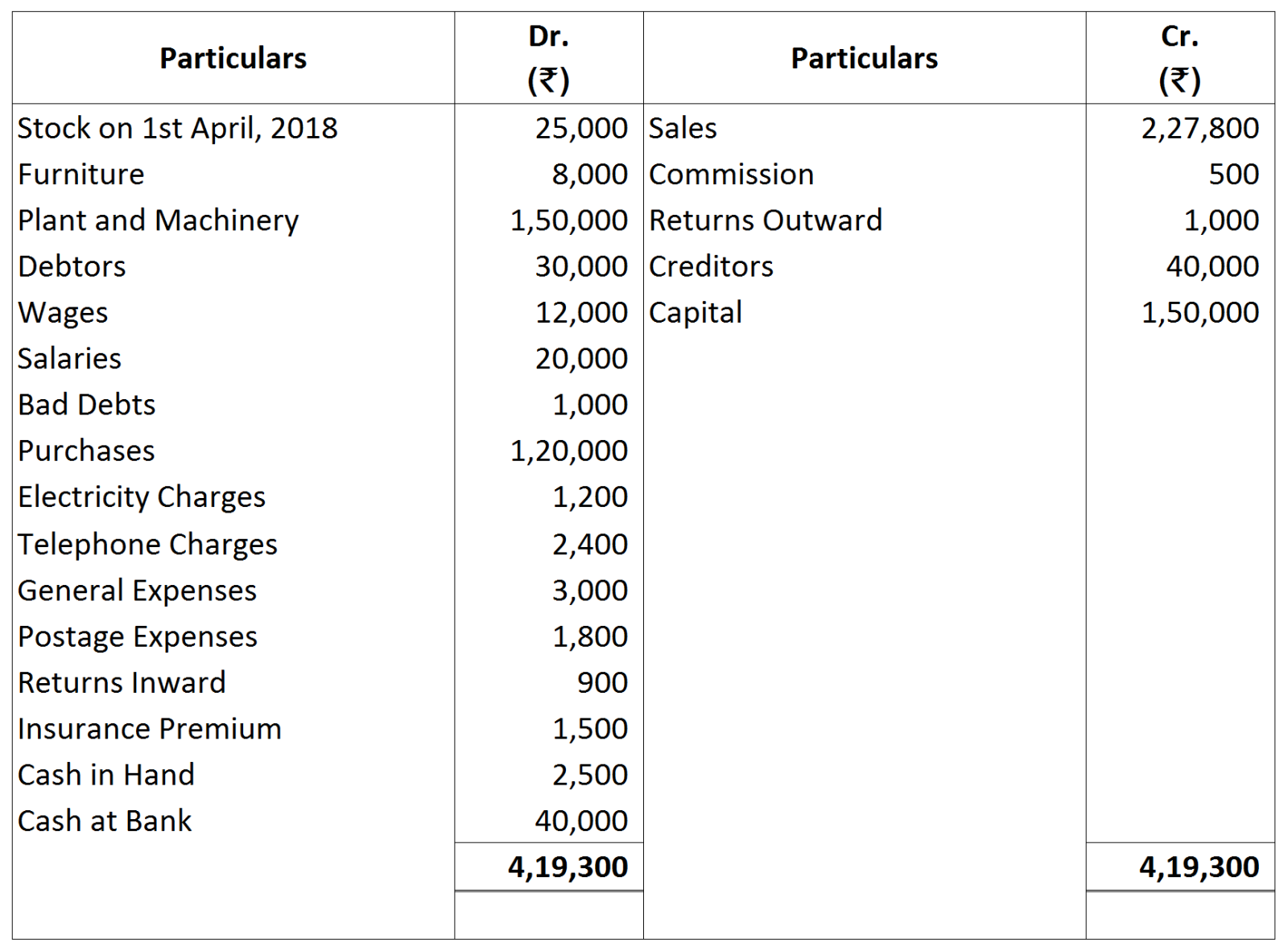
Trial Balance of a business as at 31st March, 2019 is given below:

Prepare Trading and Profit and Loss Account for the year ended 31st March, 2019 and Balance Sheet as at that date after taking into account the following adjustments:
  1. Closing Stock was valued at ₹ 7,000.
  2. Outstanding liabilities for wages were ₹ 600 and salaries ₹ 1,400.
  3. Depreciation is to be provided @ 5% p.a. on fixed assets.
  4. Included in Plant and Machinery is a machine purchased for ₹ 10,000 on 1st October, 2018.
  5. Insurance premium paid in advance ₹ 200.
What are the advantages of Computerised Accounting?