Question
Write a note on acidity of alcohols.

Answer

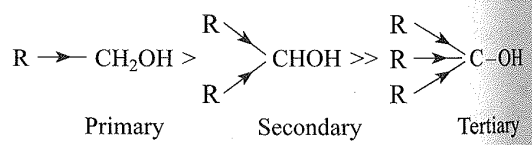
$\rightarrow$ Acidity of alcohols: The acidic character of alcohols is due to the polar nature of $O-H$ bond. An electron$-$releasing group $(-CH_3, C_2H_5) \ 2$ increases electron density on oxygen tending to decrease the polarity of $O-H$ bond. This decreases the acid strength. For this reason, the acid strength of alcohols decreases in the following order :
Image
$\rightarrow$ Alcohols are, however, weaker acids than water. This can be illustrated by the reaction of water with an alkoxide.
Image
$\rightarrow$ This reaction shows that water is a better proton donor $($i.e., stronger acid$)$ than alcohol. Also, in the above reaction, we note that an alkoxide ion is a better proton acceptor than hydroxide ion, which suggests that alkoxides are stronger bases $($sodium ethoxide is a stronger base than sodium hydroxide$).$
$\rightarrow$ Alcohols can act as both bronsted bases as well as acids. It is due to the presence of unshared electron pairs on oxygen. which makes them proton acceptors.

Need a full question paper?

Generate a complete, print-ready paper with questions like this in minutes — across 16+ boards, with answer keys.

Start Generating Free

Similar questions

Give reactions taking place at the two electrodes if these are made up of Ag.
  1. Based on the nature of intermolecular forces, classify the following solids: Benzene, Silver.
  2. $AgCl$ shows Frenkel defect while $NaCl$ does not. Give reason.
  3. What type of semiconductor is formed when Ge is doped with Al?
Discuss the nature of bonding in metal carbonyls.
The well known mineral fluorite is chemically calcium fluoride. It is known that in one unit cell of this mineral there are $4 \mathrm{Ca}^{2+}$ ions and $8 \mathrm{F}^{-}$ions and that $\mathrm{Ca}^{2+}$ ions are arranged in a fcc lattice. The $\mathrm{F}^{-}$ions fill all the tetrahedral holes in the face centred cubic lattice of $\mathrm{Ca}^{2+}$ ions. The edge of the unit cell is $5.46 \times 10^{-8} \mathrm{~cm}$ in length. The density of the solid is $3.18 \mathrm{~g} \mathrm{~cm}^{-3}$. Use this information to calculate Avogadro's number $($Molar mass of $\mathrm{CaF}_2=78.08 \mathrm{~g} \mathrm{~mol}^{-1} ).$
A solution prepared by dissolving $1.25g$ of oil of winter green (methyl salicylate) in $99.0g$ of benzene has a boiling point of $80.31^\circ C.$ Determine the molar mass of this compound. $(B.P.$ of pure benzene $= 80.10^\circ C$ and Kb for benzene $= 2.53^\circ C\ kg\ mol^{–1}).$
What product will be formed on reaction of propanal with 2-methylpropanal in the presence of NaOH? What products will be formed? Write the name of the reaction also.
  1. What is the basis of formation of the spectro-chemical series?
  2. Draw the structures of geometrical isomers of the following coordination complexes:
$[Co(NH_3)_3Cl_3]$ and $ [CoCl_2(en)_2]^+.$
(en = ethylenediamine and atomic number of Co is 27).
Calculate the mass percentage of benzene $(C_6H_6) $ and carbon tetrachloride $(CCl_4)$ if $22$ g of benzene is dissolved in $122$ g of carbon tetrachloride.
Give reasons for the following: Amino acids are amphoteric in nature.
What is ideal Solution? Explain with examples.