Question
Write a note on alternating current.
Answer

    • If the direction of the current in a resistor or in any other element changes its direction alternately, the current is called an alternating current.
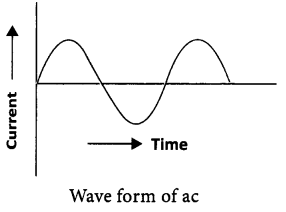
    • The alternating current varies sinusoidally with time. This variation is characterised by a term called as frequency.
    • Frequency is the number of complete cycle of variation, gone through by the ac in
      one second. s
    • In ac, the electrons do not flow in one direction because the potential of the terminals vary between high and low alternately.
    • Thus, the electrons move to and fro in the wire carrying alternating current. It is diagrammatically represented in Figure
    •  
Image

Need a full question paper?

Generate a complete, print-ready paper with questions like this in minutes — across 16+ boards, with answer keys.

Start Generating Free

Similar questions

What are the types of honey bees found in a colony?
Complete the following table.
Atomic Number Mass Number Number of Neutrons Number of Protons Number of Electrons Name of the Element
9 ______ 10 ______ ______ ______
16 ______ 16 ______ ______ ______
______ 24  ______ ______ 12 Magnesium
______ 2 ______ 1 ______  ______
______ 1 0 1 1 ______
Formula Name of the ion
1)H_(3)O^(+)-?
2)?-Acetate ion ?
3)PO_(4)^(3-)-?
4)?-Sulphate ion
5)NO_(3)^(-)-?
Exercise Problems.

An athlete completes one round of a circular track of diameter 200 m in 40 s. What will be the distance covered and the displacement at the end of 2 m and 20 s?

Briefly note the harmful effects of any four plastics.
The Earth’s distance from the Sun is 149.6 × 10⁶km and the period of Earth’s revolution is 1 year. Calculate the ratio of the squares of the periods to cubes of the major axis.
Higher Order Thinking Skill.

Imagine that student A studied the importance of certain factors in photosynthesis. He took a potted plant and kept it in dark for 24 hours. In the early hours of the next morning, he covered one of the leaves with dark paper in the centre only. Then he placed the plant in sunlight for a few hours and tested the leaf which was covered with black paper for starch.
  1. What aspect of photosynthesis was being investigated? 
  2. Why was the plant kept in the dark before the experiment? 
  3. How will you prove that starch is present in the leaves?
  4. Name the raw materials needed for photosynthesis.
The mean distance of Earth from the Sun is $149.6 \times 10^6 km$ and the mean distance of mercury from the sun is $57.9 \times 10^6 km$. The period of Earth's revolution is 1 year. What is the period of Mercury's revolution?
Differentiate graphite and diamond
List the applications of Nanochemistry.