Question
Write a note on elimination reaction.
###
Explain dehydrohalogenation reaction.
Answer

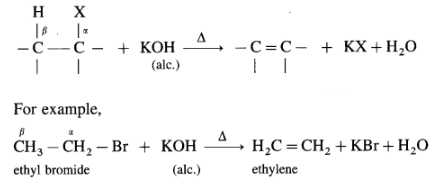
When alkyl halide having at least one $\beta$-hydrogen is boiled with alcoholic solution of potassium hydroxide ( $KOH$ ), an alkene is formed due to elimination of hydrogen atom from $\beta$-carbon and halogen atom from $\alpha$-carbon, is called dehydrohalogenation.
Image
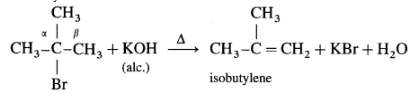
Tertiary butyl bromide when heated with alcoholic solution of potassium hydroxide forms isobutylene.
Image
This reaction is called $\beta$-elimination (or 1,2-elimination) reaction as it involves elimination of halogen and a $\beta$-hydrogen atom.
As hydrogen and halogen is removed in this reaction it is also known as dehydrohalogenation reaction.

Need a full question paper?

Generate a complete, print-ready paper with questions like this in minutes — across 16+ boards, with answer keys.

Start Generating Free

Similar questions

Calculate $\text{C-Cl}$ bond enthalpy from the following data :
$\ce{CH_3Cl_{( g )} + Cl_{2( g )} \rightarrow CH_2 Cl _{2( g )}+ HCl _{( g )}\Delta H^0=-104\ kJ}$
Bond $\text{C - H}$ $\text{C - H}$ $\text{C - H}$
$\ce{\Delta H^0 / KJ\ mol ^{-1}}$ $414$ $243$ $431$
Although $\triangle S$ for the formation of two moles of water from $H_2$​​​​​​​ and $O_2​​​​​​​$​​​​​​​ is $-327 JK^{-1}​​​​​​​$​​​​​​​, it is spontaneous. Explain. (Given ∆H for the reaction is $-572\  kJ$).
The osmotic pressure of $CaCl_2$​​​​​​​ and urea solutions of the same concentration at the same temperature are respectively $0.605$ atm and $0.245$ atm. Calculate van’t Hoff factor for $CaCl_2​​​​​​​$​​​​​​​.
Classify the following amines as simple/mixed; $1^\circ , 2^\circ , 3^\circ $ and aliphatic or aromatic.
$(C_2H_5)_2NH, (CH_3)_3N, C_2H_5 – NH – CH_3,$

Image
The solubility of o-nitrophenol and p-nitrophenol is $0.2\ g$ and $1.7\ g/100\ g$ of $H_2O$ respectively. Explain the difference.
Give common name and JUPAC name for the I11owing ethers :
What are the applications of electrochemical series (or electromotive series) ?
Calculate $\wedge_0\left( CH _2 ClCOOH \right)$ if $\wedge_0$ values for $HCl , KCl$ and $CH _2 ClCOOK$ are respectively, $4.261,1.499$ and $1.132 \Omega^{-1} m^2$ $mol ^{-1}$.
Describe the construction and working of the standard hydrogen electrode (S.H.E.). Give its advantages and disadvantages.
###
What is the standard hydrogen electrode
###
Primary reference electrode? Write the construction and working of it.
Explain dehydration of alcohols.
###
What is dehydration of alcohols? Give the chemical reactions showing dehydration of primary $\left(1^{\circ}\right)$, secondary $\left(2^{\circ}\right)$ and tertiary $\left(3^{\circ}\right)$ alcohols.