Gujarat BoardEnglish MediumSTD 12 SciencePhysicsELECTROSTATIC POTENTIAL AND CAPACITANCE2 Marks
Question
Write a note on equipotential surface.
✓
Answer
"An imaginery surface, any surface that have same electric potential at every point on it is called equipotential surface."
→Electric potential at distance $r$ from a point charge $q$, $\begin{array}{l} V =\frac{1}{4 \pi \varepsilon_0} \cdot \frac{q}{r} \quad \text { If } r \text { is constant then } \\ V =\text { const. also } \\ \end{array}$
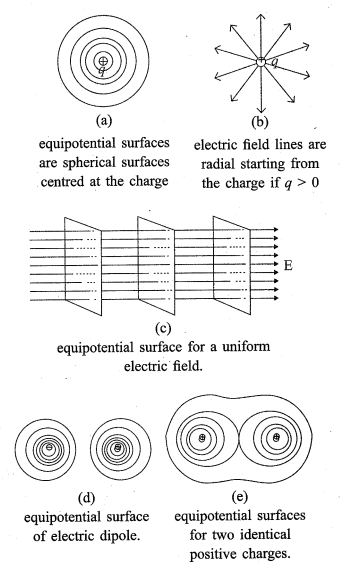
→Hence, equipotential surface for a point charge $q$ are different spheres having charge $q$ at centre, and having different radii. (Fig. a) →For such two different equipotential surfaces, potential will be different but potential for all points on any one equipotential surface will be same. →Electric field lines for a point charge are radial lines starting (originating) from the charge and ending at infinity. (or in negative charge.) So we can say that electric field lines are perpendicular to equipotential surface. →If the electric field is not perpendicular to the equipotential surface then there will be a component of $\overrightarrow{ E }$ (electric field) parallel to the surface. Which shows work needs to be done in moving the unit test charge against this component of electric field, which is against the definition of equipotential surface. →Electric potential difference between any two points on the equipotential surface is zero. $( V =$ 0 ) so, no work is required to be done in moving test charge on the surface. →Hence electric field at each point on the equipotential surface must be perpendicular to the surface. →Equipotential surfaces for uniform electric field are shown in fig. C . →If the field is along X-direction, equipotential surface must be parallel to YZ - plane.
Need a full question paper?
Generate a complete, print-ready paper with questions like this in minutes — across 16+ boards, with answer keys.