Question
Write a note on esterification of alcohols and phenols.
Answer

$\rightarrow $ Alcohols and phenols react with carboxylic acids, acid chlorides and acid anhydrides to form esters.
$Ar / RO - H + R ^{\prime}- COOH \stackrel{ H ^{+}}{\rightleftharpoons} Ar / ROCOR ^{\prime}+ H _2 O$
$Ar / R - OH +\left( R ^{\prime} CO \right)_2 O \stackrel{ H ^{+}}{\rightleftharpoons} Ar / ROCOR '+ R ^{\prime} COOH$
$R / ArOH + R ^{\prime} COCl \xrightarrow{\text { Pyridine }} R / ArOCOR ' + HCl$
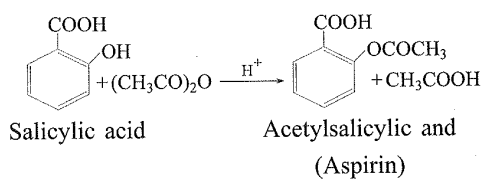
$\rightarrow $ The reaction with carboxylic acid and acid anhydride is carried out in the presence of a small amount of concentrated sulphuric acid. The reaction is reversible, and therefore, water is removed as soon as it is formed. The reaction with acid chloride is carried out in the presence of a base $($pyridine$)$ so as to neutralise $HCl$ which is formed during the reaction. It shifts the equilibrium to the right hand side. The introduction of acetyl $(CH_3CO)$ group in alcohols or phenols is known as acetylation. Acetylation of salicylic acid produces aspirin.
Image

Need a full question paper?

Generate a complete, print-ready paper with questions like this in minutes — across 16+ boards, with answer keys.
Start Generating Free

Similar questions

Complete the following reactions $:$
  1. $\text{C}_6\text{H}_5-\text{COO}^-\text{NH}^+_4\xrightarrow{\text{ }\text{ }\text{ }\text{ }\text{ }\text{ }\text{ }\text{ }\triangle\text{ }\text{ }\text{ }\text{ }\text{ }\text{ }\text{ }\text{ }\text{ }}\text{A}\xrightarrow{\text{ }\text{ }\text{ }\text{ }\text{Br}_2/\text{KOH}\text{ }\text{ }\text{ }\text{ }}\text{B}\xrightarrow{\text{ }\text{ }\text{ }\text{ }\text{CH}_3\text{COC}l_3/\text{pyridine}\text{ }\text{ }\text{ }\text{ }}\text{C}$
  2. $\text{C}_6\text{H}_5\text{N}^+_2\text{BF}^-_4\xrightarrow[\triangle]{\text{ }\text{ }\text{ }\text{ }\text{ }\text{ }\text{ }\text{ }\text{NaNO}_2/\text{Cu}\text{ }\text{ }\text{ }\text{ }\text{ }\text{ }\text{ }\text{ }\text{ }}\text{A}\xrightarrow{\text{ }\text{ }\text{ }\text{ }\text{Sn}/\text{HC}l\text{ }\text{ }\text{ }\text{ }}\text{B}\xrightarrow[\triangle]{\text{ }\text{ }\text{ }\text{ }\text{CHC}l_3+\text{alc. KOH}\text{ }\text{ }\text{ }\text{ }}\text{C}$
Observe the graph in diagram and answer the following questions.
  1. If slope is equal to $-2.0 \times 10^{-6} \sec^{-1} ,$ what will be the value of rate constant?
  2. How does the half$-$life of zero order reaction relate to its rate constant?
  1. What type of isomerism is shown by $\ce{[Co(NH_3)_5ONO]Cl_2}$?
  2. On the basis of crystal field theory, write the electronic configuration for $d^{4 }$ ion if $\Delta _o< P.$
  3. Write the hybridization and shape of $\ce{[Fe(CN)_6]^{_{3-}}}.$
$($Atomic number of $\ce{Fe = 26)}$
Match the items of column $I$ with items of column $II.$
 
Column $I$
 
Column $II$
$(i)$
Methanol
$(a)$
Conversion of phenol to $o-$hydroxysalicylic acid
$(ii)$
Kolbe’s reaction
$(b)$
Ethyl alcohol
$(iii)$
Williamson’s synthesis
$(c)$ Conversion of phenol to salicylaldehyde
$(iv)$ Conversion of $2^\circ$ alcohol to ketone $(d)$ Wood spirit
$(v)$ Reimer$-$Tiemann reaction $(e)$ Heated copper at $573K$
$(vi)$ Fermentation $(f)$ Reaction of alkyl halide with sodium alkoxide
What is the standard electrode potential? Explain it details.
  1. For the complex $\ce{[Fe(CN)_6]^{3–}},$ write the hybridization type, magnetic character and spin nature of the complex.
  1. $($At. number: $Fe=26).$
  2. Draw one of the geometrical isomers of the complex $\ce{[Pt(en)_2Cl_2]^{2+}}$ which is optically active.
  1. Write the $\text{IUPAC}$ name of the complex $\ce{[Cr(NH_3)_4 Cl_2]Cl}.$
  2. What type of isomerism is exhibited by the complex $\ce{[Co(en)_3]^{3+}}$?
$($en $=$ ethane $-1,2-$ diamine$)$
  1. Why is $\ce{[NiCl_4]^{2–}}$ paramagnetic but $\ce{[Ni(CO)_4]}$ is diamagnetic?
$($At. nos.: $Cr= 24, Co=27, Ni= 28)$
The rate constant for the decomposition of hydrocarbons is $2.418 \times 10^{–5}s^{–1}$ at $546 K$. If the energy of activation is $179.9\  kJ/mol,$ what will be the value of pre$-$exponential factor.
Identify the compounds A, B and C in the following reaction:
$\text{CH}_3-\text{Be}\ \xrightarrow{\ \ \text{Mg/ Ether}}\ \text{(A)}\ \xrightarrow[\text{(ii)}\text{Water}]{\ \ \text{CO}_2}\ \text{(B)}\ \xrightarrow[\triangle]{\ \ \text{CH}_3\text{OH}/\text{H}^+}\ \text{(C)}$
If the price of electricity require to obtain $1$ gram $M g$ from the solution of $M g ^{ 2 + }$ ion is $Rs.5 . 0 0$, then what will the price of electricity required to obtain $10$ gram of $Al$ from $Al ^{3+} ? \ ($Atomic mass of $Al = 27$ and $M g =24)$