Question
Write a note on halogenation of phenol.

Answer

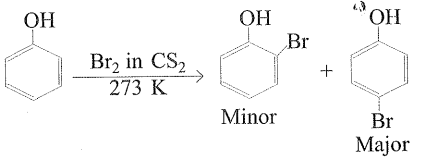
$\rightarrow$ Halogenation: On treating phenol with bromine, different reaction products are formed under different experimental conditions.
$(a)$ When the reaction is carried out in solvents of low polarity such as $CHCl_3$ or $CS_2$ and at low temperature, monobromophenols are formed.
Image
$\rightarrow$ The usual halogenation of benzene takes place in the presence of a Lewis acid, such as $FeBr^3, $ which polarises the halogen molecule. In case of phenol, the polarization of bromine molecule takes place even in the absence of Lewis acid. It is due to the highly activating effect of $-OH$ group attached to the benzene ring.
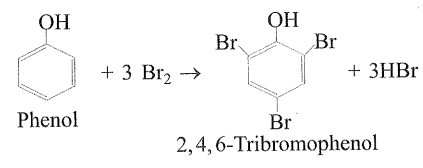
$(b)$ When phenol is treated with bromine water, $2, 4, 6-$tribromophenol is formed as white precipitate.
Image

Need a full question paper?

Generate a complete, print-ready paper with questions like this in minutes — across 16+ boards, with answer keys.
Start Generating Free

Similar questions

The Fischer projection of D-Glucose is given alongside. What happens when L-Glucose is treated with Tollens’ reagent?
Following reaction takes place in one step:
$\text{2NO(g)+O}_2\text{(g)}\rightarrow\text{2NO}_2\text{(g)}$
How will the rate of the above reaction change if the volume of the reaction vessel is reduced to one-third of its original volume? Will there be any change in the order of the reaction with reduced volume?
List various types of isomerism possible for coordination compounds, giving an example of each.
Give primary information about carbohydrate compounds?
Explain the role of the following:
  1. $NaCN$ in the separation of $ZnS$ and $PbS$
  2. $SiO_2$ in the metallurgy of $Cu$ containing Fe as impurity.
  3. Iodine in the refining of $Ti.$
Give reasons for the following:
  1. Transition metals form alloys.
  2. $Mn_2O_3$ is basic whereas $Mn_2O_7$ is acidic.
  3. $Eu^{2+}$ is a strong reducing agent.
Calculate the following:
  1. Number of $ZnS$ units in a unit cell of $ZnS.$
  2. Number of $CaF_2$ units in a unit cell of $CaF_2.$
(A), (B) and (C) are three non-cyclic functional isomers of a carbonyl compound with molecular formula $C_4H_8O$. Isomers (A) and (C) give positive Tollens’ test whereas isomer (B) does not give Tollens’ test but gives positive Iodoform test. Isomers (A) and (B) on reduction with Zn(Hg)/ conc. HCl give the same product (D).
  1. Write the structures of (A), (B), (C) and (D).
  2. Out of (A), (B) and (C) isomers, which one is least reactive towards addition of HCN?
How the following conversions can be carried out?
Ethanol to But-2-yne.
  1. What type of semiconductor is obtained when silicon is doped with boron?
  2. What type of magnetism is shown in the following alignment of magnetic moments?
  1. What type of point defect is produced when $AgCl$ is doped with $CdCl_2?$