Question
Write a note on halogenation of phenol.

Answer

$\rightarrow$ Halogenation: On treating phenol with bromine, different reaction products are formed under different experimental conditions.
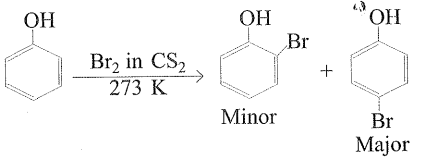
$(a)$ When the reaction is carried out in solvents of low polarity such as $CHCl_3$ or $CS_2$ and at low temperature, monobromophenols are formed.
Image
$\rightarrow$ The usual halogenation of benzene takes place in the presence of a Lewis acid, such as $FeBr^3,$ which polarises the halogen molecule. In case of phenol, the polarization of bromine molecule takes place even in the absence of Lewis acid. It is due to the highly activating effect of $-OH$ group attached to the benzene ring.

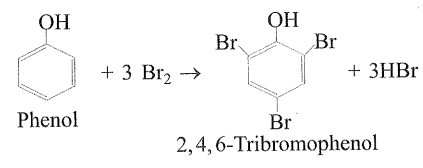
$(b)$ When phenol is treated with bromine water, $2, 4, 6-$tribromophenol is formed as white precipitate.
Image

Need a full question paper?

Generate a complete, print-ready paper with questions like this in minutes — across 16+ boards, with answer keys.
Start Generating Free

Similar questions

Give the structures of $A$ and $B$ in the following sequence of reactions:
  1. $\text{CH}_3\text{COOH}\xrightarrow[\Delta]{\text{NH}_3\ \ \ }\text{A}\ \ \ \xrightarrow{\text{NaOBr}}\text{B}$
  2. $\text{C}_6\text{H}_5\text{No}_2\xrightarrow{\text{Fe}/ \text{ HCl}}\text{A}\ \ \ \ \ \xrightarrow[0^\circ-5^\circ\text{C}]{\text{NaNo}_2+\text{HCl}}\text{B}$
  3. $\text{C}_6\text{H}_5\text{N}_2^+\text{Cl}^{-}\xrightarrow[\Delta]{\text{CuCN}}\text{A}\ \ \ \ \xrightarrow{\text{H}_2\text{O}/\text{ H}^+}\text{B}$
Calculate the e.m.f at $25^{\circ} c$ for the following cell:
$N i(s)\left|N i^{2+}(0.01 M) \| C u^{2+}(0.1 M)\right| C u(s)$
Given: $E ^0 Ni ^{+2} / Ni =-0.25 V$
$E_{C u^{2+} / C u}^0=+0.34 V$
$\left[1 F=96,500 Cmol ^{-1}\right]$. Calculate the maximum work that can be accomplished by the operation of this cell
  1. What type of isomerism is shown by the complex $\ce{[Co(en)_3]Cl_3}$?
  2. Write the hybridisation and magnetic character of $\ce{[Co(C_2O_4)_3]_3^–}$.
  1. $($At. no. of $Co = 27)$
  2. Write $\ce{IUPAC}$ name of the following Complex $\ce{[Cr(NH_3)_3Cl_3]}$
Write the mechanism of hydration of ethene to yield ethanol.
Write the equations of the reactions of forming primary amines by the following methods:
(a) Hydrolysis of alkyl isocyanide
(b) Reductive amination of carbonyl compounds
(c) Alkaline hydrolysis of alkyl isocyanate
Discuss the formation of amine compounds by reduction of nitrile and amide compounds.
What is lanthanoid contraction? What are the consequences of lanthanoid contraction?
Give the principle of the manufacture of nitric acid from ammonia?
Write down the electronic configuration of :
(a) $Cr ^{3+}$$\quad$(b) $Cu ^{+}$$\quad$(c) $Co ^{2+}$$\quad$(d) $M n ^{ 2 + }$
(e) $P m ^{ 3 + }$$\quad$(f) $Ce ^{ 4 +}$$\quad$(g) $Lu ^{2+}$$\quad$(h) $Th ^{4+}$.
The decomposition of $\ce{NH_3}$ on platinum surface $,\text{2NH}_{3}\text{(g)}\text{ }^{Pt}_\longrightarrow\text{N}_{2}\text{(g)}+\text{3H}_{2}\text{(g)}$ is a zero order reaction with $k=\text{2.5}\times\text{10}^{-4}\text{Ms}^{-1}$ . what are the rates of production of $N_2$ and $H_2?$