Question
Write a note on lichens.

Answer

Lichens occur in hostile habitats such as barren rocks, walls, tree trunks and icy regions where they can be seen as slow growing large coloured patches. They are a source of essences, dhup, havan samagri, some medicines and dyes.

Need a full question paper?

Generate a complete, print-ready paper with questions like this in minutes — across 16+ boards, with answer keys.
Start Generating Free

Similar questions

Briefly describe the structure and functions of cell wall.
A stone is thrown vertically upward with an initial velocity of $40m/ s$. Taking $g = 10m/ s^2$, find the maximum height reached by the stone. What is the net displacement and the total distance covered by the stone?
The formula of carbonate of a metal $M$ is $M_2CO_3.$
  1. What will be the formula of its iodide?
  2. What will be the formula of its nitride?
  3. What will be the formula of its phosphate?
What is chromatography? State its two applications.
Two stones are thrown vertically upwards simultaneously with their initial velocities u1 and u2 respectively. Prove that the heights reached by them would be in the ratio of $\text{u}_1^2:\text{u}_2^1$ (Assume upward acceleration is –g and downward acceleration to be +g).
A body vibrating with a time-period of $\frac{1}{256}\text{s}$ produces a sound wave which travels in air with a velocity of $350m/s.$ Calculate the wavelength.
A body travels a distance of 3km towards East, then 4km towards North and finally 9km towards East.
  1. What is the total distance travelled?
  2. What is the resultant displacement?
Give reasons for: We get a crunchy and granular feeling, when we chew pear fruit.
Copper sulphate reacts with sodium hydroxide to form a blue precipitate of copper hydroxide and sodium sulphate. In an experiment, $15.95\ g$ of copper sulphate reacted with $8.0\ g$ of sodium hydroxide to form $9.75\ g$ of copper hydroxide and $14.2\ g$ of sodium sulphate. Which law of chemical combination is illustrated by this data? Give reason for your choice.
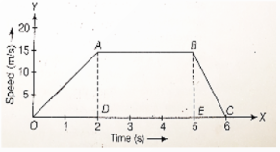
The speed-time graph of a car is given. The car weighs 1000 kg .
i. What is the distance travelled by car in the first 2 s ?
ii. What is the braking force applied at the end of 5 s to bring the car to stop within one second?
Image