Question
Write a note on plasmolysis.

Answer

When a living plant cell is placed in hypertonic solution, it loses water by osmosis and shrinks away from the cell wall. This process is known as plasmolysis and the plant cell is said to be plasmolysed.

Need a full question paper?

Generate a complete, print-ready paper with questions like this in minutes — across 16+ boards, with answer keys.

Start Generating Free

Similar questions

One of the forms of a naturally occurring solid compound $P$ is usually used for making the floors of houses. On adding a few drops of dilute hydrochloric acid to $P,$ brisk effervescence are produced. When $50g$ of reactant $P$ was heated strongly, than $22g$ of a gas $Q$ and $28g$ of a solid $R$ were produced as products. Gas $Q$ is the same which produced brisk effervescence on adding dilute $\text{HCl}$ to$ P.$ Gas $Q$ is said to cause global warming whereas solid $R$ is used for white$-$washing.
  1. What is $(i)$ solid $P (ii)$ gas $Q,$ and $(iii)$ solid $R.$
  2. What is the total mass of $Q$ and $R$ obtained from $50g$ of $P$?
  3. How does the total mass of $Q$ and $R$ formed compare with the mass of $P$ taken?
  4. What conclusion do you get from the comparison of masses of products and reactant?
  5. Which law of chemical combination is illustrated by the example given in this problem?
On a level road, a scooterist applies brakes to slow down from a speed of $10\ m/s$ to 5m/s. If the mass of the scooterist and the scooter be $150\ kg,$ calculate the work done by the brakes. $($Neglect air resistance and friction$)$
Give a brief account of cartilage.
How long will it take a force of $10N$ to stop a mass of $2.5\ kg$ which is moving at $20\ m/s?$
Draw a labelled diagram of the fractional distillation apparatus used for separating a mixture of alcohol and water.
What is crystallisation? How can this technique be used to purify impure copper sulphate?
Unicellular organisms differ from multicellular ones. How?
The following data was obtained for a body of mass $1\ kg$ dropped from a height of $5$ metres:
 
Distance above ground
Velocity
$i.$ $5m$ $0m/s$
$ii.$ $3.2m$ $6m/s$
$iii.$ $0m$ $10m/s$
Show by calculations that the above data verifies the law of conservation of energy $($Neglect air resistance$). (g = 10m/s^2).$

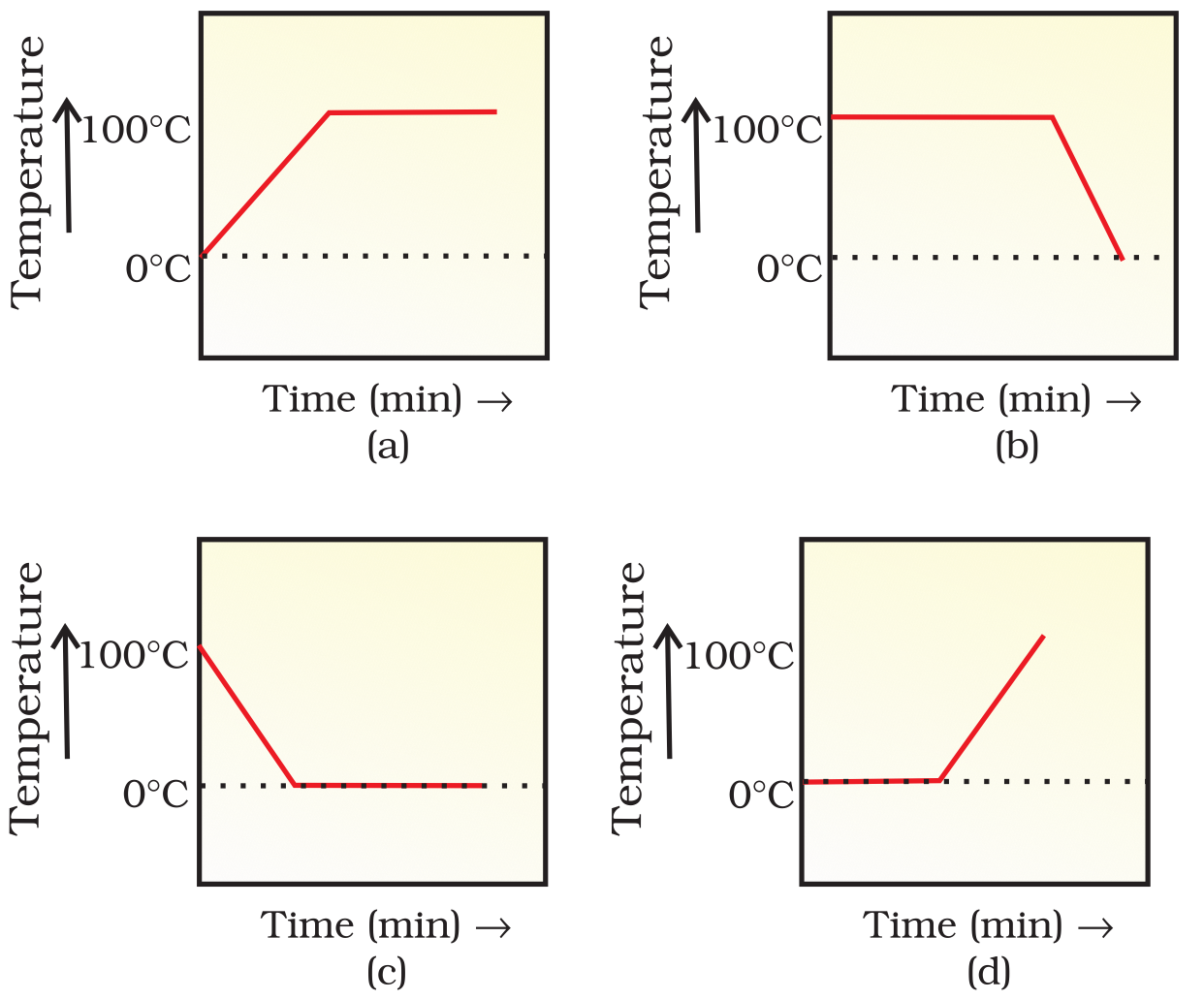
A student heats a beaker containing ice and water. He measures the temperature of the content of the beaker as a function of time. Which of the following would correctly represent the result? Justify your choice.
The mass of one atom of an element $X$ is $2.0 \times 10^{-23}g.$
  1. Calculate the atomic mass of element $X.$
  2. What could element $X$ be$?$
​​​​​​​