Question
Write a note on plasmolysis.

Answer

When a living plant cell is placed in hypertonic solution, it loses water by osmosis and shrinks away from the cell wall. This process is known as plasmolysis and the plant cell is said to be plasmolysed.

Need a full question paper?

Generate a complete, print-ready paper with questions like this in minutes — across 16+ boards, with answer keys.

Start Generating Free

Similar questions

When extremely small particles $X$ derived from the another of a flower were suspended in a liquid $Y$ and observed through a microscope, it was found that the particles $X$ were moving throughout the liquid $Y$ in a very zig zag way. It was also observed that warmer the liquid $Y,$ faster the particles $X$ moved in its surface.
  1. What could particles $X$ be$?$
  2. What do you think liquid $Y$ is$?$
  3. What is the zig-zag movement of particles $X?$
  4. What is causing the zig-zag movement of particles $X?$
  5. Name the scientist who discovered this phenomenon.
  6. What does this experiment tell us about the nature of liquid $Y?$
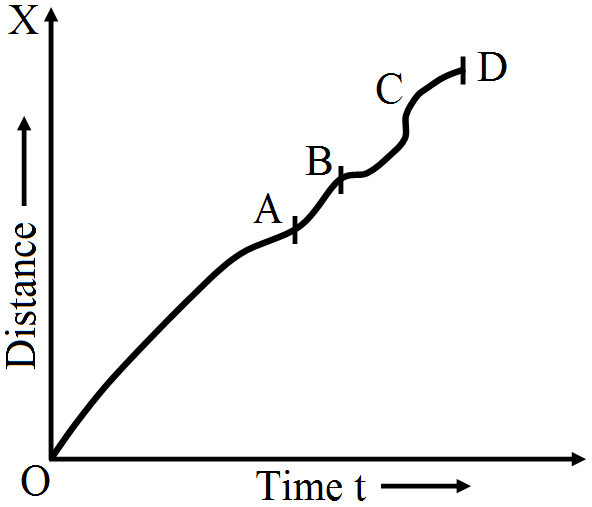
The figure shows an x-t graph of a particle moving along a straight line. What is the sign of the acceleration during the intervals OA, AB, BC, and CD?


When compared to an acute disease patient, a chronic disease patient recovers after a longtime. Is it true? Give one reason.
Mention differences between light microscope and electron microscope.
Define the soil? Give its composition and functions.
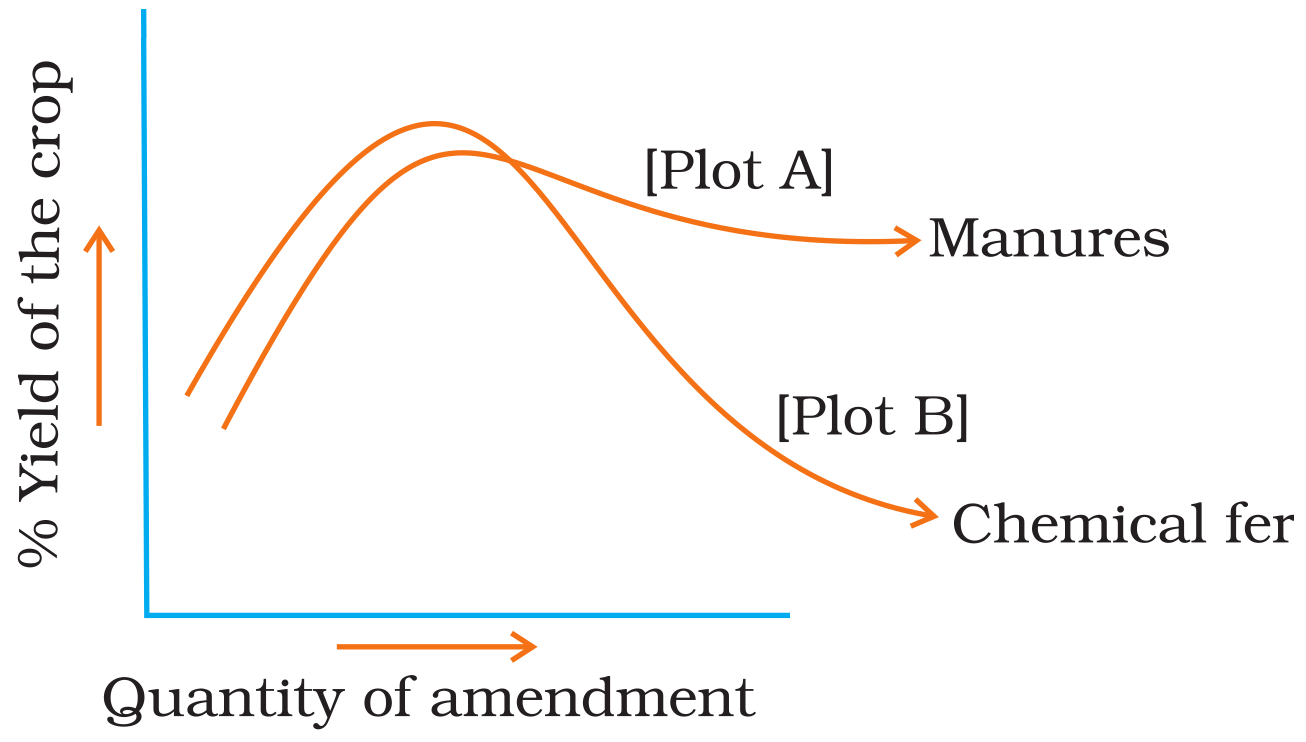
Figure shows the two crop fields $[$Plots $A$ and $B]$ have been treated by manures and chemical fertilizers respectively, keeping other environmental factors same. Observe the graph and answer the following questions.
  1. Why does plot $B$ show sudden increase and then gradual decrease in yield$?$
  2. Why is the highest peak in plot $A$ graph slightly delayed$?$
  3. What is the reason for the different pattern of the two graphs$?$
Write the main function of each of the following.
(a) Plasma membrane
(b) cell wall
(c) Ribosome
(d) Lysosome
(e) Nucleolus
(f) Endoplasmic reticulum
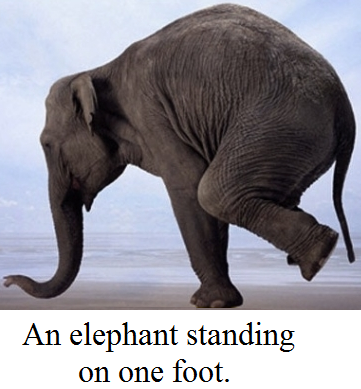
An elephant weighing $40,000\ N$ stands on one foot of area $1000\ cm^2$ whereas a girl weighing $400\ N$ is standing on one ‘stiletto’ heel of area $1\ cm^2.$

  1. Which of the two, elephant or girl, exerts a larger force on the ground and by how much?
  2. What pressure is exerted on the ground by the elephant standing on one foot?
  3. What pressure is exerted on the ground by the girl standing on one heel?
  4. Which of the two exerts larger pressure on the ground: elephant or girl?
  5. What is the ratio of pressure exerted by the girl to the pressure exerted by the elephant?
A bullet of mass $15g$ has a speed of $400m/s$. What is its kinetic energy? If the bullet strikes a thick target and is brought to rest in $2cm$, calculate the average net force acting on the bullet. What happens to the kinetic energy originally in the bullet?
How will you separate the components of a mixture containing two miscible liquids? Give experimental details.