Question
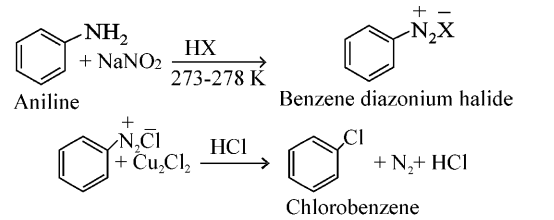
Write a note on Sandmeyer reaction.

Need a full question paper?

Generate a complete, print-ready paper with questions like this in minutes — across 16+ boards, with answer keys.

Start Generating Free

Similar questions

Henry’s law constant for CO2 in water is 1.67 x 10⁸ Pa at 298 K. Calculate the quantity of CO2 in 500 mL of soda water when packed under 2.5 atm CO2 pressure at 298 K.
The decomposition of NH3 on platinum surface,$\text{2NH}_{3}\text{(g)}\text{ }^{Pt}_\rightarrow\text{N}_{2}\text{(g)}+\text{3H}_{2}\text{(g)}$ is a zero order reaction with k$=\text{2.5}\times\text{10}^{-4}\text{Ms}^{-1}$ . what are the rates of production of N2 and H 2?
Vinyl chloride is hydrolysed more slowly than ethyl chloride.
For the complex [NiCI4]2-, write

  1. The IUPAC name.
  2. The hybridization type.
  3. The shape of the complex.

(Atomic no. of Ni = 28)

The following data were obtained during the first order thermal decomposition of SO2Cl2 at a constant volume:
SO2Cl2(g)$\rightarrow$SO2(g) + Cl2(g)
Experiment
Time/s-1
Total pressure/atm
1
2
0
100
0.4
0.7
Calculate the rate constant.
(Given: log4 = 0.6021, log2 = 0.3010)
Explain the following in one or two sentences:
Allyl chloride is hydrolysed more readily than n-propyl chloride.
CCl4 and water are immiscible whereas ethanol and water are miscible in all proportions. Correlate this behaviour with molecular structure of these compounds.CCl4 is a non-polar covalent compound, whereas water is a polar compound. CCl4 can neither form hydrogen bonds with water molecules nor can it break hydrogen bonds between water molecule, therefore, it is insoluble in water. Ethanol is a polar compound and can form hydrogen bonds with water, which is a polar solvent, therefore it is miscible with water in all proportions.
The rate constant for the decomposition of ethyl iodide
C2H5l(g) → C2H4(g)+Hl(g)
at 600K is 1.60 × 10⁻⁵ s-1 . Its energy of activation is 209kJ/mol. Calculate the rate constant of the reaction at 700K.
How is the concept of coupling reactions useful in explaining the occurrence of non spontaneous thermochemical reactions? Explain giving an example.
Explain with chemical reactions, the reaction of carboxylic acids with ammonia.