The protective tissue or the outermost covering of cells in plants is known as the epidermis, which performs protective function (protecting plants from adverse conditions). It is usually made up of a single layer of cells. In dry habitats, epidermis gets thicker to protect the plant from undue loss of water.
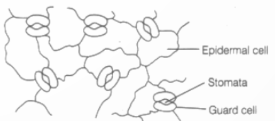
On aerial parts of the plant, epidermal cells often secrete a waxy, water-resistant layer on their outer surface. This waxy covering aids in protecting the plant against loss of water, mechanical injury and invasion by parasitic fungi. The cells of epidermal tissue are present in a continuous layer without intercellular spaces.Small pores are present on the epidermis of the leaf. These pores are called stomata. They are enclosed by two kidney-shaped cells called guard cells. They help in gaseous exchange and transpiration.
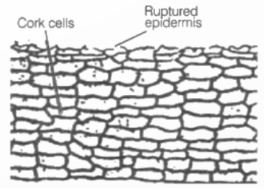
As the plant grows older, a strip of secondary meristem replaces the epidermis of the stem. This forms several layers thick cork or bark of the tree in which cells are dead and compactly arranged without intercellular spaces.