Tamilnadu BoardEnglish MediumSTD 12ChemistryMetallurgy5 Marks
Question
Write a note on thermodynamic principle of metallurgy.
✓
Answer
Thermodynamic principle of metallurgy:
The extraction of metals from their oxides can be carried out by using different reducing agents.
For example, consider the reduction of a metal
oxide $M _{ x } O _{ y }$.
$
\frac{2}{y} M _{ x } O _{ y }( s ) \rightarrow \frac{2 x}{y} M ( s )+ O _2( g ) .........(1)
$
The above reduction may be carried out with carbon. In this case, the reducing agent carbon may be oxidised to either $CO$ or $CO _2$.
- $C + O _2 \rightarrow CO _{2( g )}$ ..........(2)
- $2 C + O _2 \rightarrow 2 CO _{( g )}$ .......(3)
If carbon monoxide is used as a reducing agent, it is oxidised to $CO _2$ as follows,
$
2 CO + O _2 \rightarrow 2 CO _{2( g )} .......(4)
$
A suitable reducing agent is selected based on the thermodynamic considerations. We know that for a spontaneous reaction, the change in free energy (AG) should be negative. Therefore, thermodynamically, the reduction of metal oxide [equation (1)] with a given reducing agent [Equation (2), (3) or (4)] can occur if the free energy change for the coupled reaction. [Equations (1) \& (2), (1) \& (3) or (1) \& (4)] is negative. Hence, the reducing agent is selected in such a way that it provides a large negative AG value for the coupled reaction.
Ellingham diagram:
The change in Gibbs free energy $(\Delta G)$ for a reaction is given by the expression.
$
\Delta G =\Delta H - T \Delta S \text { }........ (1)
$
where, $\Delta H$ is the enthalpy change, $T$ the temperature in kelvin and $\Delta S$ the entropy change. For an equilibrium process, $\Delta G^{\circ}$ can be calculated using the equilibrium constant by the following expression $\Delta G^{\circ}=-R T \operatorname{lnKp}$
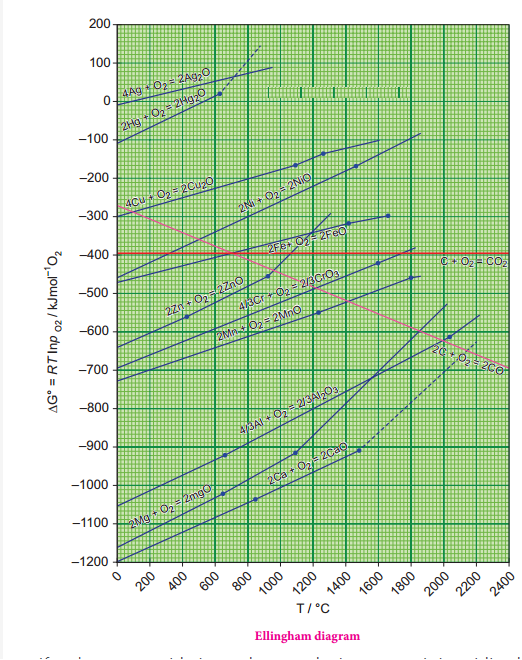
Harold Ellingham used the above relationship to calculate the $\Delta G^{\circ}$ values at various temperatures for the reduction of metal oxides by treating the reduction as an equilibrium process. He has drawn a plot by considering the temperature in the $x$-axis and the standard free energy change for the formation of metal oxide in $y$-axis. The resultant plot is a straight line with $\Delta S$ as slope and $\Delta H$ as $y$-intercept. The graphical representation of variation of the standard Gibbs free energy of reaction for the formation of various metal oxides with temperature is called Ellingham diagram.Thermodynamic principle of metallurgy:
The extraction of metals from their oxides can be carried out by using different reducing agents.
For example, consider the reduction of a metal
oxide $M _{ x } O _{ y }$.
$
\frac{2}{y} M _{ x } O _{ y }( s ) \rightarrow \frac{2 x}{y} M ( s )+ O _2( g ) .........(1)
$
The above reduction may be carried out with carbon. In this case, the reducing agent carbon may be oxidised to either $CO$ or $CO _2$.
- $C + O _2 \rightarrow CO _{2( g )}$ ..........(2)
- $2 C + O _2 \rightarrow 2 CO _{( g )}$ .......(3)
If carbon monoxide is used as a reducing agent, it is oxidised to $CO _2$ as follows,
$
2 CO + O _2 \rightarrow 2 CO _{2( g )} .......(4)
$
A suitable reducing agent is selected based on the thermodynamic considerations. We know that for a spontaneous reaction, the change in free energy (AG) should be negative. Therefore, thermodynamically, the reduction of metal oxide [equation (1)] with a given reducing agent [Equation (2), (3) or (4)] can occur if the free energy change for the coupled reaction. [Equations (1) \& (2), (1) \& (3) or (1) \& (4)] is negative. Hence, the reducing agent is selected in such a way that it provides a large negative AG value for the coupled reaction.
Ellingham diagram:
The change in Gibbs free energy $(\Delta G)$ for a reaction is given by the expression.
$
\Delta G =\Delta H - T \Delta S \text { }........ (1)
$
where, $\Delta H$ is the enthalpy change, $T$ the temperature in kelvin and $\Delta S$ the entropy change. For an equilibrium process, $\Delta G^{\circ}$ can be calculated using the equilibrium constant by the following expression $\Delta G^{\circ}=-R T \operatorname{lnKp}$
Harold Ellingham used the above relationship to calculate the $\Delta G^{\circ}$ values at various temperatures for the reduction of metal oxides by treating the reduction as an equilibrium process. He has drawn a plot by considering the temperature in the $x$-axis and the standard free energy change for the formation of metal oxide in $y$-axis. The resultant plot is a straight line with $\Delta S$ as slope and $\Delta H$ as $y$-intercept. The graphical representation of variation of the standard Gibbs free energy of reaction for the formation of various metal oxides with temperature is called Ellingham diagram.
Need a full question paper?
Generate a complete, print-ready paper with questions like this in minutes — across 16+ boards, with answer keys.