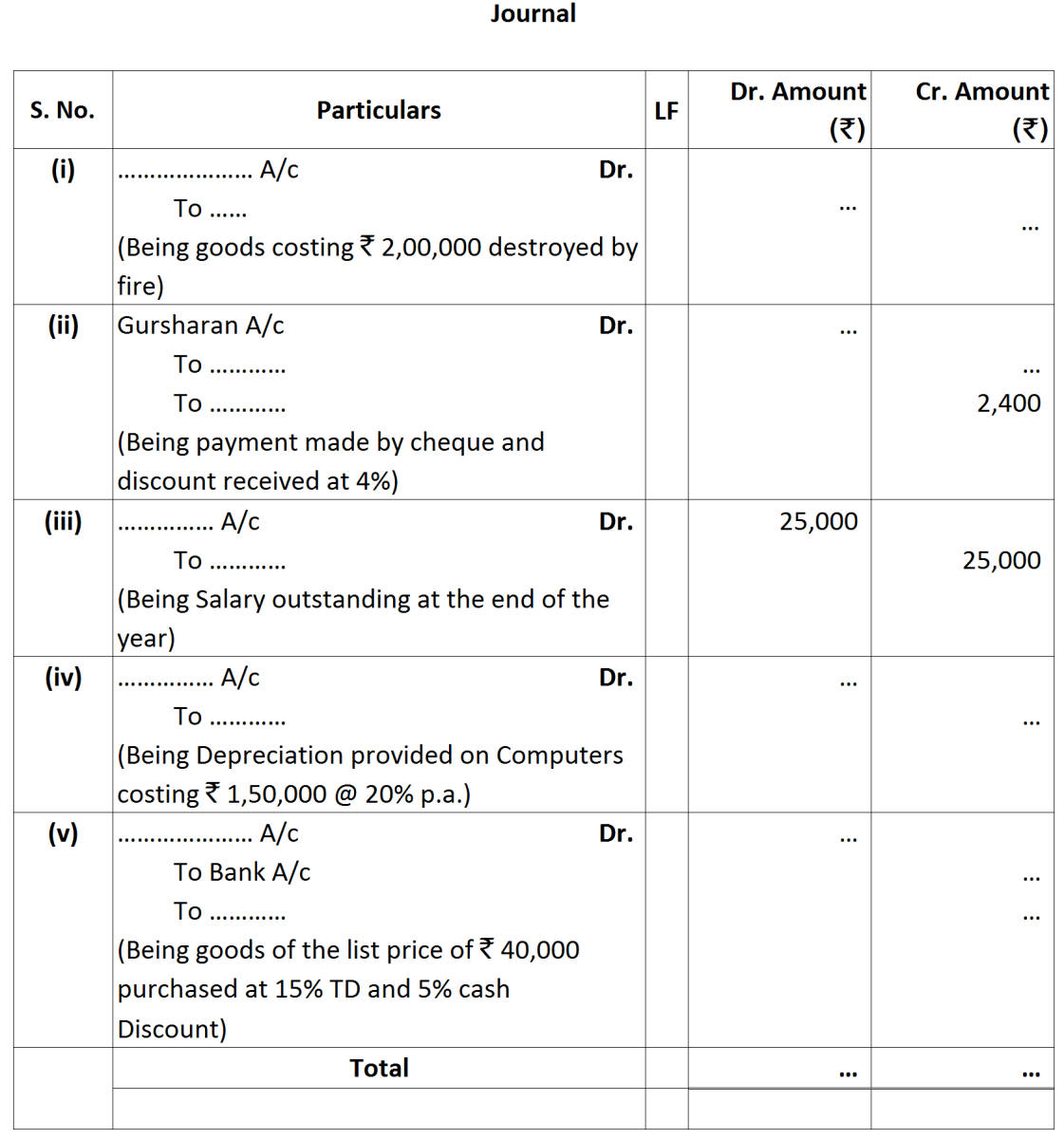
Question
Write a note on types of assets with one example of each.

Answer

Assets can be classified into (i) Non-current Assets, (ii) Current Assets, and (iii) Fictitious Assets:
  1. Non-current Assets: Non-current Assets are those assets which are held by an entity or enterprise not with the purpose to resell but are held either as investment or to facilitate business operations. In other words, those assets are held by the business from a long-term point of view. Examples of non-current assets are Fixed assets, non-current Investments, Long-term Loans and Advances and Other Non-current Assets.
Fixed Assets: Fixed assets are those non-current assets of an enterprise which are held not to resell but with the purpose to increase its earning capacity. Fixed assets are further classified into:
  1. Tangible Assets: Tangible Assets are those assets which have physical existence, i.e., they can be seen and touched. Examples of tangible assets are land, building, machinery, computer, furniture, etc.
  2. Intangible Assets: Intangible Assets are those assets which do not have physical existence, i.e., they cannot be seen and touched. Examples of intangible assets are patents, goodwill, trademarks, Computer Software, etc.
  1. Current Assets: Current Assets are those assets which are held by an entity or enterprise with the purpose of converting them into cash within a short period, i.e., one year. For example, goods are purchased with a purpose to resell and earn profit, debtors exist to convert them into cash, i.e., receive the amount from them, bills receivable exist again for receiving cash against it, etc.
  2. Fictitious Assets: Fictitious Assets are those assets which are neither tangible assets nor intangible assets. They are losses not written off in the year in which they are incurred but in more than one accounting period.

Need a full question paper?

Generate a complete, print-ready paper with questions like this in minutes — across 16+ boards, with answer keys.

Start Generating Free

Similar questions

Pass Journal entries for the following transactions:
  1. Purchased Machinery for ₹ 20,000 and paid ₹ 200 for its carriage.
  2. Received a cheque fo ₹ 4,850 from X in full settlement of his account of ₹ 5,000. Cheque was immediately deposited into bank.
  3. Received by cheque a first and final payment of 60 paise in a ₹ from Y who owed us ₹ 10,000.
  4. Sold goods to Z for ₹ 10,000 at a trade discount of 20%. Next day a cheque was received from him after deducting 5% cash discount. Cheque was immediately deposited into Bank.
  5. Goods costing ₹ 20,000 sold to Manoj at a profit of 20% on cost less 10% trade discount.
Journalise the following transactions of Singh Enterprises, Delhi:
2018
 
June 1
Started business with cash
50,000
June 2
Deposited cheque from Savings Account in firm's account
2,00,000
June 3
Received cash from Ram
50,000
June 4
Purchased goods for cash
15,000
June 11
Sold goods to M/s. Hari Sales, Delhi
12,000
June 13
Paid to Ramavtar
40,000
June 17
Received from M/s. Hari Sales
10,000
June 20
Bought furniture from S.R. Furnishers against Cash
22,400
June 27
Paid rent
28,000
June 30
Paid salary
50,000
Show the accounting equation on the basis of the following transactions and also show the Balance Sheet:
  1. Started business with Cash ₹ 60,000 and Goods ₹ 30,000.
  2. Purchased goods for Cash ₹ 40,000 and on Credit ₹ 25,000.
  3. Goods costing ₹ 48,000 sold at a profit of $33\frac{1}{3}\%.$ Three-fourth payment received in Cash.
  4. Goods costing ₹ 20,000 sold at a loss of 5%, out of which ₹ 12,000 received in Cash.
  5. Paid Rent ₹ 4,000 and Salary ₹ 6,000.
  6. Received Cash from Debtors ₹ 15,000.
  7. Paid telephone bill amounting to ₹ 800.
On March 31, 2017 the cash book showed a balance of ₹ 3,700 as cash at bank, but the bank passbook made up to same date showed that cheques for ₹ 700, ₹ 300 and ₹ 180 respectively had not presented for payment, Also, cheque amounting to ₹ 1,200 deposited into the account had not been credited. Prepare a bank reconciliation statement.
Fill in the missing information in the following journal entries:
Prepare the Vouchers:
2019
Particular
Jan-5
Received cash from Wahi & Co. on account vide cash receipt No. 551
10,000
Jan-10
Commission received vide cash receipt No. 520*
10,000
Jan-15
Sold leather purses for cash vide Cash Memo Nos. 307-310*
6,000
Jan-24
Sold two old machines vide Cash Memo No. 1560*
3,000
Transactions marked with * are subject to levy of CGST and SGST @ 6% each.
A Noida based Construction Company owns 5 cranes and the value of this asset in its books on April 01, 2017 is ₹ 40,00,000. On October 01, 2017 it sold one of its cranes whose value was ₹ 5,00,000 on April 01, 2017 at a 10% profit. On the same day it purchased 2 cranes for ₹ 4,50,000 each. Prepare cranes account. It closes the books on December 31 and provides for depreciation on 10% written down value.
There was a difference of ₹ 430 in a Trial Balance. It was placed on the Debit side of a Suspense A/c. Later on the following errors were discovered. Pass rectifying entries and prepare Suspense A/c.
  1. Purchases book was overcast by ₹ 100.
  2. Sales book was overcast by ₹ 1,000.
  3. Goods for ₹ 800 purchased from Umakant, though entered in the purchase book, has not been posted to his account.
  4. An amount of ₹ 500 has been posted to the credit side of commission account instead of ₹ 570.
  5. Goods sold to Bharti for ₹ 4,400 has been posted to her account as ₹ 4,000.
  6. Goods sold to X for ₹ 750 were recorded in purchase book.
On 1st Jan. 2012, Panjim Dryfruits Ltd. bought a plant for ₹ 15,00,000. The company writes off depreciation @ 20% p.a. on Written Down Value Method and closes its books on 31st March every year. On 1st Oct. 2014, a part of the plant purchased on 1st Jan. 2012 for ₹ 3,00,000 was sold for ₹ 1,75,000. On 1st Jan. 2015 a fresh plant was purchased for ₹ 5,00,000. Prepare Plant A/c, Provision for Dep. A/c and Plant Disposal A/c.
Following transactions of Ramesh for April, 2019 are given below. Journalise them.
2019
 
April 1
Ramesh started business with cash
1,00,000
April 2
Paid into bank
20,000
April 3
Bought goods for cash
50,000
April 4
Drew cash from bank for office use
10,000
April 13
Sold goods to Krishna
15,000
April 20
Bought goods from Shyam
22,500
April 22
Krishna returned goods
2,000
April 24
Received from Krishna
12,500
 
Allowed him discount
500
April 28
Paid cash to Shyam
21,500
 
Discount received
1,000
April 30
Cash sales for the month
80,000
April 30
Paid rent
5,000
April 30
Paid salary
10,000