Question
Write a notes on
  1. Sheet silicates
  2. Three dimensional silicate

Answer

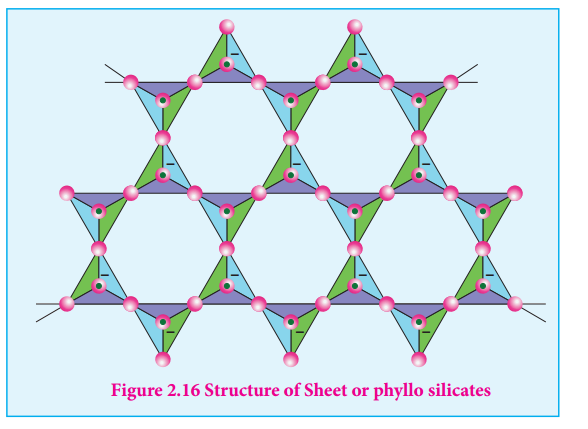
1. Sheet silicates:
Silicates which contain $\left( Si _2 O _5\right)_n^{2 n-}$ are called sheet or phyllo silicates. In these, Each $\left[ SiO _4\right]^{4-}$ tetrahedron unit shares three oxygen atoms with others and thus by forming twodimensional sheets. These sheets, silicates form layered structures in which silicate sheets are stacked over each other. The attractive forces between these layers are very week, hence they can be cleaved easily just like graphite.


Image
Example: Talc, Mica etc...
2. Three dimensional silicate:
Silicates in which all the oxygen atoms of $\left[ SiO _4\right]^{4-}$ tetrahedra are shared with other tetrahedra to form three-dimensional network are called three dimensional or tecto silicates. They have general formula $\left( SiO _2\right)_n$.
Examples:
Quartz. These tecto silicates can be converted into Three dimentional aluminosilicates by replacing $\left[\left[ SiO _4\right]^{4-}-\right.$ units by $\left[ AlO _4\right]^{5-}$ units. E.g. Feldspar, Zeolites etc.,

Need a full question paper?

Generate a complete, print-ready paper with questions like this in minutes — across 16+ boards, with answer keys.
Start Generating Free

Similar questions

An organic compound $( A )$ of molecular formula $CH _6$ reacts with $Br _2$ in the presence of $FeCl _3$ gives $( B )$ of formula $C _6 HBr$. B on treatment with mg in the presence of dry ether gives $( C )$ compound $( C )$ on treatment with dry ice followed by hydrolysis gives a compound (D) of molecular formula $C _7 H _6 O _2$. Identify $A, B, C, D$ and explain the reactions involved.
Explain optical isomerism in coordination compounds with an example.
An organic compound $(A)$ of molecular formula $C _2 H _3 OCl$ on reaction with pd and $BaSO _4$ gives (B) of formula $C _2 H _4 O$. (B) on reaction with $LiAlH _4$ gives (C) of formula $C _2 H _6 O$. (B) on reaction with 12 and NaOH gives ( D ) of formula $CH _2 ONa$ and iodoform. identify $A , B , CD$ and explain the reactions involved.
How would you measure the conductivity of ionic solutions?
What happens when nitrous acid react with
(i) Ethyl amine
(ii) Aniline
(iii) N – methyl aniline
(iv) Trimethyl amine
(v) N, N – dimethyl aniline
How are polymers classified on the basis of forces operating between their molecules? To which of these classes does nylon-6,6 belong?
An organic compound $(A)$ of molecular formula $C _4 H _{10} O$ gives no colouration in Victor Meyer's test. (A) on reaction with $P / I _2$ gives (B) of formula $C _4 H _9$ I. (B) on treatment with nitrous acid gives (C) of formula $C _3 H _9 NO _2$. (C) does not react with KOH . Identify $A , B , C$ and explain.
Write a brief note on the mechanism of enzyme catalysis.
Calculate the percentage efficiency of packing in the case of body centered cubic crystal.
Explain about the various protection methods to prevent corrosion.