Question
Write a program to create the list and ask user whether you want to delete an element if say yes then delete the element and print the new list else print the entered list.
Write a program to create the list and ask user whether you want to delete an element if say yes then delete the element and print the new list else print the entered list.
Get the step-by-step solution for this question inside the Vidyadip app.
Get the answer in the appGenerate a complete, print-ready paper with questions like this in minutes — across 16+ boards, with answer keys.
As a network consultant, you have to suggest the best network related solutions for their issues/problems raised in (a) to (d), keeping in mind the distances between various locations and other given parameters.
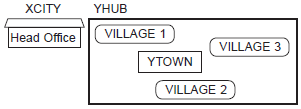
Shortest distance between various locations:
| VILLAGE 1 to YTOWN | 2 KM |
| VILLAGE 2 to YTOWN | 1.5 KM |
| VILLAGE 3 to YTOWN | 3 KM |
| VILLAGE 1 to VILLAGE 2 | 3.5 KM |
| VILLAGE 1 to VILLAGE 3 | 4.5 KM |
| VILLAGE 2 to VILLAGE 3 | 3.5 KM |
| CITY Head Office to YHUB | 30 KM |
Number of computers installed at various locations are as follows:
| YTOWN | 100 |
| VILLAGE 1 | 10 |
| VILLAGE 2 | 15 |
| VILLAGE 3 | 15 |
| CITY OFFICE | 5 |
Note:
• In Villages, there are community centers, in which one room has been given as training center to this organization to install computers.
• The organization has got financial support from the government and top IT companies.
(a) Suggest the most appropriate location of the SERVER in the YHUB (out of the 4 locations), to get the best and effective connectivity. Justify your answer.
(b) Suggest the best wired medium and draw the cable layout (location to location) to efficiently connect various locations within the YHUB.
(c) Which hardware device will you suggest to connect all the computers within each location of YHUB?
(d) Which service/protocol will be most helpful to conduct live interactions of Experts from Head Office and people at YHUB locations?
Write SQL queries for (i) to (iv) and find outputs for SQL queries (v) to (viii), which are based on the tables.
Table: VEHICLE
| Code | VTYPE | PERKM |
| 101 | VOLVO BUS | 160 |
| 102 | AC DELUXE BUS | 150 |
| 103 | ORDINARY BUS | 90 |
| 105 | SUV | 40 |
| 104 | CAR | 20 |
Note:
•PERKM is Freight Charges per kilometer
•VTYPE is Vehicle Type
| NO | NAME | TDATE | KM | CODE | NOP |
| 101 | Janish Kin | 2015-11-13 | 200 | 101 | 32 |
| 103 | Vedika sahai | 2016-04-21 | 100 | 103 | 45 |
| 105 | Tarun Ram | 2016-03-23 | 350 | 102 | 42 |
| 102 | John Fen | 2016-02-13 | 90 | 102 | 40 |
| 107 | AhmedKhan | 2015-01-10 | 75 | 104 | 2 |
| 104 | Raveena | 2015-05-28 | 80 | 105 | 4 |
| 106 | Kripal Anya | 2016-02-06 | 200 | 101 | 25 |
Note:
•NO is Traveller Number
•KM is Kilometer travelled
•NOP is number of travellers travelled in vehicle
•TDATE is Travel Date
(i) To display NO, NAME, TDATE from the table TRAVEL in descending order of NO.
(ii) To display the NAME of all the travellers from the table TRAVEL who are travelling by vehicle with code 101 or 102.
(iii) To display the NO and NAME of those travellers from the table TRAVEL who travelled between ‘2015-12-31 ’and ‘2015-04-01 ’.
(iv) To display all the details from table TRAVEL for the travellers, who have travelled distance more than 100 KM in ascending order of NOP.
(v) SELECT COUNT (*), CODE FROM TRAVEL GROUP BY CODE HAVING COUNT(*)>1;
(vi) SELECT DISTINCT CODE FROM TRAVEL;
(vii) SELECT A.CODE,NAME,VTYPE FROM TRAVEL A,VEHICLE B WHERE A.CODE=B. CODE AND KM <90;
(viii) SELECT NAME,KM*PERKM FROM TRAVEL A, VEHICLE B WHERE A.CODE=B.CODE AND A.CODE=‘105 ’;
(a) To insert a new row in the HOSPITAL table with the following data: 11,’ Kasif’, 37,’ENT’,’2018-02-25’, 300, ’M’.
(b) To set charges to NULL for all the patients in the Surgery department.
(c) To display patient details who are giving charges in the range 300 and 400 (both inclusive).
(d) To display the details of that patient whose name second character contains ‘a’.
(e) To display total charges of ENT Department.
(f) To display details of the patients who admitted in the year 2019.
(g) To display the structure of the table hospital.
(h) Write the command to create the above table.
Write SQL commands for (a) to (f) and write the outputs for (g) on the basis of tables FURNITURE and ARRIVALS
Table: FURNITURE
| NO | ITEMNAME | TYPE | DATEOFSTOCK | PRICE | DISCOUNT |
| 1 | White lotus | Double Bed | 23/02/2002 | 30000 | 25 |
| 2 | Pink feather | Baby cot | 20/01/2002 | 7000 | 20 |
| 3 | Dolphin | Baby cot | 19/02/2002 | 9500 | 20 |
| 4 | Decent | Office Table | 01/01/2002 | 25000 | 30 |
| 5 | Comfort zone | Double Bed | 12/01/2002 | 25000 | 25 |
| 6 | Donald | Baby cot | 24/02/2002 | 6500 | 15 |
| 7 | Royal Finish | Office Table | 20/02/2002 | 18000 | 30 |
| 8 | Royal tiger | Sofa | 22/02/2002 | 31000 | 30 |
| 9 | Econo sitting | Sofa | 13/12/2001 | 9500 | 25 |
| 10 | Eating Paradise | Dining Table | 19/02/2002 | 11500 | 25 |
Table: ARRIVALS
| NO | ITEMNAME | TYPE | DATEOFSTOCK | PRICE | DISCOUNT |
| 1 | Wood Comfort | Double Bed | 23/03/2003 | 25000 | 25 |
| 2 | Old Fox | Sofa | 20/02/2003 | 17000 | 20 |
| 3 | Micky | Baby cot | 21/02/2003 | 7500 | 15 |
(a) To show all information about the Baby cots from the FURNITURE table.
(b) To list the ITEMNAME which are priced at more than 15000 from the FURNITURE table.
(c) To list ITEMNAME and TYPE of those items, in which date of stock is before 22/01/2002 from the FURNITURE table in descending order of ITEMNAME.
(d) To display ITEMNAME and DATEOFSTOCK of those items, in which the discount t percentage is more than 25 from FURNITURE table.
(e) To count the number of items, whose TYPE is “Sofa ”from FURNITURE table.
(f) To insert a new row in the ARRIVALS table with the following data:
14,“Valvet touch ”, “Double bed ”, {25/03/03}, 25000,30
(g) Give the output of following SQL statement
Note: Outputs of the above mentioned queries should be based on original data given in both the tables i.e., without considering the insertion done in (f) part of this question.
(i) Select COUNT(distinct TYPE) from FURNITURE;
(ii) Select MAX(DISCOUNT) from FURNITURE, ARRIVALS;
(iii) Select AVG(DISCOUNT) from FURNITURE where TYPE=”Baby cot ”;
(iv) Select SUM(Price) from FURNITURE where DATEOFSTOCK <12/02/02;