Question
Write a quadratic polynomial, sum of whose zeros is $2\sqrt{3}$ and their product is $2.$

Answer

As we know that the quadratic
polynomial $f(x) = k[x^2 - $(sum of their roots)x + (product of their roots)]
According to question,
(sum of their roots) $=2\sqrt{3}$
And (product of their roots) = 2
Thus Putting the value in above,
$\text{f}(\text{x})=\text{k}\big[\text{x}^2-2\sqrt{3}\text{x}+2\big]$ where k is real number.
Therefore, the quadratic polynomial be
$\text{f}(\text{x})=\text{k}\big[\text{x}^2-2\sqrt{3}\text{x}+2\big]$

Need a full question paper?

Generate a complete, print-ready paper with questions like this in minutes — across 16+ boards, with answer keys.
Start Generating Free

Similar questions

Prove that: $(\operatorname{cosec} A-\sin A)(\sec A-\cos A) =\frac{1}{\tan A+\cos A}$
Find the indicated terms in the following sequences whose $n ^{\text {th }}$ terms are:
$a_n=(-1)^n n ; a_3, a_5, a_8 .$
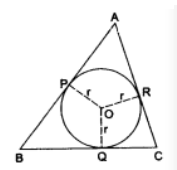
In the given figure, the sides $AB , BC$ and $CA$ of a triangle $ABC$ touch a circle with center $O$ and radius $r$ at $P , Q$ and R respectively. Prove that.
$a. AB + CQ = AC + BQ$
$b.$ area $(\Delta A B C)=\frac{1}{2}$ (perimeter of $\left.\Delta A B C\right) \times r$.
Image
A moving boat is observed from the top of a $150\ m$ high cliff moving away from the cliff. The angle of depression of the boat changes from $60^{\circ}$ to $45^{\circ}$ in $2$ minutes. Find the speed of the boat in $m / h$.
What are the coordinates of the point where the perpendicular bisector of the line segment joining the points $A(1, 5)$ and $B(4, 6)$ cuts the y-axis?
Since, $\text{x}=-\frac{1}{2},$ is a solution of the quadratic equation $3x^2 + 2kx - 3 = 0$, find the value of k.
Find the value of k for which the following system of equations has a unique solution:
$kx + 2y = 5$
$3x + y = 1$
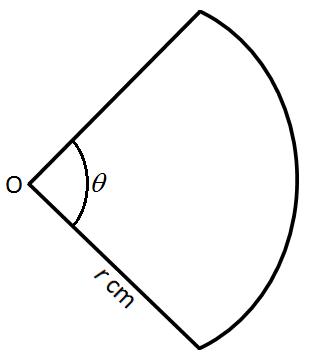
Figure shows a sector of a circle of radius r cm containing an angle $\theta.$ The area of the sector is A $cm^2$ and perimeter of the sector is $50\ cm$. Prove that.$\theta=\frac{360}{\pi}\Big(\frac{25}{\text{r}}-1\Big)$
If 4 times the $4^{\text {th }}$ term of an AP is equal to 18 times its $18^{\text {th }}$ term then find its $22^{\text {nd }}$ term.
If the point $P(x, y)$ is equidistant from the points $A(5,1)$ and $B(1,5)$, prove that $x=y$.