Question
Write a short note on advantages of seeds.

Answer

→ Seeds offer several advantages to angiosperms.
(i) Firstly, since reproductive processes such as pollination and fertilisation are independent of water, seed formation is more dependable.
(ii) Seeds have better adaptive strategies for dispersal to new habitats and help the species to colonise in other areas.
(iii) As they have sufficient food reserves, young seedlings are nourished until they are capable of photosynthesis on their own.
(iv) The hard seed coat provides protection to the young embryo.
(v) Being products of sexual reproduction, they generate new genetic combinations leading to variations.
(vi) Seed is the basis of our agriculture. Dehydration and dormancy of mature seeds are crucial for storage of seeds which can be used as food throughout the year and also to raise crop in the next season.
Need a full question paper?

Generate a complete, print-ready paper with questions like this in minutes — across 16+ boards, with answer keys.

Start Generating Free

Similar questions

"Pollen grains in wheat are shed at 3-celled stage while in peas they are shed at 2-celled stage." Explain. Where are germ pores present in a pollen grain?
In a series of experiments with Streptococcus and mice F. Griffith concluded that R-strain bacteria had been transformed. Explain.
  1. Why is Amazon rain forest referred to as lungs of the planet earth?
  2. Name any four industrial products obtained from nature.
Microbes have various contributions to the human welfare. For example, lactic acid bacteria help in checking disease causing microbes in our stomach. With reference to this fact, state the contribution of different microbes in the process of digestion in ruminants.
Answer the following questions:
Give two reasons why Mendel selected garden pea for his experiments. Give the biological name of this plant.
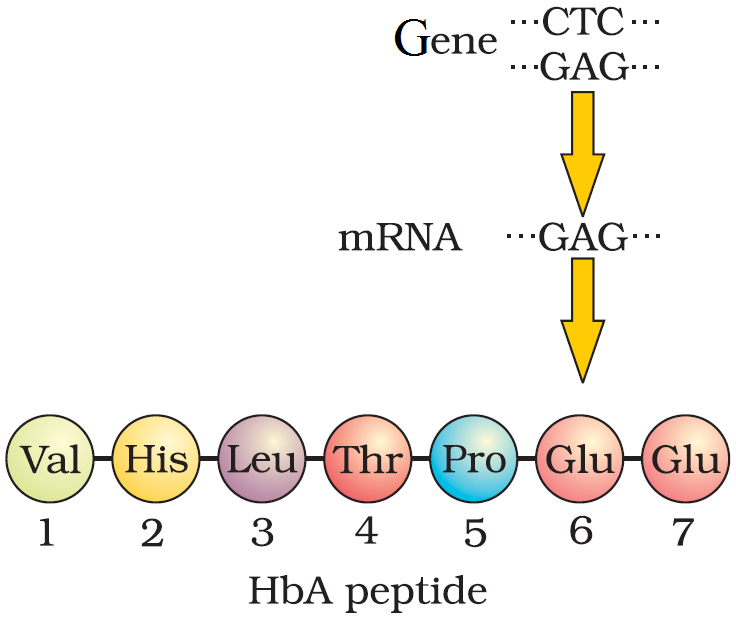
Given below is the representation of amino acid composition of the relevant translated portion of b–chain of haemoglobin, related to the shape of human red blood cells.

Is this representation indicating a normal human or a sufferer from certain related genetic disease? Give reason in support of your answer.

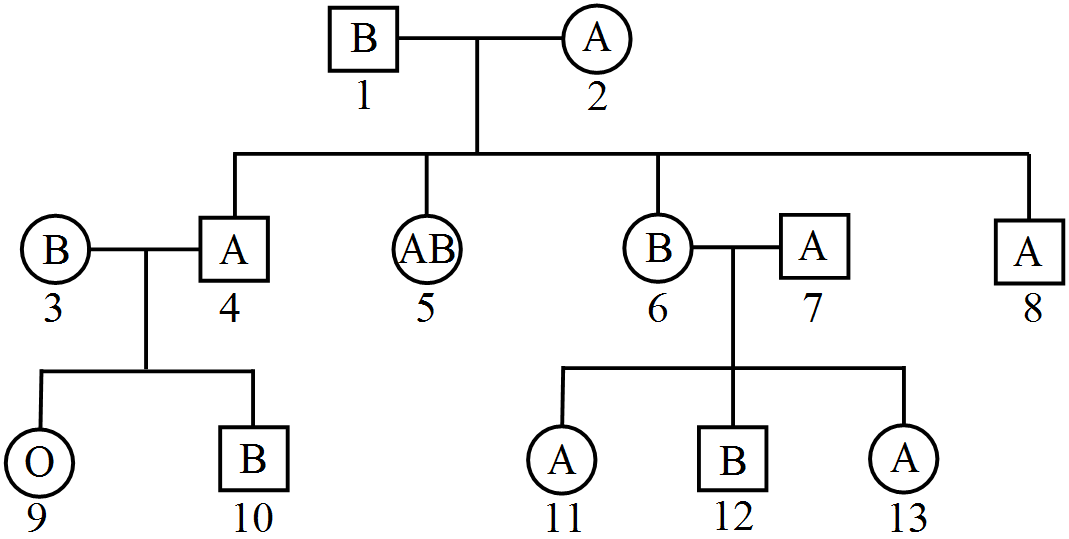
Study the pedigree chart given below, showing the inheritance pattern of blood groups in a family and answer the given questions.

  1. Give the possible genotypes of the individuals 1 and 2.
  2. Which antigen will be present on the plasma membrane of RBCs of individuals 5 and 9?
  3. Give the genotypes of the individuals 3 and 4.
With respect to Messelson and Stahl’s Experiment, answer the following questions:
  1. Identify the method used to distinguish between heavy and light isotopes of nitrogen.
  2. With the help of diagrams, compare the results for the DNA isolated after 20 minutes of experiment with the DNA which was isolated after 40 minutes.
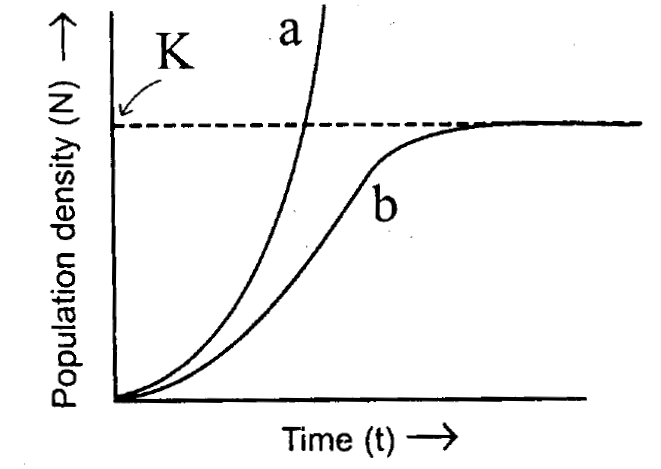
Study the population growth curves in the graph given below and answer the questions which follow:

  1. Identify the growth curves ‘a’ and ‘b'.
  2. Which one of them is considered a more realistic one and why?
  3. If dN/dt=rN(K-N/K) is the equation of the logistic growth curve, what does K stand for?
  4. What is symbolised by N?
In an E. coli cloning vector pBR 322, state the role of the following genes:
  1. Ori gene.
  2. Antibiotic resistance gene.
  3. Rop gene.