Question
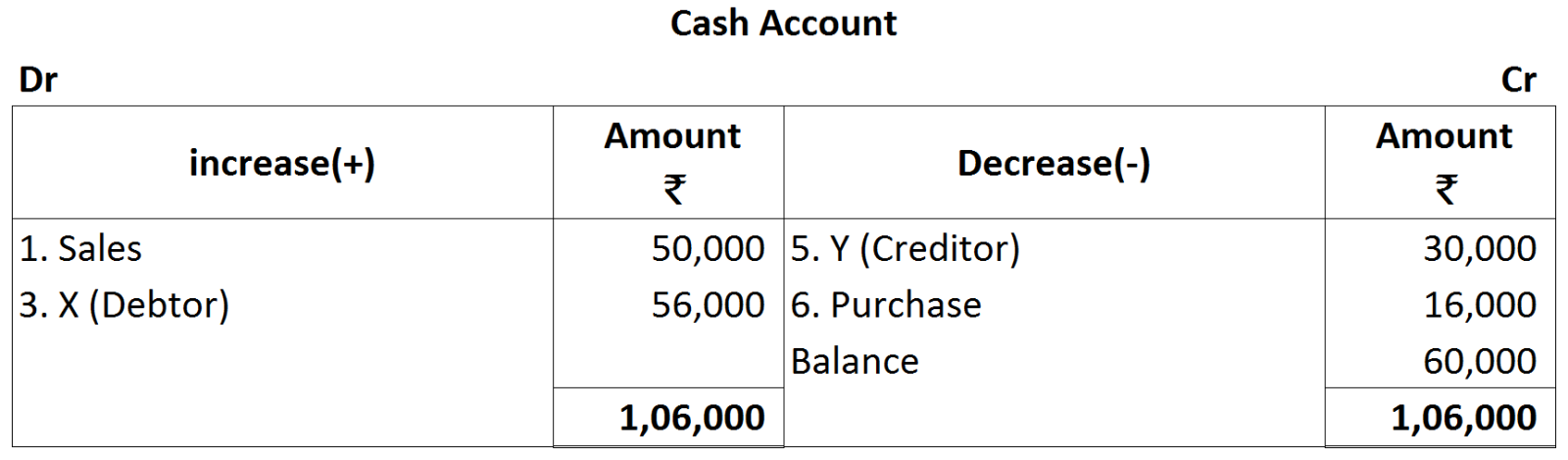
Write a short note on ‘balancing an account'. Explain by balancing a Cash Account.
Answer

A balance of an account is the difference between the total of its debit and credit sides. If the total of debit side is more than the total of credit side, the account is said to have a debit balance. It has a credit balance when total of credit side is more than the total of debit side.

Need a full question paper?

Generate a complete, print-ready paper with questions like this in minutes — across 16+ boards, with answer keys.

Start Generating Free

Similar questions

Vishal sold goods for ₹ 70,000 to Manju on Jan. 5, 2019 and drew upon her a bill of exchange payable after 2 months. Manju accepted Vishal's draft and handed over the same to Vishal after acceptance. Vishal immediately discounted the bill with his bank @ 12% p.a. On the due date Manju met her acceptance. Journalise the above transactions in the books of Vishal and Manju.
Prepare a Bank Reconciliation Statement from the following particulars:-
On 31st December 2014, I had an overdraft of ₹ 750 as shown by my Pass Book. I had issued cheques amounting to ₹ 250 of which ₹ 200 worth only seem to have been presented for payment. Cheques amounting to ₹ 100 had been paid in by me on 30th December, but of these only ₹ 75 were credited in the Pass Book. I also find that a cheque for ₹ 10 which I had debited to bank account in my books has been omitted to be banked. There is a debit of ₹ 25 in my Pass Book for interest.
An entry of ₹ 30 of a payment by a customer direct into the bank appears in the Pass Book. My Pass Book also shows a credit of ₹ 60 to my account for interest on investments directly collected by my bankers.
Prepare a Purchase Book in the books of M/s Modern Furniture House, Lucknow (U.P) from the following transactions assuming CGST @ 6% and SGST @ 6%.
2017
 
June 5


Bought from Mohan Lal & Co., Kanpur (U.P)
20 Godrej Chairs @ ₹ 2,000 each
5 Godrej Tables @ ₹ 6,000 each
Trade Discount 20%
June 10


Purchased from Bharat Bhushan & Sons, Varanasi (U.P)
5 Almirahs @ ₹ 12,000 each
2 Revolving Chairs @ ₹ 20,000 each
Trade Discount 10%
June 14


Purchased from Surya Traders, Lucknow (U.P)
80 Desks @ ₹ 2,500 each
10 Sofa Sets @ ₹ 20,000 each
Trade Discount @ 15%
June 20
 
Purchased for cash from Gopi Chand Haldi Ram, Delhi
4 Tables @ ₹ 5,000 each
25 June
 
Bought Furniture for office use from New Furniture House, Faridabad on Credit
5 Chairs @ ₹ 2,500 per Chair.
2 Tables @ ₹ 5,000 per Table.
On April 01, 2010 Jain & Sons purchased a second hand plant costing ₹ 2,00,000 and spent ₹ 10,000 on its overhauling. It also spent ₹ 5,000 on transportation and installation of the plant. It was decided to provide for depreciation @ 20% on written down value. The plant was destroyed by fire on Oct. 31, 2013 and an insurance claim of ₹ 50,000 was admitted by the insurance company. Prepare plant account assuming that the company closes its books on March 31, every year.
Record the following transactions in the Sales Book of M/s Ajanta Electronics, Ranchi (Jharkhand) assuming CGST @ 9% and SGST @ 9%.
2018
 
March 1
Sold to Vandna Electronics, Kolkata (West Bengal) Vide Invoice No. 1255
50 Musical Alarm Clocks @ ₹ 800 each
40 Wall Clocks @ ₹ 500 each
Trade Discount 20%
March 10
Sold to Mohan Watch Company, Patna (Bihar) Vide Invoice No. 1256
25 Deluxe Wall Clocks @ ₹ 800 each
Trade Discount 10%
March 15
Sold to Superior Watch Company, Ranchi Vide Invoice No. 1257
75 Deluxe Wall Clocks @ ₹ 800 each
40 Super Deluxe Wall Clocks @ ₹ 1,000 each
Trade Discount 15%
March 20
Sold to Modern Electronics, Ranchi Vide Cash Memo No. 5234
100% Musical Alarm Clocks @ ₹ 800 each
Trade Discount 20%
On 1st January, 2010, Arun purchased from Barun goods invoiced at ₹ 10,000. On the same date, Barun drew upon Arun a bill for the amount at 2 months and Arun accepted the same. On 4th January, 2010, Barun got the bill discounted with his bank @12% per annum. On due date, Arun told Barun that he was not in a position to pay the full amount and requested Barun to accept ₹ 5,000 in cash and draw a fresh bill at 2 months for the remaining amount plus interest at 15% per annum, Barun agreed. The second bill was duly met on the due date.
Give journal entries to record the above transactions in the books of Barun.
Give four advantages of Straight Line Method of providing depreciation.
A Company purchased a second-hand machine on 1st April, 2016, for ₹ 30,000 and immediately spent ₹ 4,000 on its repair and ₹ 1,000 on its installation. On Oct. 1, 2018, the machine was sold for ₹ 25,000. Prepare Machine Account after charging depreciation @ 10% p.a. by diminishing balance method, assuming that the books are closed on 31st March every year. IGST was charged @12% on purchase and sale of machine.
On 31st March, 2023, Bank Statement of Gopal shows credit balance of ₹ 33,570
whereas Cash Book showed debit balance of ₹ 53,000.
It was observed that the differences were because of the following:
i. Cheques and drafts sent to the bank but not collected and credited, amounted to ₹ 7,900 while cheque for ₹ 2,000 was received unpaid.
ii. Three cheques drawn for ₹ 3,000; ₹ 1,500 and ₹ 2,000 respectively were not presented for payment till 30th April, 2023.
iii. Bank has paid a cheque of ₹ 10,000 but it has not been entered in the Cash Book and a cheque of ₹ 5,000 which was discounted with the bank was dishonoured by the drawee on the due date.
iv. Bank has charged ₹ 130 as its commission for collecting outstation cheques and had credited an interest of ₹ 100 in the account.
v. A wrong debit of ₹ 5,000 was made by the bank, which was reversed on 4th April, 2023. Prepare Bank Reconciliation Statement as on 31st March, 2023.
Rectify the following errors:
  1. Bought Radio for ₹ 1,000 for the proprietor was debited to General Expenses A/c.
  2. Bought goods from Mohan ₹ 2,000 was passed through the Sales Book, however, the account of Mohan was credited correctly.
  3. Wages due ₹ 1,500 has not been taken into account.
  4. Goods Returned by Kamal ₹ 240 has been debited to his account ₹ 420.