Question
Write a short note on Double Entry System of Accounting.

Answer

Double Entry System of accounting is a system of accounting under which both, debit and credit, aspects of accounting are recorded. A transaction has two aspects Debit and Credit and at the time of recording a transaction, one aspect is recorded on the debit side and other aspect is recorded on the credit side. For example, at the tirr e of cash purchases, goods are received and in return cash is paid. In the transaction, two aspects are involved, i.e., receiving goods and paying cash and under the Double Entry System, both these aspects are recorded. One part, i.e., the receipt of goods, is debited and the second part, i.e., payment of cash, is credited. In other words, if only two accounts are affected (as in the purchase of building for cash), one account, Builcing, is debited and the other account, Cash, is credited for the same amount. If more than two accounts are affected by a transaction, the sum of the debit entries must be equal to the sum of the credit entries. Thus, on any day, total amount debited is equial to the total amount credited.
Thus, we can define Double Entry System as: "The system which recognises and records both aspects of a transaction. The Double Entry System has proved to be a scientific and complete system of accounting.”

Need a full question paper?

Generate a complete, print-ready paper with questions like this in minutes — across 16+ boards, with answer keys.
Start Generating Free

Similar questions

Give rectifying journal entries for the following errors:
  1. Sale of goods to Madan ₹ 6,000 were entered in the sales book as ₹ 600.
  2. A credit purchase of ₹ 1,500 from Ajay has been wrongly passed through the sales book.
  3. Repairs to building ₹ 300 were debited to building account.
  4. ₹ 2,050 paid to Rohit is posted to the debit of Mohit's account as ₹ 5,020.
  5. Purchase return book is overcast by ₹ 400.
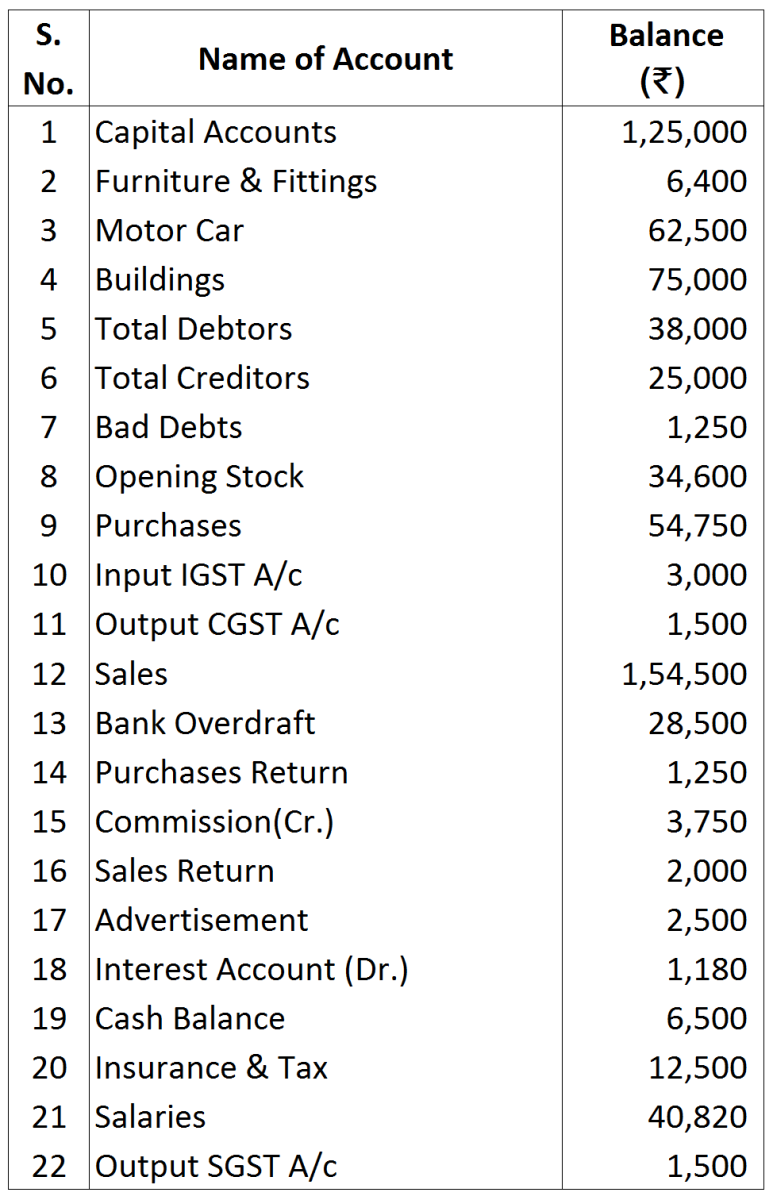
From the following information, prepare a Trial Balance of M/s. Prayag for the year ended $31^{st}$​​​​​​​ March,$ 2019:$​​​​​​​
Give any four points of distinction between Reserve and Provision.
On 1st April, 2015, a Company bought Plant and Machinery costing ₹ 68,000. It is estimated that its working life is 10 years, at the end of which it will fetch ₹ 8,000. Additions are made on 1st April, 2016 to the value of ₹ 40,000 (Residual value ₹ 4,000). More additions are made on Oct. 1, 2017 to the value of ₹ 9,800 (Break up value ₹ 800). The working life of both the additional Plant and machinery is 20 years.
Show the Plant and Machinery account for the first four years, if depreciation is written off according to Straight Line Method. The accounts are closed on 31st March every year.
On 1st April, 2019, the following were Ledger balances of M/s. Ram & Co., Delhi:
Cash in Hand ₹ 300; Cash at Bank ₹ 7,000; Bills Payable ₹ 1,000; Zahir (Dr.) ₹ 800; Stock ₹ 4,000; Gobind (Cr.) ₹ 2,000; Sharma (Dr.) ₹ 1,500; Rahul (Cr.) ₹ 900; Capital ₹ 9,700.
Transactions during the month of April, 2019 were:
2019
 
April 2
Bought goods from Gobind, Delhi
900
April 3
Sold goods to Sharma, Kanpur
1,000
April 5
Bought goods from Rahul, Delhi
1,200
April 8
Sold goods to Zahir, Kolkata
500
April 15
Paid Gobind by cheque on account*
1,500
April 18
Received from Sharma a cheque of
2,000
 
Allowed him discount*
50
April 20
Sold goods to Sharma, Kanpur
800
April 20
Paid rent by cheque
200
April 25
Sold goods to Zahir, Kolkata
1,000
April 30
Paid salaries in cash*
300
Inter-state transactions are subject to levy of IGST @ 12% and Intra-state transactions are subject to levy of CGST and SGST @ 6% each. GST is not levied on transactions marked with (*).
Post the above transactions to the Ledger and prepare the Trial Balance on 30th April, 2019.
Rectify the following errors:
  1. Total of one page of the Sales Book was carried forward to the next page as ₹ 2,785 instead of ₹ 2,587.
  2. A cheque of ₹ 400 received from Mohan was dishonoured and had been posted to the debit side of the ‘Allowance Account’.
  3. Return of goods worth ₹ 5,000 by a customer was entered in the Purchases Return Book.
  4. Sum of ₹ 200 owed by ‘X’ has been included in the list of Sundry Creditors.
  5. Sale of old furniture worth ₹ 430 was credited to the Sales Account as ₹ 340.
Classify the under-mentioned errors into:
  1. Error of Omission
  2. Error of Commission
  3. Compensating Error
  4. Error of Principle
  1. Purchased goods from Bhardwaj on credit for ₹ 600, but were recorded in the purchase book as ₹ 6,000.
  2. Amount paid for the proprietor’s life insurance premium was debited to 'General Expenses Account'.
  3. Goods amounting to ₹ 2,000 have been returned to Chakravarti, but no entry has been made in the books.
  4. An excess debit of ₹ 4,500 has been made in the account of X, whereas Y's account has been credited by ₹ 5,000 instead of ₹ 500.
  5. Goods sold to Suresh for ₹ 650 were recorded as ₹ 560 in the Sales Book.
  6. Typewriter purchased for office use has been debited to Purchases Account.
  7. Wages paid for the construction of Building ₹ 15,000 were recorded in "Wages Account'.
  8. Goods for ₹ 500 have been taken by the proprietor for his personal use, for which no entry has been passed in the books.
Write a note on types of assets with one example of each.
Pass entries in the books of Mr. Roopani of Gujarat assuming CGST @ 9% and SGST@ 9%.
1.
Purchased goods for ₹ 2,00,000 from Suryakant of Jaipur (Rajasthan) on Credit.
2.
Sold goods for ₹ 1,50,000 to Mr. Pawar of Mumbai (Maharashtra) and the cheque received was sent to bank.
3.
Sold goods for ₹ 2,50,000 within the state on credit.
4.
Paid insurance premium of 20,000 by cheque.
5.
Purchased furniture for office for ₹ 60,000 by cheque.
6.
Payment made of balance amount of GST.
Pass Journal entries for the following transactions:
  1. Purchased Machinery for ₹ 20,000 and paid ₹ 200 for its carriage.
  2. Received a cheque fo ₹ 4,850 from X in full settlement of his account of ₹ 5,000. Cheque was immediately deposited into bank.
  3. Received by cheque a first and final payment of 60 paise in a ₹ from Y who owed us ₹ 10,000.
  4. Sold goods to Z for ₹ 10,000 at a trade discount of 20%. Next day a cheque was received from him after deducting 5% cash discount. Cheque was immediately deposited into Bank.
  5. Goods costing ₹ 20,000 sold to Manoj at a profit of 20% on cost less 10% trade discount.