Embryo develops at the micropylar end of the embryo sac where the zygote is situated.
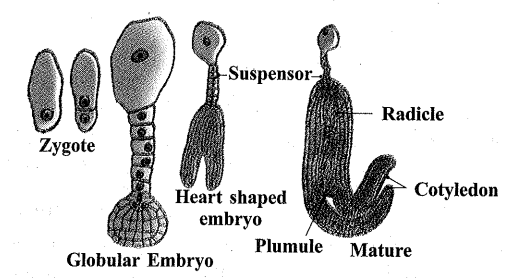
→ Most zygotes divide only after certain amount of endosperm is formed. This is an adaptation to provide assured nutrition to the developing embryo.
→ Though the seeds differ greatly, the early stages of embryo development (embryogeny) are similar in both monocotyledons and dicotyledons.
→ Figure depicts the stages of embryogeny in a dicotyledonous embryo. The zygote gives rise to the proembryo and subsequently to the globular, heart-shaped and mature embryo.
Dicotyledonous embryo:
→ A typical dicotyledonous embryo, consists of an embryonal axis and two cotyledons.
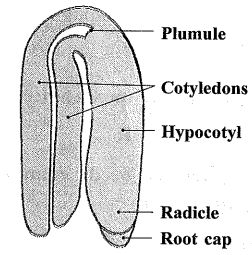
(i) Epicotyl: The portion of embryonal axis above
the level of cotyledons is the Epicotyl, which terminates with the plumule or stem tip.
(ii) Hypocotyl: The cylindrical portion below the level of cotyledons is Hypocotyl that terminates at its lower end in the radicle or root tip. The root tip is covered with a root cap.
Monocotyledonous embryo :
→ Embryos of monocotyledons possess only one cotyledon.
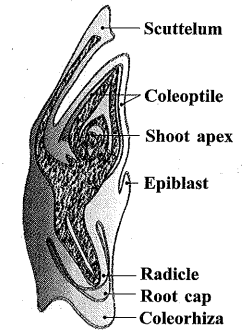
(i) Scutellum: In the grass family the cotyledon is called scutellum that is situated towards one side (lateral) of the embryonal axis.
(ii) Coleorrhiza: At its lower end, the embryonal axis has the radical and root cap enclosed in an undifferentiated sheath called Coleorrhiza.
(iii) Coleoptile: The portion of the embryonal axis above the level of attachment of scutellum is the epicotyl. Epicotyl has a shoot apex and a few leaf primordia enclosed in a hollow foliar structure, the Coleoptile.
