Question
Write a short note on endosperm development.

Answer

→ Endosperm development precedes embryo development.
→ The primary endosperm cell divides repeatedly and forms a triploid endosperm tissue.
→ The cells of this tissue are filled with reserve food materials and are used for the nutrition of the developing embryo.
→ In the most common type of endosperm development, the PEN undergoes successive nuclear divisions to give rise to free nuclei. This stage of endosperm development is called free-nuclear endosperm.
→ Subsequently cell wall formation occurs and the endosperm becomes cellular.
→ The number of free nuclei formed before cellularisation varies greatly.
→ The coconut water from tender coconut that you are familiar with, is nothing but free- nuclear endosperm (made up of thousands of nuclei) and the surrounding white kernel is the cellular endosperm.
→ Endosperm may either be completely consumed by the developing embryo (e.g., pea, groundnut, beans) before seed maturation or it may persist in the mature seed (e.g. castor and coconut) and be used up during seed germination.

Need a full question paper?

Generate a complete, print-ready paper with questions like this in minutes — across 16+ boards, with answer keys.

Start Generating Free

Similar questions

A regulatory body working under MoEF for the release of transgenic crop is ____________:
  1. NBPGR
  2. NSC
  3. NIPGR
  4. GEAC
Read the following and answer any four questions from (i) to (v) given below:
A 23 year old Sahil has been diagnosed with an infection of reproductive tract caused by bacteria. He complains about burning sensation during urination, pus-containing discharge and pain around genitalia. This infection has incubation period of 2-5 days but can be cured.
  1. From which disease is Sahil suffering?
  1. Chlamydiasis.
  2. Herpes.
  3. Gonorrhoea.
  4. Syphilis.
  1. Which among the following reproductive tract infections is transmitted by bacteria?
  1. Trichomoniasis.
  2. Chancroid.
  3. Genital warts.
  4. Both (a) and (b).
  1. Which mode of treatment would be useful for Sahil?
  1. Cryosurgery.
  2. Use of Podophyllum preparation.
  3. Use of antibiotic ampicillin.
  4. It cannot be treated.
  1. What technique was used to diagnose Sahil's disease?
  1. Gram staining of discharge and culture.
  2. ELISA Test.
  3. Antibody detection.
  4. Antigen test.
  1. Find the odd one out.
  1. Treponema pallidum.
  2. Neisseria gonorrhoeae.
  3. Haernophilus ducreyi.
  4. Trichomonas vaginalis.
Read the following and answer any four questions from (i) to (v) given below:

The process of translation requires transfer of genetic information from a polymer of nucleotides to synthesise a polymer of amino acids. The relationship between the sequence of amino acids in a polypeptide and nucleotide sequence of DNA or mRNA is called genetic code. George Gamow suggested that in order to code for all the 20 amino acids, code should be made up of three nucleotides.

  1. What is a codon?
  1. A length of DNA which codes for a particular protein.
  2. A part of the tRNA molecule to which a specific amino acid is attached.
  3. A part of the tRNA molecule which recognises the triplet code on the messenger RNA.
  4. A part of the messenger RNA molecule that has a sequence of bases coding for an amino acid.
  1. Three consecutive bases in the DNA molecule provide the code for each amino acid in a protein molecule. What is the maximum number of different triplets that could occurs?
  1. 16
  2. 20
  3. 24
  4. 64
  1. Listed below are some amino acids and their corresponding mRNA triplets.
Amino acid
mRNA triplet
Phenylalanine
UUU
Lysine
AAG
Arginine
CGA
Alanine
GCA
Which DNA sequence would be needed to produce the following polypeptide sequence? Alanine-Arginine-Lysine-Phenylalanine

  1. $\text{CGT}\ \ \ \text{GCT}\ \ \ \text{TTC}\ \ \ \text{AAA}$

  2. $\text{CGT}\ \ \ \text{GCT}\ \ \ \text{TTC}\ \ \ \text{TTT}$

  3. $\text{CGU}\ \ \ \text{GCU}\ \ \ \text{UUC}\ \ \ \text{AAA}$

  4. $\text{CGU}\ \ \ \text{GCU}\ \ \ \text{UUC}\ \ \ \text{TTT}$

  1. Identify the non-sense codons among the following.
  1. AUG
  2. GUG
  3. UAA
  4. UGG
  1. A polypeptide is made using synthetic mRNA molecules as shown.
Synthetic mRNA used
Polypeptide produced
UUUAAAUUUAAA
Phenylalanine-Iysine-phenylalanine-Iysine

What are the DNA codes for the amino acids phenylalanine and lysine?

S.no
Phenylalanine
Lysine
(a)
AAA
TTT
(b)
AAA
UUU
(c)
GGG
CCC
(d)
TTT
GGG
Draw a schematic diagram of typical anatropous ovule and describe structure of megasporangium in detail.###With a neat, labelled diagram, describe the parts of a typical angiosperm ovule.
Read the following and answer any four questions from (i) to (v) given below:

A young couple married for 5 years is unable to bear a child in spite of not practicing any birth control method. Upon consultation, doctor advised them an assisted reproductive technology involving transfer of gametes into oviducts.

  1. Identify the technique adopted by the couple.
  1. ZIFT
  2. JUI
  3. GIFT
  4. ICSI
  1. What is the pre-requisite of this technique?
  1. Gamete formation should be normal.
  2. Fallopian tubes should be normal.
  3. Female should have thick endometrial lining.
  4. Male should be able to copulate the female.
  1. Assertion: GIFT is an in-vitro fertilisation technique.

Reason: In GIFT, gametes are fertilised outside the female body.

  1. Both assertion and reason are true, and reason is the correct explanation of assertion.
  2. Both assertion and reason are true, but reason is not the correct explanation of assertion.
  3. Assertion is true, but reason is false.
  4. Both assertion and reason are false.
  1. The procedure advised to couple involves the transfer of:
  1. Fertilised ovum.
  2. Embryo with 8 blastomeres.
  3. Sperms and unfertilised ovum.
  4. Embryo with 16 blastomeres.
  1. What is the success rate of this procedure?
  1. 30-50%
  2. < 20%
  3. 80-85%
  4. 27-30%
Read the following and answer any four questions from (i) to (v) given below:

When it comes to biopesticides, one of the most widely used fungi is Beauveria bassiana. It infects a range of insects like, pecan weevil, Colorado potato beetle, kudzu bug, etc. It causes a disease known as the white muscardine. Even after an insect is killed, the white mold continues to produce millions of new infective spores that are released into the environment. It is commercially formulated as products including Naturalis L, Mycotrol, BotaniGard, etc. Some other widely used molds are Trichoderma, Metarhizium, etc. Some of them release enzymes that dissolve potential pathogens, others form barriers around plant roots and make it impossible for harmful bacteria and pathogens to pass through.

  1. The key benefits of the biopesticides are that they are:
  1. Highly effective.
  2. Target specific.
  3. Reduced environmental risks.
  4. all of these.
  1. Naturalis-L is a conunercial formulation containing:
  1. Bacterial biopesticide.
  2. Fungal biopesticide.
  3. Fungal biofertiliser.
  4. Chemical pesticide.
  1. Which of the following is used as an effective bacterial biopesticide?
  1. Trichoderma.
  2. Beauveria.
  3. Bacillus thuringiensis.
  4. All of these.
  1. Baeuveria causes a disease called:
  1. White muscardine.
  2. Aspergillosis
  3. Green muscardine.
  4. Powdary mildews.
  1. Assertion: Trichoderma, found in root ecosystem, exerts biological control over several plant pathogens.

Reason: Trichoderma release enzyme which inhibits growth of several disease causing pathogens.
  1. Both assertion and reason are true and reason is the correct explanation of assertion.
  2. Both assertion and reason are true but reason is not the correct explanation of assertion.
  3. Assertion is true but reason is false.
  4. Both assertion and reason are false.
Read the following and answer any four questions from (i) to (v) given below:

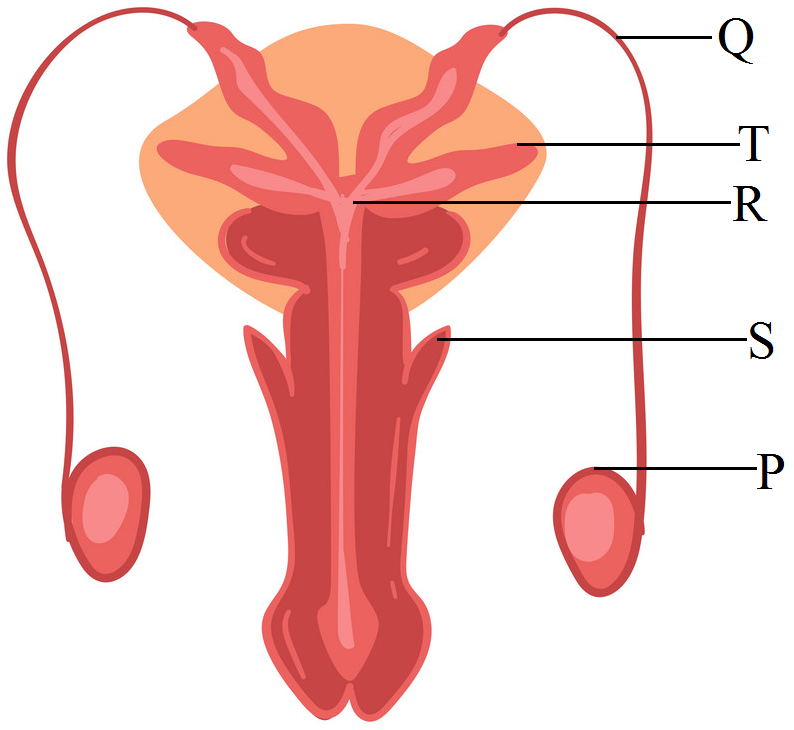
Human male reproductive system comprises of a pair of testes, primary sex organs associated with formation of gametes and production of sex hormone. Study the given figure of human male reproductive system and answer the following questions.

  1. Which of the following is correct for labelled part P?
  1. P is rete testis which transports sperms to outside.
  2. P is epididymis which secretes fluid that nourish the sperms.
  3. P is epididymis that carry sperms and secretion of seminal vesicles.
  4. P is rete testis, which lies along inner side of each testis and stores the sperms.
  1. Identify the correctly matched pair.
  1. Q - Vasa efferentia.
  2. R - Ejaculatory duct.
  3. S - Seminal vesicle.
  4. T - Cowper's gland.
  1. Which statement is incorrect for Q?
  1. It carries spermatozoa from epididymis to ejaculatory duct.
  2. Q are only 2 in number.
  3. It arises from rete testis.
  4. It constitutes male sex accessory duct.
  1. Which structure passes through the prostate gland and carries sperms and secretion of seminal vesicle?
  1. P.
  2. T.
  3. S.
  4. R.
  1. Assertion: Mucus present in secretion of bulbourethral gland decreases the number of sperms damaged during ejaculation.

Reason: Mucus lubricates the end of penis and lining of the urethra.

  1. Both assertion and reason are true, and reason is the correct explanation of assertion.
  2. Both assertion and reason are true, but reason is not the correct explanation of assertion.
  3. Assertion is true, but reason is false.
  4. Both assertion and reason are false.
Microorganisms include bacteria, viruses, fungi and protozoa. In our mind, we presume, most of the time, that microbes are always harmful. Microbes are, of course, the causal agents of many infections diseases of plants and animals including humans but they also have lots of beneficial role. Lactic acid bacteria (LAB) are one of this kind of useful group. These are Gram positive, non-sporulating, either rod-shaped or spherical bacteria. They produce lactic acid in milk products as major metabolic end product of carbohydrate fermentation. LAB are considered as natural fermentors. Lactobacillus is a common LAB which converts lactose sugar of milk into lactic acid, that causes coagulation and partial digestion of milk protein casein. Milk is then changed into curd, yoghurt and cheese. Lactobacillus is also used in probiotics which have potentially beneficial effect on gut ecosystem of humans. Some other probiotic strain used belong to the Genus Bifidobacterium.

  1. Which of the following is not considered as microorganisms?
  1. Bacteriophage.
  2. Streptococcus.
  3. Porphyra.
  4. Staphylococcus.
  1. Select the incorrect option regarding the characteristics of lactic acid bacteria.
  1. They are rod-shaped or spherical.
  2. They are Gram positive.
  3. They take part in carbohydrate fermentation.
  4. They are acid intolerant.
  1. Which of the following is not a lactic acid producing bacteria?
  1. Streptococcus.
  2. Lactococcus.
  3. Saccharomyces.
  4. Enterococcus.
  1. Probiotics are:
  1. Gut friendly live bacteria.
  2. Acid balancing alternated bacteria.
  3. Beneficial amount of dead bacteria.
  4. Gram negative attenuated bacteria.
  1. Assertion: Lactobacillus bacteria do not retain crystal violet stain while staining.

Reason: Lactobacillus have a very thin layer of peptidoglycan layer in their cell wall.

  1. Both assertion and reason are true and reason is the correct explanation of assertion.
  2. Both assertion and reason are true but reason is not the correct explanation of assertion.
  3. Assertion is true but reason is false.
  4. Both assertion and reason are false.
Describe the process of DNA Fingerprinting in detail.
Read the following and answer any four questions from (i) to (v) given below:

In today's world, more than 25% of human population is suffering from hunger and malnutrition. Scientists have developed techniques where microbes are grown on industrial scale as a source of good protein which can be grown from waste water, animal manure and even sewage. Single cell proteins are such products. TI1e biomass or protein is extracted from pure or mixed cultures of algae, yeasts, fungi or bacteria. These are a very good source of food for human consumption.

  1. Why the name single cell protein is applied?
  1. It contains only one type of protein.
  2. It is obtained from unicellular edible microbes.
  3. It contains only one type of microorganism.
  4. All of these.
  1. Which of the following is considered under single cell protein?
  1. Algae.
  2. Fungi.
  3. Cyanobacteria.
  4. All of these.
  1. Microorganisms can be a useful food resource for increasing human population because:
  1. These are easy to harvest.
  2. These can grow in water system.
  3. They have a high rate of multiplication thus producing huge biomass.
  4. They have high level of nucleic acid.
  1. Single cell protein can be grown from:
  1. Waste water.
  2. Animal manure.
  3. Sewage.
  4. All of these.
  1. Assertion: Production of single cell protein reduces pollution.

Reason: Single cell protein can be grown from waste water and even sewage.

  1. Both assertion and reason are true and reason is the correct explanation of assertion.
  2. Both assertion and reason are true but reason is not the correct explanation of assertion.
  3. Assertion is true but reason is false.
  4. Both assertion and reason are false.