Question
Write a short-note on p-type semiconductors.

Answer


Image
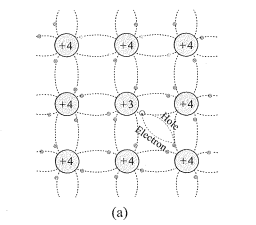
As shown in Fig., to prepare this type of semiconductors, in pure $S i$ or $G e$, trivalent impurity like $A /, B , I n$ etc. are added. (In the outer most orbit, there are 3 electrons in such atoms, so they are called tri-valent.)
Image
The dopant has one valence electron less than the $S i$ and $G e$ atoms, and therefore, this atom can form covalent bonds with neighbouring three $S i$ atoms but does not have any electron to offer to the fourth $S i$ atom.
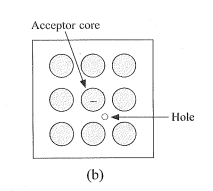
So, a vacancy (empty space) or hole is created in the bond between the fourth neighbour and the trivalent atom, as shown in the Fig.
Since the neighbouring Si atom in the lattice wants an electron in place of a hole, an electron in the outer orbit of an atom in the neighbourhood may jump to fill this vacancy, leaving a vacancy or hole at its own site.
Thus the hole is available for conduction. Hole has the tendency to attract/accept an electron. Hence, such impurities are called acceptor impurities.
Apart from this, at room temperature, some covalent bonds break and pair of electron and a hole is created.
Thus, for such a material, the holes are majority carriers and electrons are minority carriers.
Since, the holes behave as a positive charge due to deficiency of negatively charged electrons, from the first letter of the word positive, such extrinsic semiconductors doped with trivalent impurity are called $p$-type semiconductors.
For $p$-type semiconductors. $n_h \gg n_e$.

Need a full question paper?

Generate a complete, print-ready paper with questions like this in minutes — across 16+ boards, with answer keys.
Start Generating Free

Similar questions

An ideal gas expands from 100cm3 to 200cm3 at a constant pressure of 2.0 × 10⁵ Pa when 50J of heat is supplied to it. Calculate,
  1. The change in internal energy of the gas.
  2. The number of moles in the gas if the initial temperature is 300K.
  3. The molar heat capacity Cp at constant pressure.
  4. The molar heat capacity Cv at constant volume.
What is reverse bias? Explain the change occuring in the junction under the effect of reverse bias.
Sketch a graph showing the variation of fringe width versus the distance of the screen from the plane of the slits (keeping other parameters same) in Young’s double slit experiment. What information can one obtain from the slope of this graph?
The potential barrier existing across an unbiased p-n. junction is 0·2 volt. What minimum kinetic energy a hole should have to diffuse from the p-side to the n-side if,
  1. The junction is unbiased.
  2. The junction is forwardbiased at 0.1 volt.
  3. The junction is reverse-biased at 0.1 volt?
Find the ratio of the lengths of an iron rod and an aluminium rod for which the difference in the lengths is independent of temperature. Coefficients of linear expansion of iron and aluminium are 12 × 10-6 °C-1 and 23 × 10-6 °C-1 respectively.
The ends of a metre stick a.re maintained at 100°C and 0°C. One end of a rod is maintained at 25°C. Where should its other end be touched on the metre stick so that there is no heat current in the rod in steady state?
Electromotive forces of two cells are $E_1$ and $E _2$ and their internal resistances are $r_1$ and $r_2$. Find equivalent electromotive force and equivalent internal resistance on joining them in series.
A 10cm long rod carries a charge of $+50\mu\text{C}$ distributed uniformly along its length. Find the magnitude of the electric field at a point 10cm from both the ends of the rod.
Find the charge supplied by the battery in the arrangement shown in figure.

Two identical loops P and Q each of radius 5 cm are lying in perpendicular planes such that they have a common centre as shown in the figure. Find the magnitude and direction of the net magnetic field at the common centre of the two coils, if they carry currents equal to 3 A and 4 A respectively.