Question
Write a short-note on p-type semiconductors.
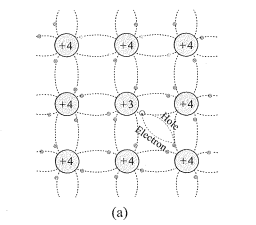
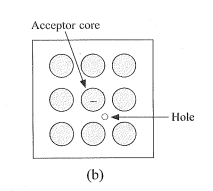
Answer


Image
As shown in Fig., to prepare this type of semiconductors, in pure $S i$ or $G e$, trivalent impurity like $A /, B , I n$ etc. are added. (In the outer most orbit, there are 3 electrons in such atoms, so they are called tri-valent.)
Image
The dopant has one valence electron less than the $S i$ and $G e$ atoms, and therefore, this atom can form covalent bonds with neighbouring three $S i$ atoms but does not have any electron to offer to the fourth $S i$ atom.
So, a vacancy (empty space) or hole is created in the bond between the fourth neighbour and the trivalent atom, as shown in the Fig.
Since the neighbouring Si atom in the lattice wants an electron in place of a hole, an electron in the outer orbit of an atom in the neighbourhood may jump to fill this vacancy, leaving a vacancy or hole at its own site.
Thus the hole is available for conduction. Hole has the tendency to attract/accept an electron. Hence, such impurities are called acceptor impurities.
Apart from this, at room temperature, some covalent bonds break and pair of electron and a hole is created.
Thus, for such a material, the holes are majority carriers and electrons are minority carriers.
Since, the holes behave as a positive charge due to deficiency of negatively charged electrons, from the first letter of the word positive, such extrinsic semiconductors doped with trivalent impurity are called $p$-type semiconductors.
For $p$-type semiconductors. $n_h \gg n_e$.

Need a full question paper?

Generate a complete, print-ready paper with questions like this in minutes — across 16+ boards, with answer keys.

Start Generating Free

Similar questions

The nucleus $^{235}_{92}\text{Y},$ initially at rest, decays into $^{231}_{90}\text{X}$ by emitting an $\alpha-$particle
$^{235}_{92}\text{Y}\xrightarrow{ \ \ \ \ \ \ \ \ } \ ^{231}_{90}\text{X}+ \ ^4_2\text{He}+\text{energy}.$
The binding energies per nucleon of the parent nucleus, the daughter nucleus and $\alpha-$particle are 7.8MeV, 7.835MeV and 7.07MeV, respectively. Assuming the daughter nucleus to be formed in the unexcited state and neglecting its share in the energy of the reaction, find the speed of the emitted $\alpha-$particle. (Mass of $\alpha-$particle = 6.68 × 10⁻²⁷kg).
What are permanent magnets? What is an efficient way of preparing a permanent magnet? Write two characteristic properties of materials which are required to select them for making permanent magnets.
Two harmonic waves of monochromatic light

$\text{y}_{1} = \text{a} \cos\omega\text{t}\text{ and } \text{y}_{2} = \text{a} \cos(\omega\text{t} + \Phi)$

are superimposed on each other. Show that maximum intensity in interference pattern is four times the intensity due to each slit. Hence write the conditions for constructive and destructive interference in terms of the phase angle$\Phi$.
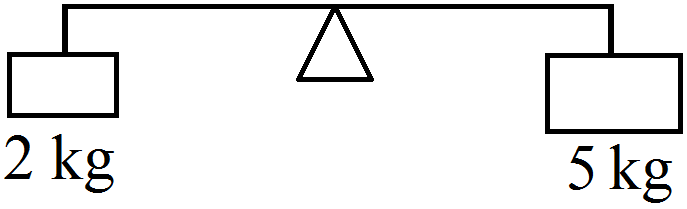
A steel wire of original length 1m and cross-sectional area 4.00mm2 is clamped at the two ends so that it lies horizontally and without tension. If a load of 2.16kg is suspended from the middle point of the wire, what would be its vertical depression? Y of the steel = 2.0 × 10¹¹N/m2 Take g = 10m/s2.
A converging lens and a diverging mirror are placed at a separation of 15cm. The focal length of the lens is 25cm and that of the mirror is 40cm. Where should a point source be placed between the lens and the mirror so that the light, after getting reflected by the mirror and then getting transmitted by the lens, comes out parallel to the principal axis?
  1. Write the important properties of photons which are used to establish Einstein’s photoelectric equation.
  2. Use this equation to explain the concept of (i) threshold frequency and, (ii) Stopping potential.
A beam of light consisting of two wavelengths, 650 nm and 520 nm, is used to obtain interference fringes in a Young’s double-slit experiment.
  1. Find the distance of the third bright fringe on the screen from the central maximum for wavelength 650 nm.
  2. What is the least distance from the central maximum where the bright fringes due to both the wavelengths coincide?
A light rod of length 1m is pivoted at its centre and two masses of 5kg and 2kg are hung from the ends as shown in figure. Find the initial angular acceleration of the rod assuming that it was horizontal in the beginning.

Two neutral particles are kept 1m apart. Suppose by some mechanism some charge is transferred from one particle to the other and the electric potential energy lost is completely converted into a photon. Calculate the longest and the next smaller wavelength of the photon possible.
Design a logical circuit using AND, OR and NOT gates to evaluate $\text{A}\overline{\text{BC}}+\text{B}\overline{\text{CA}}.$