Question
Write a short note on 'Valves' in electronics.

Answer

Before the discovery of transistors in 1948, valves (vacuum tubes) were widely used in electronic circuits.
Types of valves are as follows:
(i) Vacuum diode : which has two electrodes Anode (often called plate), and cathode.
(ii) Vacuum triode : which has three electrodes - cathode, plate and grid.
(iii) Vacuum tetrode : which has anode, cathode and 2 grids, so total four electrodes.
(iv) Vacuum pentode : which has 5 electrodes.
In a vacuum tube, the electrons are supplied by a heated cathode (current is passed through the filament kept very close to the cathode and by heating the cathode, electrons are emitted by Thermionic emission process.)
Controlled flow of electrons in vacuum is obtained by varying the voltage between its different electrodes. Vacuum is required in the inter-electrode region (/space). Otherwise the moving electrons may lose their energy on collision with the air molecules in their path.
In these devices, the electrons can flow only from cathode to the anode (i.e. only in one direction). Therefore such devices are generally referred to as valves.
These vacuum tube devices are bulky, consume high power, operate generally at high voltages ( $\sim 100 V$ ) and have limited life and low reliability.

Need a full question paper?

Generate a complete, print-ready paper with questions like this in minutes — across 16+ boards, with answer keys.
Start Generating Free

Similar questions

If water in one flask and castor oil in other are violently shaken and kept on a table, which will come to rest earlier?
Write a short note on Ultra violet rays.
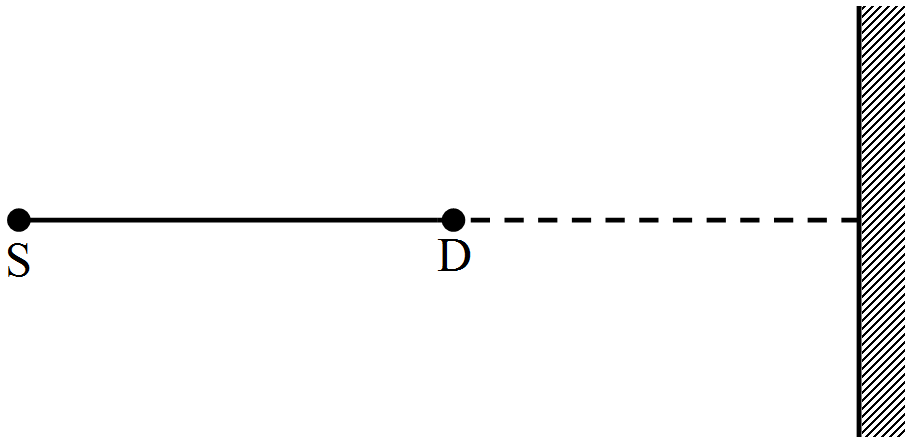
A source of sound S and a detector D are placed at some distance from one another. A big cardboard is placed near the detector and perpendicular to the line SD as shown in figure, It is gradually moved away and it is found that the intensity changes from a maximum to a minimum as the board is moved through a distance of 20cm. Find the frequency of the sound emitted. Velocity of sound in air is 336m/s.

What is absolute refractive index? On what factors does it depend ?
A $100 \Omega$ resistor is connected to a $220 V, 50 Hz$ AC supply.
(a) What is the rms value of current in the circuit?
(b) What is the net power consumed over a full cycle?
Is it necessary to have two waves of equal intensity to study interference pattern? Will there be an effect on clarity if the waves have unequal intensity?
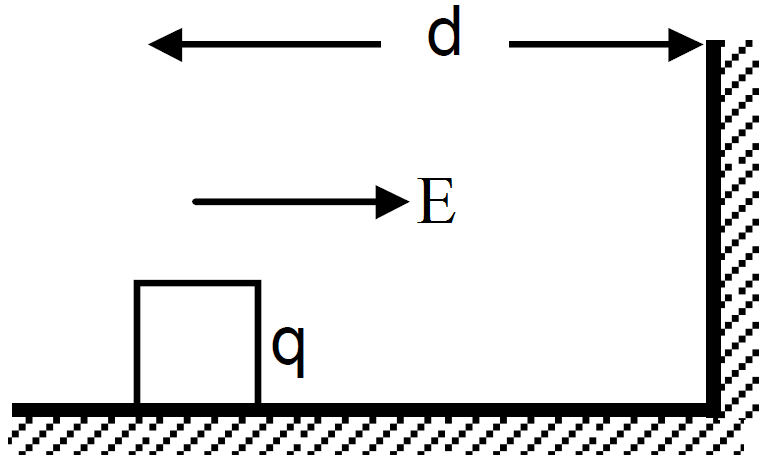
A block of mass m containing a net positive charge q is placed on a smooth horizontal table which terminates in a vertical wall as shown in figure. The distance of the block from the wall is d. A horizontal electric field E towards right is switched on. Assuming elastic collisions (if any) find the time period of the resulting oscillatory motion. Is it a simple harmonic motion?

A hydrogen atom contains one proton and one electron. It may be assumed that the electron revolves in a circle of radius 0.53 angstrom (1 angstrom = 10-10m and is abbreviated as A) with the proton at the centre. The hydrogen atom is said to be in the ground state in this case. Find the magnitude of the electric force between the proton and the electron of a hydrogen atom in its ground state.
The potential difference across the terminals of a battery of emf 12V and internal resistance $2\Omega$ drops to 10V when it is connected to a silver voltameter. Find the silver deposited at the cathode in half an hour. Atomic weight of silver is 107.9g/mole.
A capacitor of capacitance 'C' is being charged by connecting it across a dc source along with an ammeter.Will the ammeter show a momentary deflection during the process of charging? If so, how would you explain this momentary deflection and the resulting continuity of current in the circuit? Write the expression for the current inside the capacitor.