Question
Write a short note on
a. Vapour pressure.
b. Surface tension
c. Viscosity.
Answer

a. Vapour pressure:
  • Molecules of liquid have tendency to escape from its surface to form vapour above it. This called evaporation.
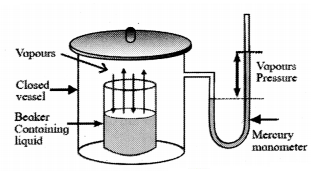
  • When a liquid is placed in a closed container, the liquid undergoes evaporation and vapours formed undergo condensation.
  • At equilibrium, the rate of evaporation and rate of condensation are equal.
  • The pressure exerted by the vapour in equilibrium with the liquid is known as saturated vapour pressure or simply vapour pressure.
  • Vapour pressure is measured by means of a manometer.
  • The most common unit for vapour pressure is torr. $1$ torr = $1$ mm Hg.
Image
[Note: i. The vapour pressure of water is also called aqueous tension.
ii. Water has a vapour pressure of approximately $20$ torr at room temperature.]
b. Surface tension:
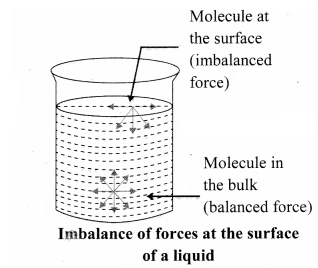
  • The particles in the bulk of liquid are uniformly attracted in all directions and the net force acting on the molecules present inside the bulk is zero.
  • But the molecules at the surface experience a net attractive force towards the interior of the liquid, or the forces acting on the molecules on the surface are imbalanced.
  • Therefore, liquids have tendency to minimize their surface area and the surface acts as a stretched membrane.
  • The force acting per unit length perpendicular to the line drawn on the surface of liquid is called surface tension.
  • Unit: Surface tension is measured in SI unit, N m$^{-1}$ and is denoted by Greek letter ‘γ’
Image
c. Viscosity:
i. Liquids (fluids) have tendency to flow.
ii. Viscosity measures the magnitude of internal friction in a liquid or fluid to flow as measured by the force per unit area resisting uniform flow.
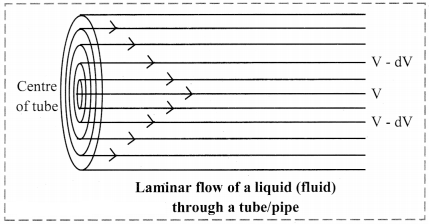
iii. Different layers of a liquid flow with different velocity. This called laminar flow. Here, the layers of molecules in the immediate contact of the fixed surface remains stationary. The subsequent layers slip over one another. Strong intermolecular forces obstruct the layers from slipping over one another, resulting in a friction between the layers.
iv. Viscosity is defined as the force of friction between the successive layers of a flowing liquid. It is also the resistance to the flow of a liquid.
v. When a liquid flow through a tube, the central layer has the highest velocity, whereas the layer along the inner wall in the tube remains stationary. This is a result of the viscosity of a liquid. Hence, a velocity gradient exists across the cross-section of the tube.
Image
vi. Viscosity is expressed in terms of coefficient of viscosity, ‘η’ (Eta). The SI unit of viscosity coefficient is N s m$^{-2}$ (newton second per square meter). In CGS system, the unit (η) is measured in poise.
$1 poise = 1 g cm^{-1} s^{-1} = 10^{-1} kg m^{-1} s^{-1}$​​​​​​​

Need a full question paper?

Generate a complete, print-ready paper with questions like this in minutes — across 16+ boards, with answer keys.
Start Generating Free