Question
Write a value of $\int\text{e}^{\text{x}}\sec\text{x}(1+\tan\text{x})\text{dx}$

Answer

Let $\text{I}=\int\text{e}^{\text{x}}\sec\text{x}(1+\tan\text{x})\text{dx}$ $=\int\text{e}^{\text{x}}(\sec\text{x}+\sec\text{x}\tan\text{x})\text{dx}$ Let $\text{e}^{\text{x}}\sec\text{x}=\text{t}$ $(\text{e}^{\text{x}}\sec\text{x}+\text{e}^{\text{x}}\sec\text{x}\tan\text{x})\text{dx}=\text{dt}$ $\text{e}^{\text{x}}\sec\text{x}(1+\tan\text{x})\text{dx}=\text{dt}$ $\therefore\text{I}=\int\text{dt}$ $=\text{t}+\text{C}$$=\text{e}^{\text{x}}\sec\text{x}+\text{C}$ $(\because\text{t}=\text{e}^{\text{x}}\sec\text{x})$

Need a full question paper?

Generate a complete, print-ready paper with questions like this in minutes — across 16+ boards, with answer keys.

Start Generating Free

Similar questions

Write a value of $\int\text{x}^2\sin\text{x}^3\text{ dx}$
An integer m is said to be related to another integer n if m is a multiple of n.Check if the relation is symmetric, reflexive and transitive.
Let N be the set of natural numbers and R be the relation on N × N defined by (a, b) R (c, d) iff ad = bc for all a, b, c, d $\in$ N. Show that R is an equivalence relation.
Evaluate the following integrals:
$\int\sqrt{4\text{x}^2-5}\text{dx}$
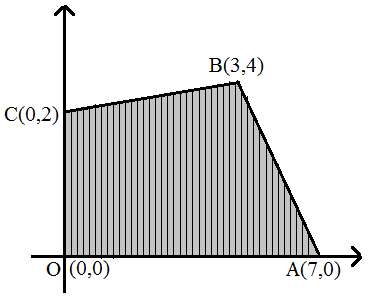
Feasible region (shaded) for a LPP is shown in Maximise Z = 5x + 7y.
If $\text{A} = \begin{bmatrix}3 & 1 \\-1 & 2\end{bmatrix},$ show that $A^2 - 5A + 7I = 0$.
Differentiate the following functions with respect to x:
$\log_7(2\text{x}-3)$
Show that if $A=\left[\begin{array}{ll} \cos \theta & \sin \theta \\ -\sin \theta & \cos \theta \end{array}\right], \text { then } A^{n}=\left[\begin{array}{cc} \cos n \theta & \sin n \theta \\ -\sin n \theta & \cos n \theta \end{array}\right]$
A laboratory blood test is 99% effective in detecting a certain disease when its infection is present. However, the test also yields a false positive result for 0.5% of the healthy person tested (i.e. if a healthy person is tested, then, with probability 0.005, the test will imply he has the disease). If 0.1% of the population actually has the disease, what is the probability that a person has the disease given that his test result is positive?
Find the points on the line $\frac{\text{x}+2}{3}=\frac{\text{y}+1}{2}=\frac{\text{z}-3}{2}$ at a distance of 5 units from the point P(1, 3, 3).