Question
Write all the possible isomers of $[Co(NH_3)_5(SCN)]Cl$.

Answer

$\left[\mathrm{Co}\left(\mathrm{NH}_3\right)_5(\mathrm{SCN})\right] \mathrm{Cl},\left[\mathrm{Co}\left(\mathrm{NH}_3\right)_5(\mathrm{NCS})\right] \mathrm{Cl},\left[\mathrm{Co}\left(\mathrm{NH}_3\right)_5 \mathrm{Cl}\right] \mathrm{SCN},\left[\mathrm{Co}\left(\mathrm{NH}_3\right)_5 \mathrm{Cl}\right] \mathrm{NCS}$.
$MA_5B$ type complexes do not show geometrical or optical isomerism.

Need a full question paper?

Generate a complete, print-ready paper with questions like this in minutes — across 16+ boards, with answer keys.
Start Generating Free

Similar questions

  1. Indicate the principle behind the method used for the refining of zinc.
  2. What is the role of silica in the extraction of copper?
  3. Which form of the iron is the purest form of commercial iron?
An optically active amino acid (A) can exist in three forms depending on the pH of the medium. The molecular formula of (A) is $C_3H_7NO_2$.
  1. Write the structure of compound (A) in aqueous medium. What are such ions called?
  2. In which medium will the cationic form of compound (A) exist?
  3. In alkaline medium, towards which electrode will the compound (A) migrate in electric field?
Draw figure to show the splitting of d orbitals in an octahedral crystal field.
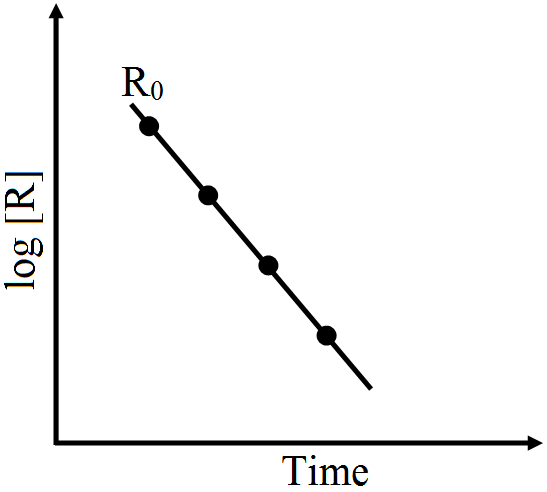
Observe the graph in diagram and answer the following questions.
  1. If slope is equal to $-2.0 \times 10^{-6} \sec^{-1}$, what will be the value of rate constant?
  2. How does the half-life of zero order reaction relate to its rate constant?
Depict the galvanic cell in which the reaction:
$ Z n(s)+2 A g^{+}(a q) \rightarrow Z n^{2+}(a q)+2 A g(s) $
takes place. Further show:
i. Which of the electrodes is negatively charged?
ii. The carries of current in the cell.
iii. Individual reaction at each electrode.
Give the products of following carbonyl compounds when oxidised with acidic $KMnO _4$ or acidic $K _2 Cr _2 O _7$.
(i) $CH _3 CHO$
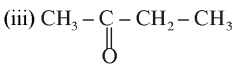
(ii) $CH _3 COCH _3$
Image
Complete the following chemical reaction equations:
$\text{Cr}_2\text{O}^{2-}_7(\text{aq})+\text{Fe}^{2+}(\text{aq})+\text{H}^+(\text{aq})\xrightarrow{\ \ \ \ \ \ \ \ \ }$
A first order reaction has a rate constant of $0.0051\ min^{–1}$. If we begin with $0.10 M$ concentration of the reactant, what concentration of the reactant will be left after $3$ hours?
Write one difference in each of the following:
  1. Write the dispersed phase and dispersion medium of milk.
  2. Write one similarity between physisorption and chemisorption.
  3. Write the chemical method by which $Fe(OH)_3$ sol is prepared from $FeCl_3.$
  1. Write the principle of vapour phase refining.
  2. What is the role of depressant in froth floatation process?
  3. Write the name of reducing agent to obtain iron from $Fe_2O_3$ at high temperature.